Zenith Angle Calculator
Calculate zenith angle, altitude, solar cosine projection, rough air mass, and observing clearance for solar work or telescope planning on JSCalc-Blog.com.
Zenith Angle Results
Formula Breakdown
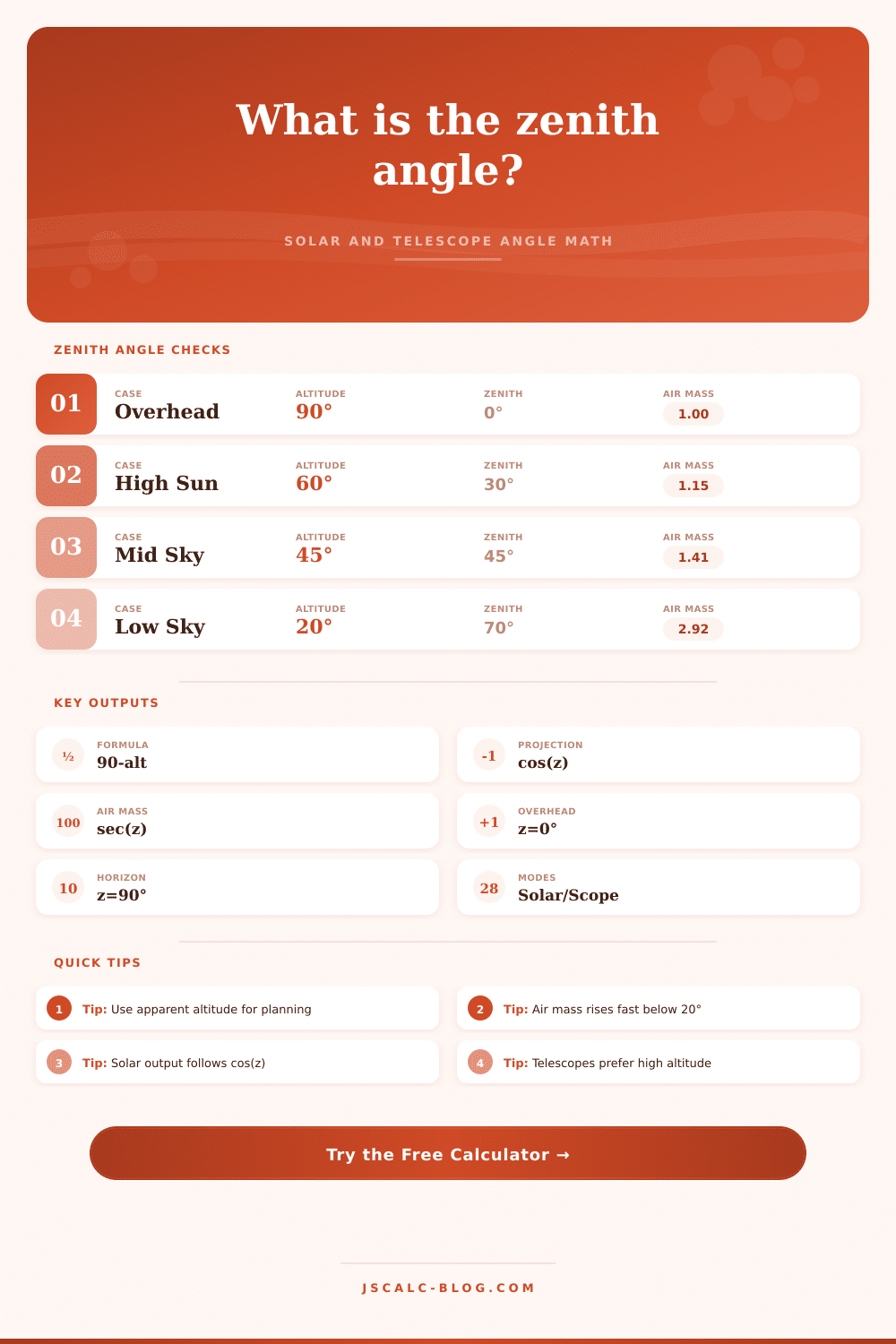
Zenith angle: z = 90° - altitude. A star, planet, or the Sun at altitude 65° has z = 25°.
Solar cosine projection: direct-beam projection = cos(z). This is 1.000 overhead, 0.707 at z = 45°, and 0.174 at z = 80°.
Rough air mass: air mass = sec(z) = 1 / cos(z). This simple estimate is useful at moderate zenith angles and becomes rough near the horizon.
Clearance: apparent clearance = altitude + refraction correction - local horizon obstruction. Telescope mode emphasizes altitude, air mass, and clearance; solar mode emphasizes cosine projection and transmission.
| Altitude | Zenith angle | cos(z) projection | Rough air mass sec(z) | Observing note |
|---|---|---|---|---|
| 90° | 0° | 1.000 | 1.00 | Overhead; best geometry. |
| 75° | 15° | 0.966 | 1.04 | Excellent solar and telescope geometry. |
| 60° | 30° | 0.866 | 1.15 | Strong solar projection; crisp observing. |
| 45° | 45° | 0.707 | 1.41 | Common practical planning threshold. |
| 30° | 60° | 0.500 | 2.00 | Half direct-beam projection. |
| 20° | 70° | 0.342 | 2.92 | Atmospheric losses become important. |
| 10° | 80° | 0.174 | 5.76 | Low and sensitive to haze/refraction. |
| 0° | 90° | 0.000 | Not stable | On the horizon; sec(z) diverges. |
| Air mass | Typical altitude | Zenith range | Solar use | Telescope use |
|---|---|---|---|---|
| 1.00–1.15 | 60°–90° | 0°–30° | Very strong projection. | Best clarity and least extinction. |
| 1.15–1.41 | 45°–60° | 30°–45° | Good direct-beam geometry. | Good for most targets. |
| 1.41–2.00 | 30°–45° | 45°–60° | Moderate projection. | Usable, but seeing may soften. |
| 2.00–2.92 | 20°–30° | 60°–70° | Losses are noticeable. | Plan for extinction and horizon glow. |
| 2.92–5.76 | 10°–20° | 70°–80° | Weak projection except special cases. | Low-priority target window. |
| 5.76+ | Below 10° | Above 80° | Very horizon-sensitive. | Only when timing is critical. |
Solar Observing Mode
Solar mode treats the angle as direct-beam geometry, so the main multiplier is the solar cosine projection cos(z).
- Best practical range: z below 45° when possible.
- Projection halves at z = 60° because cos(60°) = 0.5.
- Transmission estimate uses the chosen air profile raised across rough air mass.
- Horizon obstruction is shown as clearance, not folded into z.
Telescope Observing Mode
Telescope mode favors higher altitude because rough air mass, extinction, turbulence, and horizon glow increase at large z.
- Best practical range: altitude above 45° when scheduling allows.
- Altitude below 30° often means air mass above 2.0.
- Refraction can lift apparent altitude, especially near the horizon.
- Clearance should stay positive after local horizon obstruction.
| Preset | Mode | Altitude | Zenith | Why it matters |
|---|---|---|---|---|
| Equator equinox noon | Solar | 90° | 0° | Sun nearly overhead at equinox. |
| New York summer noon | Solar | 72° | 18° | Strong summer direct-beam geometry. |
| London winter Sun | Solar | 15° | 75° | Low winter Sun with large air mass. |
| Atacama clear Sun | Solar | 78° | 12° | High desert solar angle. |
| Mauna Kea target | Telescope | 70° | 20° | High-altitude observatory target. |
| Backyard telescope | Telescope | 35° | 55° | Common suburban target height. |
| Input angle | Complement | Projection | Air mass |
|---|---|---|---|
| Altitude 80° | Zenith 10° | 0.985 | 1.02 |
| Altitude 65° | Zenith 25° | 0.906 | 1.10 |
| Altitude 50° | Zenith 40° | 0.766 | 1.31 |
| Altitude 35° | Zenith 55° | 0.574 | 1.74 |
| Altitude 25° | Zenith 65° | 0.423 | 2.37 |
| Altitude 15° | Zenith 75° | 0.259 | 3.86 |
For telescopes and solar panels, it is important to know angle between the point directly overhead and where the Sun sits. Because it’s all about how well your equipment will work.
A lot of folks look at a weather app and think if it’s sunny outside, the sky must be clear. Wrong. The atmosphere are filtering. Objects heading down towards the horizon thicken it. Now there’s haze in the bright sunlight. And stars appear fuzzy.
Why the Sun’s Angle Matters
Knowing the relationship between you and the point directly overhead, called the zenith (technical term). Is essential to your view. No more math for you; calculator does it. You enter the zenith angle (or altitude). And off we go.
From that entry, tool produces three results. First is the solar cosine projection. This represent the amount of direct radiation falling on a sloped surface. If the Sun are directly overhead, then the number is one; it’s full intensity. The closer to horizontal the sun goes, the smaller the number get. Why? Because it tracks the cosine of the zenith angle.
At forty-five degrees, you’ll get roughly seventy percent power output different than max. At sixty degrees, it’s half. For this reason, northern solar install often have trouble during the winter months. The days are long, but the Sun strikes at a shallow angle, weakening the effective impact when it finally makes it onto the panel.
The issue for telescope user is similar: air mass. Air mass is an estimate of how much atmosphere light has traveled through. The calculator use the secant of the zenith angle. That’s a reasonable enough estimate as long as your line-of-sight isn’t close to the horizon. When you’re at the top (straight up), then air mass is equal to one. On an object at thirty degrees above the horizon, the air mass double; it’s equal to two. Down below twenty degrees over the horizon, the air mass are approaching three. That means there’s three times as much air in the way when compared too looking straight up.
All that additional air scatters blue light. You get dimming of fainter objects, plus the air itself become turbulent. That turbulence smears out fine details. Anyone who’s had some experience observing knows that staring at objects down by the horizon is frequently a useless exercise. The atmosphere twist things around. There’s nothing you can do about that no matter what high-priced gear you own.
Your local obstruction count. You can enter your local obstructions, such as hills or trees, into the tool. This is important, because bottom of the atmosphere is the densest. It’s also most turbulent. So even though there may be nothing in the sky, if you’re trying to hit something on the horizon, you’re going through crappy air at the bottom of the atmosphere.
The tool incorporates refraction correction, which take into account how light bends closer to the horizon. This causes apparent position of objects near the horizon to rise. While it’s not much overhead, it matters down close to the horizon. Down around the horizon it can move things up to a half-degree. If that throws off your shot, you should of missed.
This is where tool shows us, through its presets, that the reality of geography matter. The Zenith Angle of the Sun in winter in Oslo is not the same as the Zenith Angle of the Sun in the Atacama desert. Different locations have different atmospheres and different equipment behaves differently there. It’s still the same piece of hardware. But it travels through a differnt amount of air.
That understanding allow you to plan. You know when to point up and see what you’re after because it’ll be high in the sky at that time. And you know to expect solar conditions based off seasonal angles. That turns your intuition into data. It makes your results better if you wait for moddern geometry.