Habitable Zone Distance Calculator
Estimate conservative and optimistic star-to-planet orbital distances from stellar luminosity, radius, temperature, and editable S_eff boundary flux.
Habitable Zone Results
L/Lsun is the star luminosity relative to the Sun. S_eff is the effective stellar flux for a chosen boundary. Larger S_eff values move the boundary inward; smaller values move it outward.
| Term | Meaning | Typical Source | Calculator Use |
|---|---|---|---|
| L/Lsun | Stellar luminosity relative to the Sun | Catalog value or radius-temperature estimate | Scales every distance by square root |
| S_eff | Boundary flux received by a planet | Habitable-zone climate limit | Defines inner or outer edge |
| R/Rsun | Stellar radius relative to the Sun | Observed stellar properties | Optional luminosity calculation |
| T_eff | Stellar effective temperature in kelvin | Spectral measurement | Optional luminosity calculation |
| Preset Star | Spectral Type | Luminosity | Radius | Temperature |
|---|---|---|---|---|
| A0 white star | A0 V | 48 Lsun | 2.4 Rsun | 9700 K |
| F5 bright star | F5 V | 2.6 Lsun | 1.3 Rsun | 6500 K |
| G2 Sun twin | G2 V | 1 Lsun | 1 Rsun | 5772 K |
| K2 orange star | K2 V | 0.39 Lsun | 0.78 Rsun | 5000 K |
| M0 red dwarf | M0 V | 0.08 Lsun | 0.6 Rsun | 3800 K |
| TRAPPIST-1 like | M8 V | 0.00055 Lsun | 0.12 Rsun | 2550 K |
| Boundary | Role | Default S_eff | Solar Distance | Interpretation |
|---|---|---|---|---|
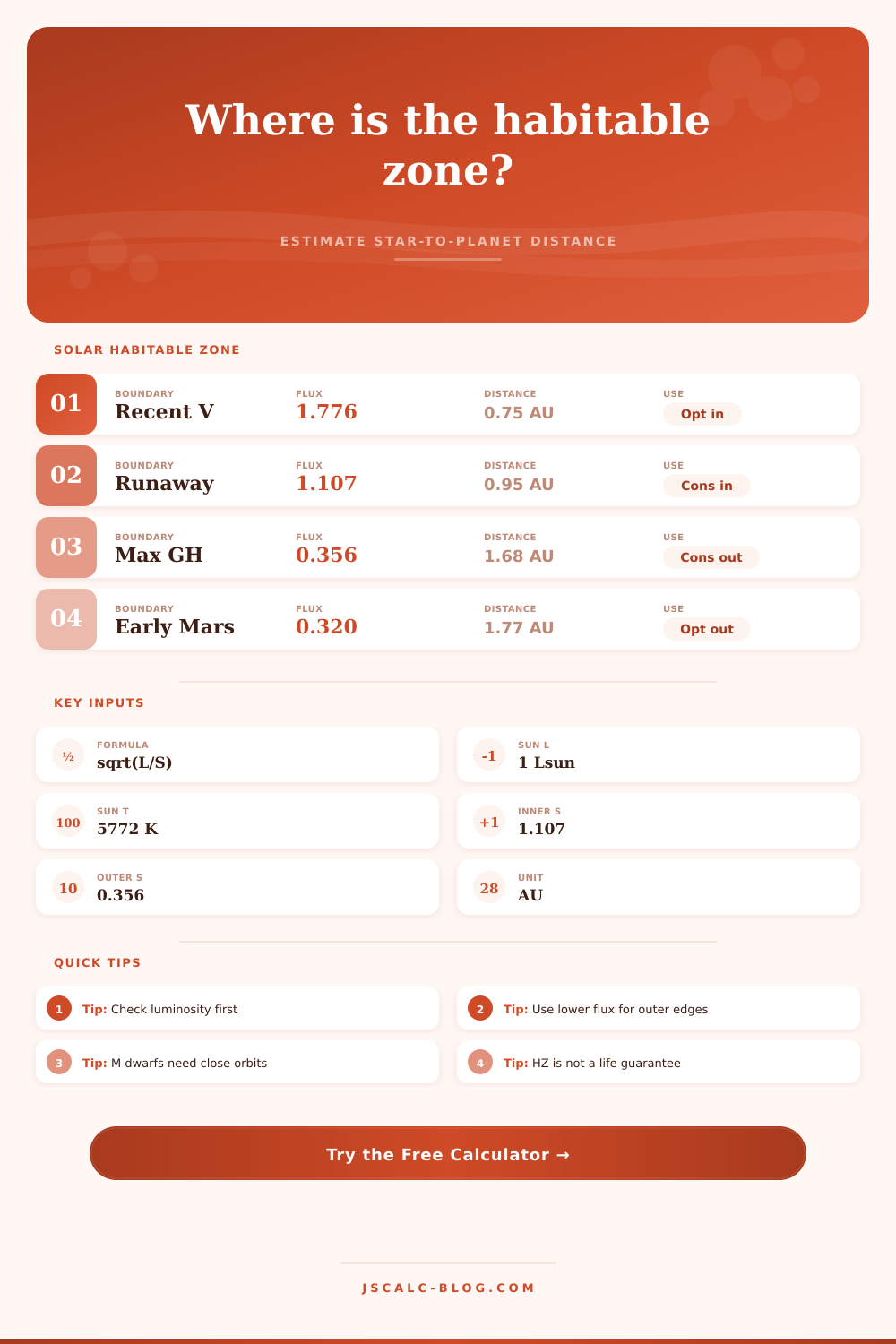
| Recent Venus | Optimistic inner | 1.776 | 0.75 AU | A very broad inner limit based on Venus-like history |
| Runaway greenhouse | Conservative inner | 1.107 | 0.95 AU | Approximate flux where oceans may be lost rapidly |
| Maximum greenhouse | Conservative outer | 0.356 | 1.68 AU | Outer edge before added CO2 stops warming effectively |
| Early Mars | Optimistic outer | 0.320 | 1.77 AU | A broader outer limit inspired by ancient Mars evidence |
| Luminosity | Conservative Inner | Conservative Outer | Optimistic Inner | Optimistic Outer |
|---|---|---|---|---|
| 0.001 Lsun | 0.030 AU | 0.053 AU | 0.024 AU | 0.056 AU |
| 0.01 Lsun | 0.095 AU | 0.168 AU | 0.075 AU | 0.177 AU |
| 0.1 Lsun | 0.300 AU | 0.530 AU | 0.237 AU | 0.559 AU |
| 1 Lsun | 0.950 AU | 1.676 AU | 0.750 AU | 1.768 AU |
| 10 Lsun | 3.005 AU | 5.299 AU | 2.373 AU | 5.590 AU |
| 50 Lsun | 6.721 AU | 11.851 AU | 5.306 AU | 12.500 AU |
The habitable zone may seem like a straightforward ring around a star, but it’s actualy a moving target depending on temperament of the star itself. A dim red dwarf will chill its surroundings to form iceballs, or boil any nearby planets if they’re too close; a hot blue giant would do likewise.
By taking into account both stellar luminosity and how much heat a given planet can absorbs, this calculator can estimate exactly how far away that sweet spot is. The orbital mechanics are handle for you so you can get down to business: what happens than?
How to Use the Habitable Zone Calculator
But here’s the catch: There’s a relationship between distance from a star and its power. And that relationship isn’t linear. Luminosity is what controls this. Double the brightness of the Sun, and you don’t double the distance of the habitable zone. You shift it outward by the square root of the stars luminosity. This pushes it to roughly 1.4 times its present position.
That’s where people get tripped up. They assume it scales along a straight line. Nope! The curve is real.
Here’s how the calculator works: First it takes whatever luminosity you inputted and divides it by some measure of the amount of energy striking a planet atmosphere (called the effective stellar flux; we’ll call it S_eff). That number is a threshold: Cross it and the ocean freeze over or the atmosphere turns into a runaway greenhouse. And you can draw those lines any way you like.
To be on the safe side, we’re using the so-called runaway greenhouse limit as the inner boundary and the maximum greenhouse limit as the outer boundary. Both of these takes into account the idea that this planet has an Earth-like composition, including a nitrogen-oxygen atmosphere.
For writers looking to stretch their storylines across time and space, there are other boundaries: the optimistic ones, extending all the way back to early Mars or ahead to recent Venus. Buyer beware; while such extended bounds make for interesting speculation, a world at the optimistic outer end could of depend upon a hefty layer of carbon dioxide in order to hold onto its water. That would seem a precarious balance.
There are two methods for deriving luminosity using this tool. If you’re looking at data from catalogs, you can enter the luminosity directly (that should be pretty accurate). However, if you have some combination of incomplete information about the star (maybe you know its effective temperature and/or size), then you could plug those numbers into the tool, too.
In this case, it assume you want to scale your radius squared and your temperature to the fourth power compared to the Sun. Why? That’s because it uses what’s called the Stefan-Boltzmann law, and it works out how much energy a body emits based off its radius scaled up by its temperature. The key to remember here is that changing the temperature just a little bit makes a huge difference in the amount of energy emitted. That means that something that is just 10% hotter than the sun might actualy be far more luminous.
But all depends on stellar type. That’s what the different spectral class preset buttons emphasize. A red and dim M-dwarf has an amazingly tight habitable zone. Close to the star. Why? This closeness make it tidally locked, meaning one side always faces the star and the other stays in darkness.
The calculator shows you how far away the zone is… but not whether the atmosphere will be sufficiently efficient at circulating heat. That requires inference. A more stable, wider zone exist around a G-type star such as our Sun. An A-type star is short-lived and brilliant, possibly dying out before advanced life could evolve.
Please don’t mistake it for a promise of life. Consider it a screening tool. Which tells us where physical liquid water might exist on a world. Actual habitability requires things like volcanic activity, cloud cover, magnetic field and geology. This calculator gets the party started; the rest is left to the planet.
View these results in that context: they’re a place to start your own investigations. These are just coordinates, and that is where the story happens.