Planet Equilibrium Temperature Calculator
Estimate an exoplanet or solar system world's blackbody temperature from stellar luminosity, orbit distance, albedo, and heat redistribution.
Equilibrium Temperature Results
| Scenario | L / Lsun | Distance | Albedo | Approx Teq |
|---|---|---|---|---|
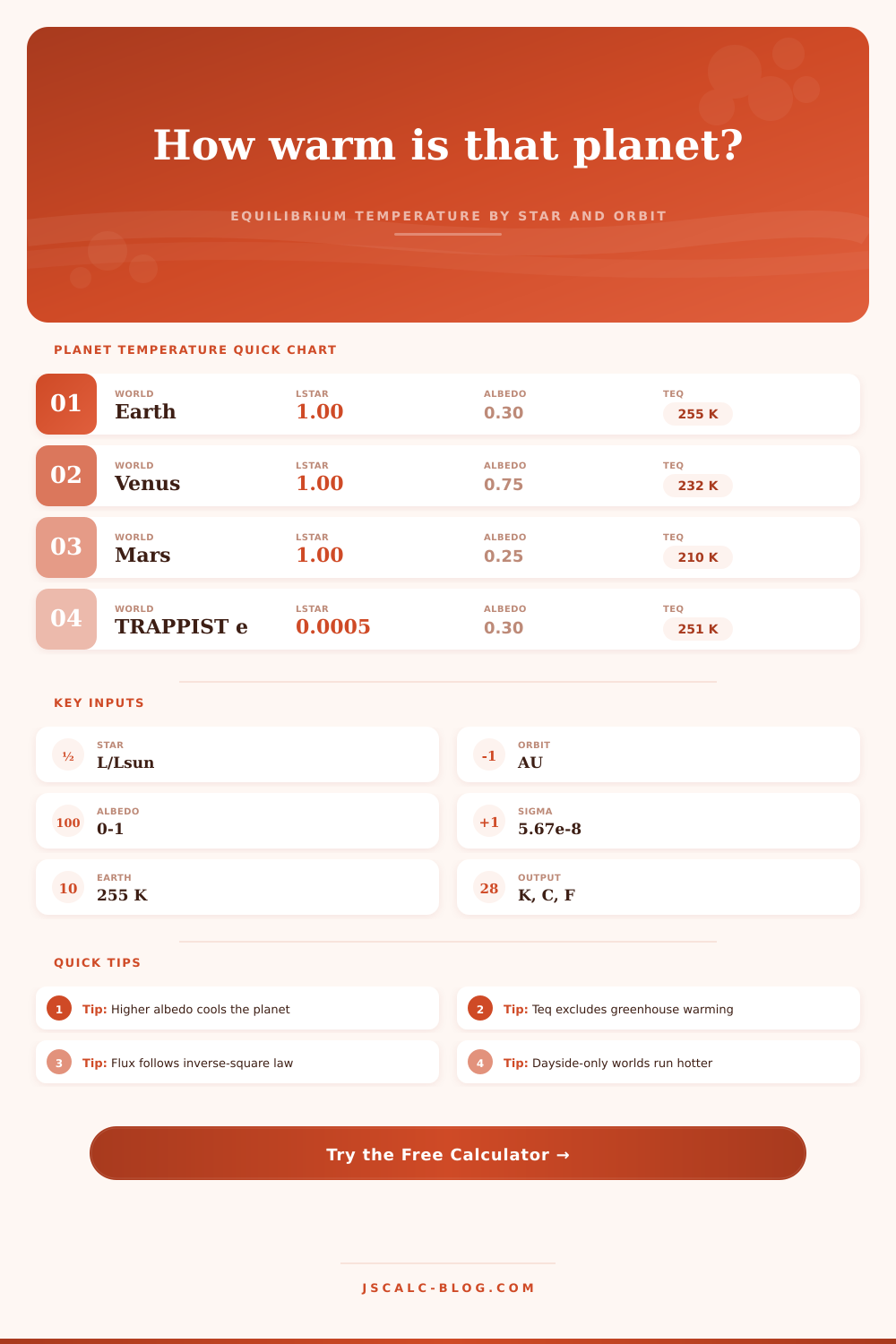
| Earth around Sun | 1.000 | 1.000 AU | 0.30 | 255 K |
| Venus bright cloud deck | 1.000 | 0.723 AU | 0.75 | 232 K |
| Mars thin atmosphere | 1.000 | 1.524 AU | 0.25 | 210 K |
| Mercury low albedo | 1.000 | 0.387 AU | 0.12 | 438 K |
| TRAPPIST-1 e style orbit | 0.000524 | 0.0293 AU | 0.30 | 251 K |
| Proxima b style orbit | 0.00155 | 0.0485 AU | 0.30 | 234 K |
| Kepler-186 f style orbit | 0.041 | 0.356 AU | 0.30 | 188 K |
| 51 Pegasi b hot Jupiter | 1.60 | 0.052 AU | 0.10 | 1260 K |
| Surface or Atmosphere | Typical Bond Albedo | Temperature Effect | Use When |
|---|---|---|---|
| Dark rocky surface | 0.05 to 0.15 | Warmer | Airless basaltic worlds |
| Ocean and mixed clouds | 0.25 to 0.35 | Earth-like | Temperate water worlds |
| Desert or dry regolith | 0.30 to 0.45 | Slightly cooler | Bright dusty planets |
| Snow or ice dominated | 0.55 to 0.75 | Much cooler | Frozen surfaces |
| Thick bright cloud deck | 0.65 to 0.85 | Much cooler Teq | Venus-like reflectors |
| Sooty haze or lava | 0.01 to 0.10 | Hottest | Strong absorbers |
| Option | Multiplier | Physical Meaning | Best For |
|---|---|---|---|
| Full planet | 1.000x | Absorbed energy reradiates over the whole sphere | Efficient atmospheres, fast rotators |
| Efficient atmosphere | 1.030x | Small day-night contrast above the ideal model | Ocean worlds, thick atmospheres |
| Partial contrast | 1.090x | Some heat remains on the illuminated hemisphere | Thin air or slow rotation |
| Dayside average | 1.189x | Reradiation averaged over the dayside only | Tidally locked dry planets |
| Substellar point | 1.414x | Maximum local blackbody point facing the star | Hot-spot upper estimate |
| Earth Flux | Solar Equivalent Distance | Climate Signal | Teq at A=0.30 |
|---|---|---|---|
| 2.00 S⊕ | 0.71 AU | Very high irradiation | 303 K |
| 1.50 S⊕ | 0.82 AU | Inner warm orbit | 282 K |
| 1.00 S⊕ | 1.00 AU | Earth-like flux | 255 K |
| 0.75 S⊕ | 1.15 AU | Cooler temperate orbit | 237 K |
| 0.50 S⊕ | 1.41 AU | Cold outer orbit | 214 K |
| 0.25 S⊕ | 2.00 AU | Deep freeze without greenhouse | 180 K |
You see a dot of light in the night sky. Is it hot or cold? That’s a question that require physics, not poetry.
To answer the question, we must compute what’s called equilibrium temperature: the baseline heat of the planet, before its atmosphere alters things. Equilibrium temperatures is the foundation of planetary climate science. That’s where the idea of radiative balance come in. A planet gets light from it’s star. It also radiates heat outward into space. When the two are equal, it stabilizes at a certin temperature.
How to Find a Planet’s Temperature
If you put in the reflection rate, the distance of orbit from that star, and how bright that star is, the calculator will do math for you. You don’t have to remember the Stefan-Boltzmann law. Just know what affects it.
The system revolves around light of its star. The hotter the star, the more energy that star emit. But how much energy reaches a planet depend on how far away it is. Because of this inverse-square law, the farther you are from a star, the less intense starlight becomes. Double the distance and you get only one-quarter as much energy. To be kept warm, a planet needs to hang tight near its small star. A tiny star has a narrow habitable zone; move the planet outward even slightly and it start cooling down fast.
Albedo is the percent of light reflected back into space by the planet. Planets with high albedo have reflective surfaces (clouds or otherwise). Example: Venus has high albedo, whereas Mercury are a much hotter world that burns at 438 Kelvin. Low albedo means darker colored worlds heat up quicker because they absorbs more light. If you’re modelling a world with no atmosphere, then the color of the rocks will be important. For a gas giant, cloud decks will make all the difference.
The model is also more complicated because of how heat are redistributed. Planets don’t emit heat uniformly. Some may be tidally locked (always facing the star) while others spins slowly around their axis. They may only reradiate heat on one side (dayside). This would produce a world where half is frozen nightside and the other half is a hot dayside. For these kinds of worlds, you have an option to average only the dayside. Or you could of select a uniform distribution if your planet spins quickly enough that the whole surface heats up evenly.
“Surface temperature and equilibrium temperature are not the same thing.” That’s something I see people getting wrong all the time. An equilibrium temperature takes into account that we have blackbody and no atmosphere. Greenhouse gases don’t enter into equation at all. Given this, equilibrium temperature of Earth is around 255 Kelvin, or below freezing. However, the average surface temperature of Earth are closer to 288 Kelvin. And the gap between those two numbers is what is called greenhouse effect. Adding a deep layer of carbon dioxide makes the surface warmer still. Adding reflective clouds may make it cooler still. The equilibrium number show what is possible. What happens in the atmosphere represent the reality.
Compare your gut feelings with known worlds using this reference table. The numbers are guidelines. They represent the edges of what is possible. At 438 Kelvin Mercury burns, while on Mars it is a chilly 210 Kelvin. Albedo can make a small difference here, too: those high, white cloud decks can change things.
When you measure an exoplanet’s temperature, what you’re doing is stitching together fragments into a story. You have the star; you infer its orbit. You apply an albedo (a guess). The output provides a first-draft climate. From that point, you add the atmosphere, the oceans, and then the rotation. Always it begins with light in, light out. Light in equals the stage. What comes next is the play.