Limiting Magnitude of a Telescope Calculator
Estimate the faintest stellar magnitude your telescope can reach from aperture, sky brightness, seeing, transparency, observer experience, and target type.
Only the simple aperture formula before observing-condition offsets.
Sky, seeing, transparency, observer, and target adjustments added together.
Approximate flux ratio between your naked-eye limit and the telescope limit.
Matches many brighter Messier and NGC point-like members.
The calculator first converts the clear aperture to millimeters, then applies the practical stellar limiting magnitude formula above. Larger aperture reaches fainter stars because light-gathering area rises with diameter squared.
Observing conditions are added as magnitude offsets: adjusted limit = aperture limit + sky offset + seeing offset + transparency offset + observer offset + target profile offset.
Magnitude gain versus naked eye is adjusted telescope limit minus the entered naked-eye limit. A 1 magnitude gain means about 2.512 times fainter light can be detected.
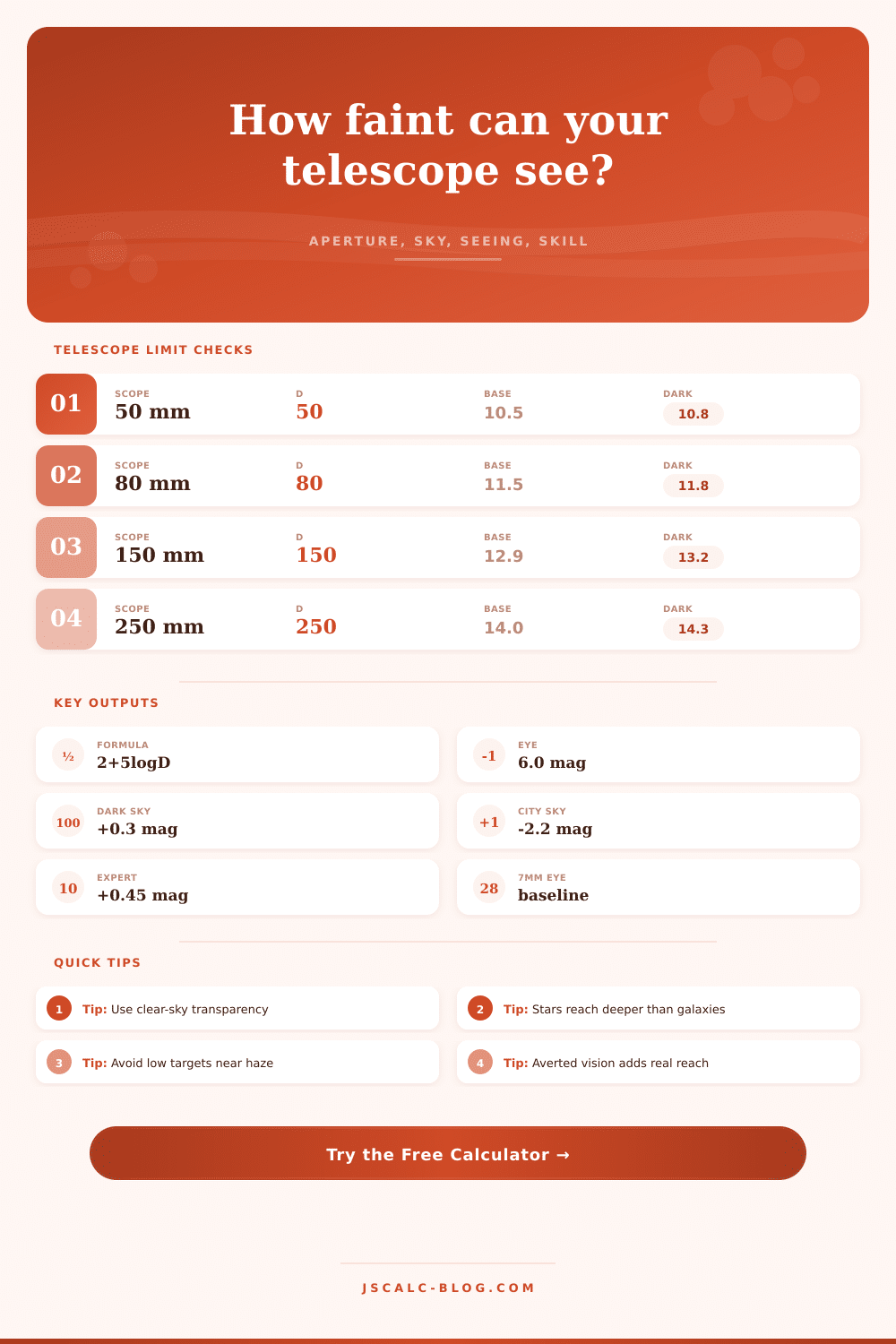
| Aperture | Base limit | Light grasp vs 7 mm | Gain from 6.0 eye | Typical visual role |
|---|---|---|---|---|
| 50 mm | 10.5 mag | 51x | 4.5 mag | finder, bright clusters, double stars |
| 70 mm | 11.2 mag | 100x | 5.2 mag | large binoculars, sweeping Milky Way fields |
| 80 mm | 11.5 mag | 131x | 5.5 mag | small refractor, brighter Messier targets |
| 100 mm | 12.0 mag | 204x | 6.0 mag | portable refractor or Maksutov |
| 130 mm | 12.6 mag | 345x | 6.6 mag | tabletop Newtonian and open clusters |
| 150 mm | 12.9 mag | 459x | 6.9 mag | common 6 inch Dobsonian |
| 200 mm | 13.5 mag | 816x | 7.5 mag | 8 inch SCT or Dobsonian |
| 250 mm | 14.0 mag | 1276x | 8.0 mag | 10 inch deep-sky aperture |
| 300 mm | 14.4 mag | 1837x | 8.4 mag | 12 inch galaxy and globular work |
| 400 mm | 15.0 mag | 3265x | 9.0 mag | large amateur observatory instrument |
| Input | Setting | Offset | Use when |
|---|---|---|---|
| Sky | Excellent dark sky, Bortle 1-2 | +0.7 mag | Zodiacal light and Milky Way structure are obvious |
| Sky | Dark rural sky, Bortle 3 | +0.3 mag | Milky Way is detailed and horizons are not bright |
| Sky | Suburban sky, Bortle 5-6 | -0.7 mag | Milky Way weak or absent overhead |
| Sky | Urban core, Bortle 8-9 | -2.2 mag | Bright skyglow limits faint star contrast |
| Seeing | Excellent steady Airy disks | +0.3 mag | Stars focus to tight points at useful power |
| Seeing | Poor bloated star images | -0.6 mag | Stellar points smear and threshold stars vanish |
| Transparency | Exceptional dry air | +0.5 mag | Low humidity and no smoke or thin cloud |
| Transparency | Thin cloud or smoke veil | -1.0 mag | Bright stars remain but contrast is reduced |
| Factor | Setting | Offset | Practical meaning |
|---|---|---|---|
| Observer | Beginner direct vision | -0.4 mag | Threshold stars are easy to miss without averted vision |
| Observer | Casual averted vision | -0.2 mag | Reasonable planning value for occasional observing |
| Observer | Practiced deep-sky observer | 0.0 mag | Baseline for the formula after adaptation |
| Observer | Experienced threshold observer | +0.25 mag | Uses field motion, rest, and comparison stars well |
| Observer | Expert and fully dark adapted | +0.45 mag | Best-case visual detection under controlled conditions |
| Target | Stellar point source | 0.0 mag | Best match for limiting magnitude star estimates |
| Target | Extended galaxy or nebula | -0.8 mag | Surface brightness spreads light across the background |
| Target | Diffuse comet or patch | -1.2 mag | Low contrast objects need a brighter integrated magnitude |
| Magnitude gain | Fainter flux ratio | Example from 6.0 eye | Interpretation |
|---|---|---|---|
| 1.0 mag | 2.5x | 7.0 mag | Small but visible threshold improvement |
| 2.0 mag | 6.3x | 8.0 mag | Many more field stars appear |
| 4.0 mag | 39.8x | 10.0 mag | Finder or small binocular reach |
| 6.0 mag | 251x | 12.0 mag | Small telescope deep-sky star fields |
| 8.0 mag | 1585x | 14.0 mag | Large amateur scope from a dark site |
| 9.0 mag | 3981x | 15.0 mag | Very large aperture and disciplined observing |
Suitable for bright open clusters, doubles, and guide stars in light-polluted conditions.
Typical reach for finder scopes, binoculars, and small refractors under fair skies.
Common range for 130 to 250 mm visual telescopes when sky contrast is managed well.
Requires dark adaptation, careful charts, stable stars, and clean transparency.
You’ve got one of those moment when your eyes see one thing but your brain won’t believe it because you know there should be something else, like looking up with a telescope in hand at an apparently empty patch of sky. What’s wrong? Is it a trick? Use the limiting magnitude calculator and turn that invisible universe into numbers, numbers of stuff you’re missing and numbers of things you’re making visible.
Of course, there is more than just the glass. There’s the patience, the steadiness of the air, the darkness of your site, and the size of your aperture. Let the tool do the math; let yourself do the planning.
How the Calculator Works
It’s a straightforward equation based off a logarithm. According to the old formula, each doubling of the diameter of your main lens or mirror will give about a 1.5 magnitudes increase in reach. Where your 50mm finder scope barely nudges up against tenth magnitude, your 250mm Dobsonian should be able to bump right past the fourteenth. That figure is the best-case-scenario baseline. It presumes a perfectly dark night, perfect seeing, and a perfectly good observer. Rarely do we get all three at once.
To offset the discrepancy, the calculator layers additions accounting for your skill level, atmospheric transparency, and sky brightness. It turns an ideal theoretical maximum into a realistic guess.
The single most variable factor here may well be sky quality. If you’re at a Bortle class one location (meaning you see the Milky Way casting shadows), there will be a noticeable increase in your limit versus a night viewed from your suburban driveway with street lights bleeding up into the air above you. Two whole magnitudes of difference. Not a rounding error. A difference that makes the difference between seeing core of a distant galaxy…or not. To account for this, the tool allows you to choose your sky condition. It will dim or brighten the hypothetical horizon to match how light pollution washes out the contrast.
And then there’s the air. Conditions determine if the stars will be crisp pinpoints of light or rather soft, bloated blobs. If the atmosphere is turbulent, the light of a dim star spreads out into a larger area. That lowers the maximum brightness of the star, and makes it more difficult to separate from surrounding sky. The calculator penalizes you with bad seeing. It knows that a huge aperture won’t help when the atmosphere shimmers.
And then there’s transparency. Thin haze or high humidity may not hide the bright stars from your view, but they’ll soak up the faint light of distant objects in the deep sky. One’s like a clear window. The other’s like one coated in a thin film.
What about you, the observer? As a human, your eyes is more than just digital sensors. Sure, your eyes adjust in the dark, but they also requires training. Without this, someone starting out with straight-ahead viewing will fail to see stars that an experienced observer detects by looking away and using averted vision. Light then lands on the peripheral (and thus more sensitive) retinal rod cells. There’s a slider in the calculator for experience level; recognizing that true magnitude gain come from learning and skill.
And it knows the difference between an extended object and a point source. Because nebulae and other such things are extended, they has low surface brightness; i.e., their light is scattered across a greater area. By definition they are less easy to perceive than a star of the same total magnitude. The calculator punishes them, making your estimate more realistic about what you’ll realy see.
Knowing those inputs shifts your perspective on what’s possible that night. You don’t curse the telescope for failing to display all its supposed capabilities. You learn about the sky conditions. You anticipate good seeing. Or you try to improve your averted vision.
This isn’t a crystal ball. It’s a planning tool. Rather than wondering if you’ll see a faint group of stars through your eight inch scope from your city balcony, you find out whether you should of get in the car and visit a darker location. It closes the gap between what the spec sheet promises and what the eyepiece reveals.
In the end, astronomy is just as much about what you can expect as it is about collecting photons. The math sets the stage, but the sky is the show. Plug in the variables, get the magnitude of your target, and then look up and see whether the universe will confirm or deny. The math provides a target; the view offers the wonder. And that’s the real limit we’re attempting to push (one photon at a time).