Telescope Light Gathering Power Calculator
Compare aperture, collecting area, dark-adapted eye light gain, optical throughput, and limiting magnitude improvement for common telescope sizes.
🔭 Real Telescope Presets
⚙ Aperture Inputs
Light Ratio vs Reference
0x
raw aperture ratioLight Ratio vs Eye
0x
relative to selected pupilClear Collecting Area
0
square millimetersMagnitude Gain
0 mag
from light ratioFormula Breakdown
📌 Comparison Grid
📐 Formula Method
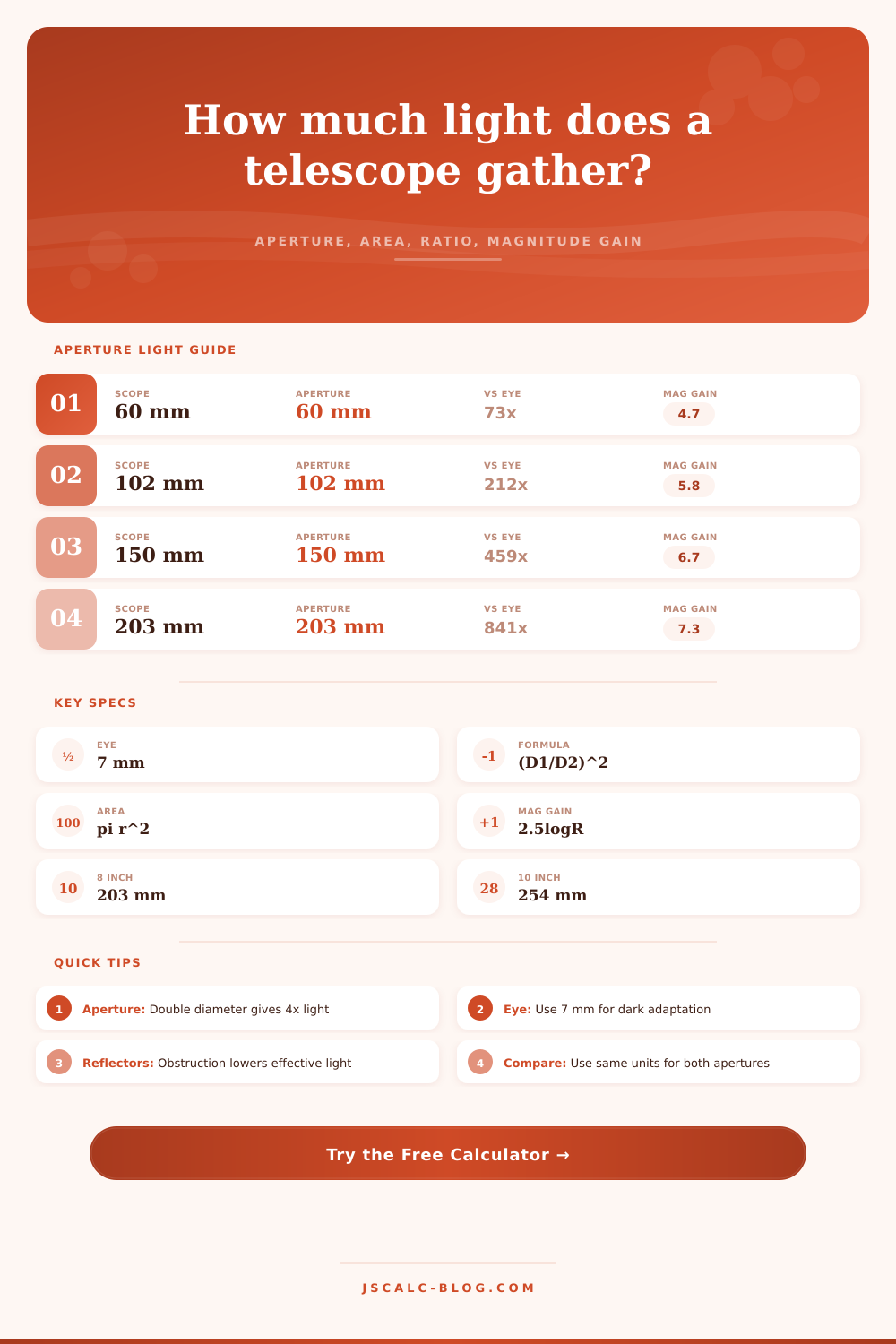
Light gathering ratio = (D1 / D2)² where D1 is the telescope aperture and D2 is the comparison aperture.
Collecting area = pi × (D / 2)² using aperture diameter in millimeters, before optical losses.
Magnitude gain = 2.5 × log10(ratio) for the raw light ratio relative to the selected eye pupil or reference aperture.
Obstruction and transmission estimates are applied separately as effective light throughput, so the calculator shows both the pure aperture math and a practical adjusted estimate.
📊 Common Aperture Light Table
| Aperture | Common Type | Area (mm²) | Vs 7 mm Eye | Magnitude Gain |
|---|---|---|---|---|
| 50 mm | Finder or binocular objective | 1,963 | 51x | 4.3 mag |
| 60 mm | Small refractor | 2,827 | 73x | 4.7 mag |
| 80 mm | Rich-field refractor | 5,027 | 131x | 5.3 mag |
| 102 mm | Four inch refractor | 8,171 | 212x | 5.8 mag |
| 130 mm | Tabletop reflector | 13,273 | 345x | 6.3 mag |
| 150 mm | Six inch reflector | 17,671 | 459x | 6.7 mag |
| 203 mm | Eight inch SCT or Dobsonian | 32,365 | 841x | 7.3 mag |
| 254 mm | Ten inch Dobsonian | 50,671 | 1,317x | 7.8 mag |
🔎 Telescope Type Adjustment Table
| Optical Design | Typical Obstruction | Typical Transmission | Practical Note |
|---|---|---|---|
| Refractor | 0% | 88-94% | No central obstruction; contrast usually stays high. |
| Newtonian reflector | 20-30% | 82-88% | Secondary mirror reduces clear collecting area. |
| Dobsonian reflector | 20-28% | 82-88% | Same aperture math as Newtonian reflectors. |
| Maksutov-Cassegrain | 28-35% | 78-84% | Compact tube; meniscus and mirrors reduce throughput. |
| Schmidt-Cassegrain | 33-36% | 74-82% | Large secondary and multiple surfaces affect delivered light. |
| Binocular objective | 0% | 85-94% | Enter one objective for single-aperture comparison. |
🌟 Magnitude Gain Lookup
| Light Ratio | Magnitude Gain | Diameter Ratio | Example Interpretation |
|---|---|---|---|
| 2x | 0.75 mag | 1.41x | Small but visible gain on threshold objects. |
| 4x | 1.51 mag | 2.00x | Doubling aperture quadruples gathered light. |
| 10x | 2.50 mag | 3.16x | Deep-sky targets become much easier. |
| 25x | 3.49 mag | 5.00x | Typical jump from eye to small binocular objective. |
| 100x | 5.00 mag | 10.00x | A 70 mm scope is about 100x a 7 mm eye. |
| 1,000x | 7.50 mag | 31.62x | Eight to ten inch class versus naked-eye pupil. |
🧮 Reference Aperture Comparison
| Reference | Diameter | Area | Use When Comparing |
|---|---|---|---|
| Urban eye pupil | 5 mm | 19.6 mm² | Bright-site observing or older-eye estimate. |
| Dark-adapted eye | 7 mm | 38.5 mm² | Classic astronomy light gathering baseline. |
| Finder scope | 50 mm | 1,963 mm² | Compare main telescope to finder or binocular. |
| Small refractor | 80 mm | 5,027 mm² | Estimate upgrade from grab-and-go refractor. |
| Four inch scope | 102 mm | 8,171 mm² | Compare common refractor and Mak sizes. |
| Eight inch scope | 203 mm | 32,365 mm² | Benchmark for serious visual observing. |
💡 Telescope Calculation Tips
It is an experience to look at something for the first time with a telescope, seeing things that could never be seen by the unaided eye. You see a sharp crater on the moon. A fuzzy smudge in the Orion Nebula that resolves into gas and dust.
That’s the magic moment… When aperture is big enough to collect enough light. Here’s a calculator that quantifies it. That cuts through all the marketing and tells you how much light your scope collects versus your eye or someone else’s instrument.
Why Telescope Size Matters for Seeing Stars
The principle is a basic bit of geometry: doubling the diameter quadruples the light gathering capacity. Area = diameter squared. That means doubling the diameter quadruples the light-gathering ability. An eight inch telescope capture far less light then a ten inch. So what’s fainter gets to show up.
You’ll need to input your specs, but after that the calculator take over and figures out the magnitude difference for you, saving you having to do all the math yourself about comparing areas of circles and such. That’s where aperture starts, then comes the real world.
Some of that light gets lost as it travels down the telescope. Light is lost through reflection from surfaces or absorption by the glass in refractors. Light is also lost as it reflect from the secondary mirror and bounces around the open tube structure of reflectors. You can use the tool to compensate for those losses. You can do this by including your optics’ transmission value and any central obstruction.
So if you have a big aperture Schmidt Cassegrain, much of that light will be blocked by its thick secondary mirror. This is included in the calculation, giving you a practical throughput number instead of theoretical max.
But the comparisons of scope sizes are contextual. Sometimes you’re asking “how much brighter will something be seen through an eight inch reflector than my existing six inch?” And sometimes you’re asking “how big a difference will I see versus my own dark adapted pupil, which peaks at roughly seven millimeters for most younger observers (decreasing with age)?”
This is where the reference options comes into play. They allow you to choose a comparison point that are appropriate to your circumstances. What if you are in a light polluted city? Your effective pupil is reduced, making the relative benefit of a larger scope even more apparent.
Another useful output is magnitude gain, which converts the raw light ratios to the astronomical magnitude system. A single magnitude corresponds to approximately 2.5 times brighter or dimmer, so if the calculator returns three magnitudes, that means you’re looking at an object roughly fifteen times fainter than your eye can see. That’s where this could of helped you set reasonable expectations.
Sure, you probably won’t be able to see the Andromeda Galaxy as a bright disk. But you’ll be able to see more of it.
Magnification is cheap. Put a high power eyepiece in just about any scope and bingo, you have more magnification. The light spreads out across a bigger area and becomes dimmer and shakier.
Aperture is heavy, expensive and determines light grasp and resolution. Look at the aperture first when you are shopping for a scope; everything else is secondary. But there’s a catch. Bigger openings will result in increased weight (the tube itself), bulkier mount, and longer cool down time.
You can’t tote around a 10-inch Dobsonian; it’s too unwieldy. However, a small refractor will fit into your car trunk and points at a moment’s notice. This is where the calculator comes in: How much of an optical advantage do you really need versus how much extra weight/cost is that going to add?
Maybe you never plan on taking it anywhere but your back yard. In that case, maybe the bigger scope makes sense. But if you like to go out to dark sky sites, portability may be higher up on your priority list.
In the end, let the numbers guide you; follow your eyes. Go with whatever telescope you are most likely to operate. Use knowledge of light gathering power to select a telescope appropriate for your observing needs. Turn vague wishes into specific expectations with an understanding of what your aperture can provide. Instead of “I think I saw something,” know with certainty what you will see. The photons are there, all you have to do is get some glass around them.