Exit Pupil Calculator
Calculate telescope exit pupil from aperture, magnification, eyepiece focal length, and f-ratio, then check brightness and eye pupil clipping for real observing setups on JSCalc-Blog.com.
Your Telescope Exit Pupil
| Exit pupil | Typical use | View character | Useful guidance |
|---|---|---|---|
| 0.3 to 0.5 mm | Extreme double-star work | Very dim, sensitive to floaters | Only steady air and sharp optics make this pleasant. |
| 0.5 to 1.2 mm | Moon, planets, tight doubles | High image scale, lower brightness | Common planetary range when seeing supports the power. |
| 1.2 to 2.0 mm | Globular clusters, small nebulae | Strong contrast with useful scale | A practical high-medium range for many telescopes. |
| 2.0 to 3.0 mm | Galaxies, nebulae, general deep sky | Balanced brightness and magnification | Often the best first try for faint objects. |
| 3.0 to 5.0 mm | Open clusters, sweeping, filters | Bright and relaxed | Good with narrowband filters and large extended objects. |
| 5.0 to 7.0 mm | Maximum field and finder eyepieces | Very bright, lowest power | May waste aperture if the observer eye pupil is smaller. |
| Above 7.0 mm | Special low-power setups | Likely clipped by the eye | Usually too large for adult nighttime pupils. |
| Setup | Aperture | F-ratio | Eyepiece | Exit pupil |
|---|---|---|---|---|
| 80 mm short refractor | 80 mm | f/5 | 32 mm | 6.4 mm |
| 102 mm ED refractor | 102 mm | f/7 | 24 mm | 3.4 mm |
| 130 mm Newtonian | 130 mm | f/5 | 25 mm | 5.0 mm |
| 150 mm Dobsonian | 150 mm | f/8 | 10 mm | 1.25 mm |
| 8 inch SCT | 203 mm | f/10 | 40 mm | 4.0 mm |
| 10 inch fast Dob | 254 mm | f/4.7 | 31 mm | 6.6 mm |
| 90 mm Maksutov | 90 mm | f/13.9 | 32 mm | 2.3 mm |
| 14 inch Dobsonian | 356 mm | f/4.5 | 21 mm | 4.7 mm |
| Observer condition | Approx eye pupil | Largest useful exit pupil | What happens above it |
|---|---|---|---|
| Bright daytime viewing | 2 to 3 mm | About 2.5 mm | The eye stops down the telescope quickly. |
| City observing | 4 to 5 mm | About 4.5 mm | Low-power views brighten sky glow more than objects. |
| Typical dark adaptation | 5 to 6 mm | About 5.5 mm | Some oversized finder eyepieces may lose aperture. |
| Young, fully dark adapted | 6 to 7 mm | About 6.5 mm | Fast telescopes can use very long focal length eyepieces. |
| Older adult dark adapted | 4 to 6 mm | Measure or estimate personally | A 7 mm exit pupil may act like a smaller telescope. |
| Binocular-style comfort | 4 to 5 mm | Usually 4 to 5 mm | Easy eye placement with less clipping risk. |
| Target type | Good first exit pupil | Why it works | Adjustment clue |
|---|---|---|---|
| Large emission nebula | 4 to 6 mm | Bright image for filters and broad structure | Lower power if the object spills past the field. |
| Open cluster | 2.5 to 5 mm | Frames many stars while keeping sparkle | Increase magnification if the cluster is compact. |
| Galaxy | 1.5 to 3 mm | Darkens sky while preserving enough object light | Try 2 mm first, then move both directions. |
| Globular cluster | 1 to 2 mm | Adds scale for resolving outer stars | Use smaller pupils only in steady seeing. |
| Moon | 0.8 to 1.5 mm | Controls glare and increases image scale | Go larger for full-disk comfort. |
| Jupiter or Saturn | 0.6 to 1.2 mm | Balances brightness, color, and detail | Seeing usually decides the smallest useful pupil. |
| Double star | 0.4 to 1.0 mm | Pushes separation and diffraction pattern size | Back off if the Airy pattern turns messy. |
There you are, standing behind eyepiece looking through at Saturn’s rings. What you see is blurry. And dark. Did you get the telescope wrong? Is it defective? Could be, but more likely it’s something called the exit pupil. That tiny number can mean the difference between seeing clear details or fuzzy blob. Exit pupil is the key to knowing when you choose an eyepiece that makes sense. Instead of blindly picking one that doesn’t work.
How do you know what size exit pupil works best on any given night? Plug your scope specifications into this exit pupil calculator, and it will crunch the numbers for you. That way, instead of throwing darts at a board, you’ll have a plan about which focal length to use based off whatever the heavens present.
What Is the Exit Pupil?
What goes in comes out: The beam of light coming from the eyepiece is called the exit pupil. Does it fit through your eye’s pupil? No? Light spills out the sides. This wasted light is called clipping, and it make you see only center of your telescope’s aperture. A ten-inch scope becomes a six-inch one without you knowing.
Is it narrow enough? It collects all the light, but the image become dimmer and more sensitive to atmospheric turbulence. Match biological limits of your vision with output from your telescope. That’s the sweet spot.
There are two ways to get correct number with the tool. You can plug in the telescope’s f-ratio and eyepiece focal length, or you can plug in the telescope’s aperture and magnification you’re after. Either way, it leads to same number. When you’ve got lens in your hand, the first one will be quicker. If you know how much magnification you’d like, then second approach makes more sense.
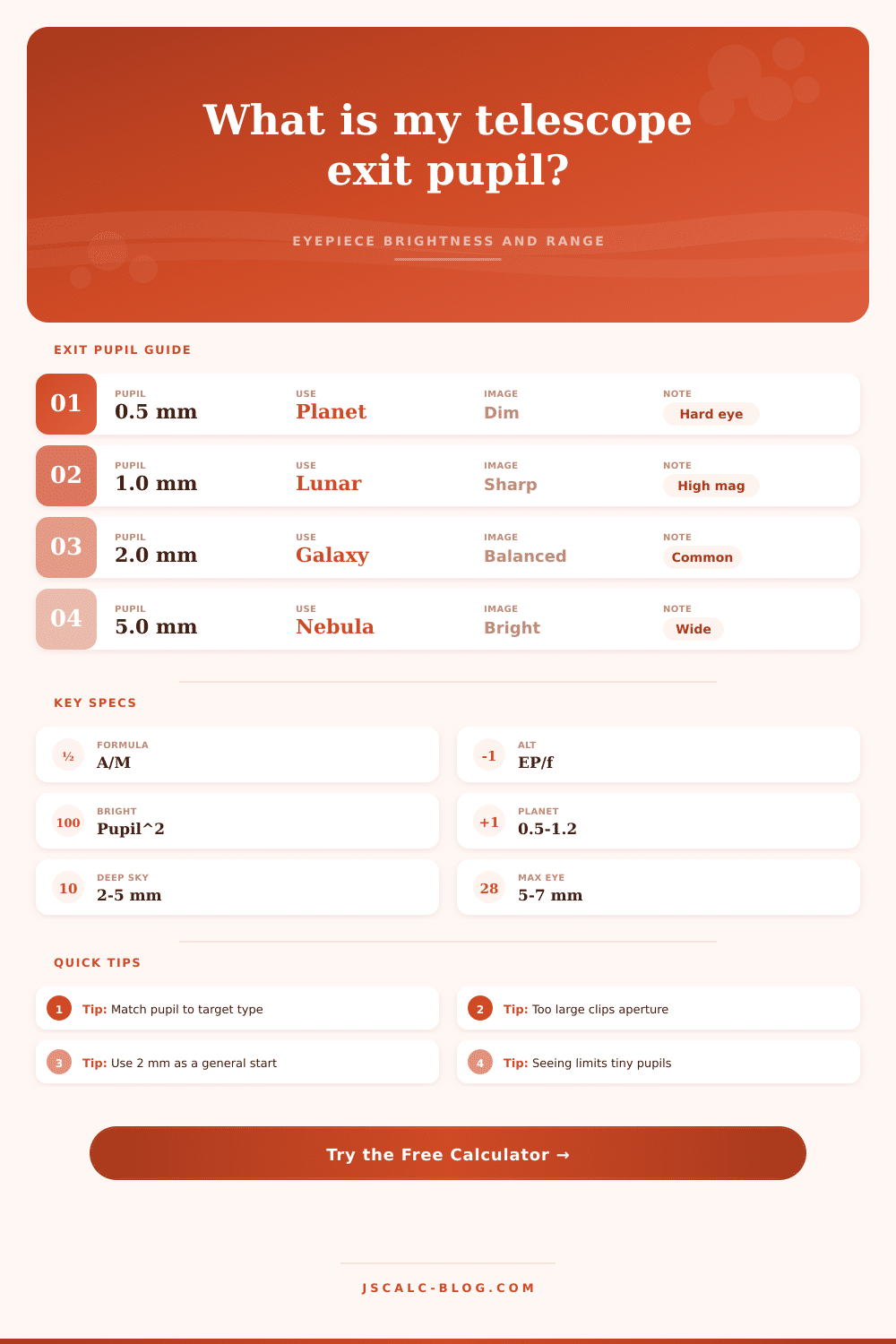
For deep-sky objects such as nebulae, you generally desire a bigger exit pupil. Two to five millimeters is a good range. It gives you enough magnification (to split the object out of the background sky glow) but it doesn’t make image too dim. Adults typically don’t need to go beyond seven millimeters because our eyes just can’t open that far in the darkness. That additional light never gets onto retina.
For planetary observing, it’s a different story. Here, we want smaller exit pupils, often under one and a half millimeters. Why? This is for higher image scale. This reduces the glare that comes off bright objects such as the cloud bands of Jupiter. But soon enough you run into a wall: the seeing conditions here on Earth make air distort. Beyond one millimeter for the exit pupil, pushing the image further down rarely improves matters. It merely becomes dimmer and more prone to swimming around in thermal currents. As table on this page illustrates, using a smaller pupil requires better seeing. This is the hard truth about visual astronomy.
How bright should it be? The brightness of the view scales with the square of the exit pupil, which is the amount of light that goes through. Because brightness scales with the square of the exit pupil, a larger beam makes the view much more different than just linearly brighter. That non-linear increase affects things you can and cannot resolve. Drop down too deep into high-power rabbit hole and the faint smudges in the Orion Nebula just dissapears. But then you spread out the beam again, and they’re back. You are sacrificing magnification for gain.
You know what you want to see: A bit of detail on Mars or the whole extent of an open cluster? The trick is knowing which one. Age comes into this, as well. Younger people’s pupils are larger and able to dilate more. Perhaps a young person (twenty) has a maximum pupil diameter of seven millimeters. An older person like me with a fifty-year-old body have a five-millimeter max.
Use a wide-field eyepiece on a fast telescope, and maybe you’re throwing away aperture. The light doesn’t get into your eye. Enter your best guess at pupil size in the calculator. It will tell you what fraction of the aperture you are using. If it’s half, you know that outer part of your mirror isn’t doing anything for you. Back off some power or live with it. It’s a handy sanity-check so you don’t waste time getting frustrated.
Begin with mid-range eyepiece. For general observing two or three millimeters is a good place to start. Sweep the sky. Go bigger if something appears too small, go smaller if something appears out of focus and/or too dim. Don’t trust what’s labeled in the box. Trust your beam size. When you’ve memorized this range, you won’t have to hunt for that perfect lens. You’ll enjoy the view. And sky doesn’t wait for anyone, but proper pupil clarifies it well enough.