Rayleigh Criterion Calculator
Calculate diffraction-limited angular resolution, arcseconds, physical line-pair separation at range, and the aperture needed to resolve a chosen detail.
🔭Optics Presets
⚙Resolution Inputs
Rayleigh Resolution Results
📊Comparison Grid
📐Formula Breakdown
The result is the diffraction limit for a circular aperture. Atmospheric seeing, aberrations, sampling, focus, contrast, and sensor pixels can make real systems resolve less detail.
📋Wavelength Reference Table
| Band or Line | Wavelength | Common Use | Resolution Effect |
|---|---|---|---|
| Violet laser | 405 nm | Laser optics, microscopy | Sharper than green by about 26% |
| Hydrogen beta | 486.1 nm | Nebula filters, spectroscopy | About 12% sharper than 550 nm |
| Green visual | 550 nm | Eye response, visual telescopes | Standard visual reference |
| Hydrogen alpha | 656.3 nm | Solar and nebula imaging | About 19% broader than 550 nm |
| Near infrared | 1.0 um | IR cameras, adaptive optics | About 1.8 times broader than green |
| Mid infrared | 10 um | Thermal imaging | About 18 times broader than green |
| Hydrogen radio line | 21.1 cm | Neutral hydrogen mapping | Needs very large dishes or baselines |
🔬Aperture Resolution Table at 550 nm
| Clear Aperture | Rayleigh Angle | Moon Separation | Typical Context |
|---|---|---|---|
| 5 mm | 27.7 arcsec | 51.6 km | Dark-adapted human eye pupil |
| 50 mm | 2.77 arcsec | 5.16 km | Binocular or small camera lens |
| 80 mm | 1.73 arcsec | 3.23 km | Small refractor telescope |
| 150 mm | 0.92 arcsec | 1.72 km | Medium amateur telescope |
| 203 mm | 0.68 arcsec | 1.27 km | 8 inch telescope |
| 1 m | 0.138 arcsec | 257 m | Research-class aperture |
| 2.4 m | 0.058 arcsec | 107 m | Hubble-class aperture at 550 nm |
| 10 m | 0.0138 arcsec | 25.8 m | Large ground telescope, diffraction only |
🌐Physical Separation Lookup
| Angular Limit | At 1 km | At Moon Distance | At 1 AU |
|---|---|---|---|
| 60 arcsec | 0.291 m | 112 km | 43,500 km |
| 10 arcsec | 48.5 mm | 18.6 km | 7,250 km |
| 1 arcsec | 4.85 mm | 1.86 km | 725 km |
| 0.1 arcsec | 0.485 mm | 186 m | 72.5 km |
| 0.01 arcsec | 48.5 um | 18.6 m | 7.25 km |
| 0.001 arcsec | 4.85 um | 1.86 m | 725 m |
💡Telescope Aperture Requirements
| Goal | Wavelength | Angular Detail | Required Aperture |
|---|---|---|---|
| Split 2 arcsec double star | 550 nm | 2 arcsec | 69 mm |
| Split 1 arcsec double star | 550 nm | 1 arcsec | 138 mm |
| Resolve 500 m on the Moon | 550 nm | 0.268 arcsec | 514 mm |
| Resolve 100 m on the Moon | 550 nm | 0.0537 arcsec | 2.57 m |
| Hubble at 500 nm | 500 nm | 0.052 arcsec | 2.42 m |
| JWST at 2 um | 2000 nm | 0.077 arcsec | 6.54 m |
| 10 mas infrared detail | 2200 nm | 0.010 arcsec | 55.4 m |
✅Resolution Tips
The gray disk floating in space looks like a marbled ball; when you point a little telescope at the moon it appears smooth. Sure, you know there are craters there with sharp edges, but they won’t appear in your scope. That’s how optical resolution works: It’s something we’re all frustrated by and sometimes it has nothing to do with magnification.
If your telescope’s aperture is too small no matter how many times you turn the dial to zoom, you will see nothing more. The answer is physical, and it’s built into very nature of light.
What Is Telescope Resolution?
That hard limit are defined by what is called the Rayleigh criterion, which precisely spells out how far apart two point sources of light has to be in order to appear as one indistinct blob. The math is straightforward; all it does is divide the diameter of aperture collecting the light by the wavelength of the light you’re looking at.
The calculator above will do that for you, but understanding how it works change how you see your gear. First, you have to choose a wavelength, and most folks simply assume green light (around five hundred and fifty nanometers) since that’s what human eye is tuned to best. If you’re photographing something like a hydrogen-alpha nebula, however, then you’re dealing with red light (six hundred and fifty-six nanometers).
The lighter the wavelength, the finer detail it resolve. The longer the wavelength, the larger mirror required. There’s no negotiating.
The flip side of the equation are aperture. A bigger lens (or a bigger mirror) collect more light, and it squishes that diffraction pattern toward a smaller central spot. This is where the physics of making things with round openings kicks in: a 1.22 factor appear in the formula as the cost of working with round things.
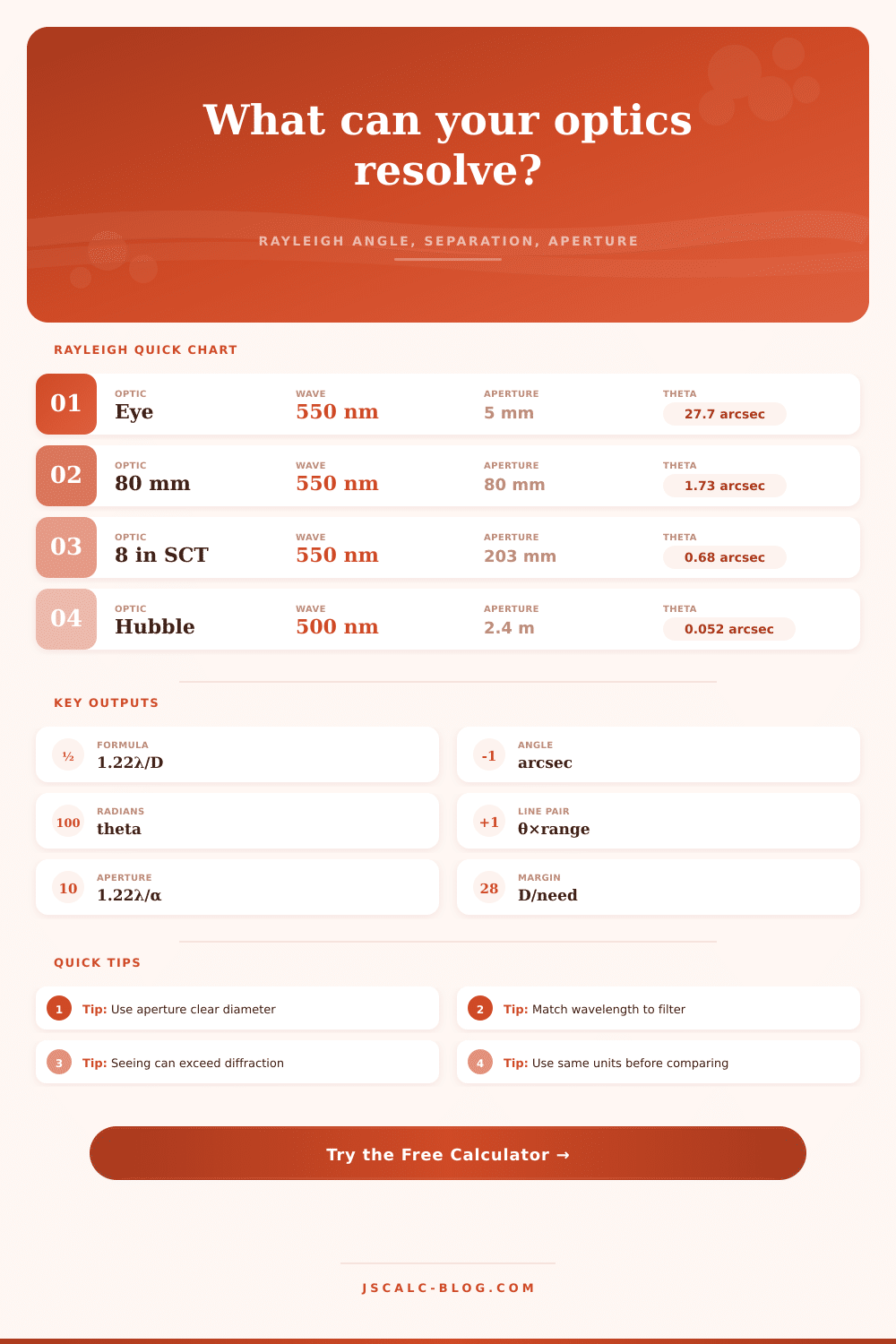
The page has a neat reference table that spells it all out, and it turns out that even a “standard” eighty-millimeter telescope (a refractor in this case) is limited to around one point seven arcseconds resolution. That sounds like nothing, but at moon’s distance, one point seven arcseconds means a real-world gap of more than three kilometers. So if the edge of whatever crater you’re trying to image is less then that across, forget it (you’ll never see it), regardless of how much sharpening you apply in computer afterwards.
The complication for those of us down here on Earth is atmospheric seeing. Even if a big scope could theoretically resolve a pair of stars separated by less than half an arcsecond, the atmosphere above your observatory may be turbulent enough to blur them both into two-arcsecond blobs. That’s the worst-case scenario, the diffraction limit. But that’s under ideal conditions, perfect optics; perfectly still air. In reality, whatever is worse different than the atmosphere and the instrument itself will cap your resolving power.
Knowing one from the other will save you money from buying larger glass; you’d better to wait for better nights. If you want to know how large an aperture you need to split a particular object, such as a double star a couple of arcseconds apart, the program can works in reverse for you. Turns out that a modest six-inch scope is frequently capable of splitting reasonably separated stars.
The challenge increases when you want to resolve tight binary systems or finer detail on planetary surfaces. At that point, the aperture requirements starts to grow steeply, well beyond something practical for mounting at home.
It’s not a checklist for box-checking; it’s a way to set your expectations of what’s physically possible before you invest any frustration or money chasing ghosts in your photos. It’s all numbers, no wiggle room, but the lessons is flexible: choose your filters well and respect the air mass. Understand that bigger isn’t always better; it has to cooperate first.
Understand that the moon is still a gray marble most times. But when the numbers falls into place, the craters will be there, clear as day, and waiting for you to look at them.