Constant Acceleration Travel Time Calculator
Estimate rest-to-rest travel time, peak speed, optional coast duration, and beta for symmetric acceleration and braking.
Travel Time Results
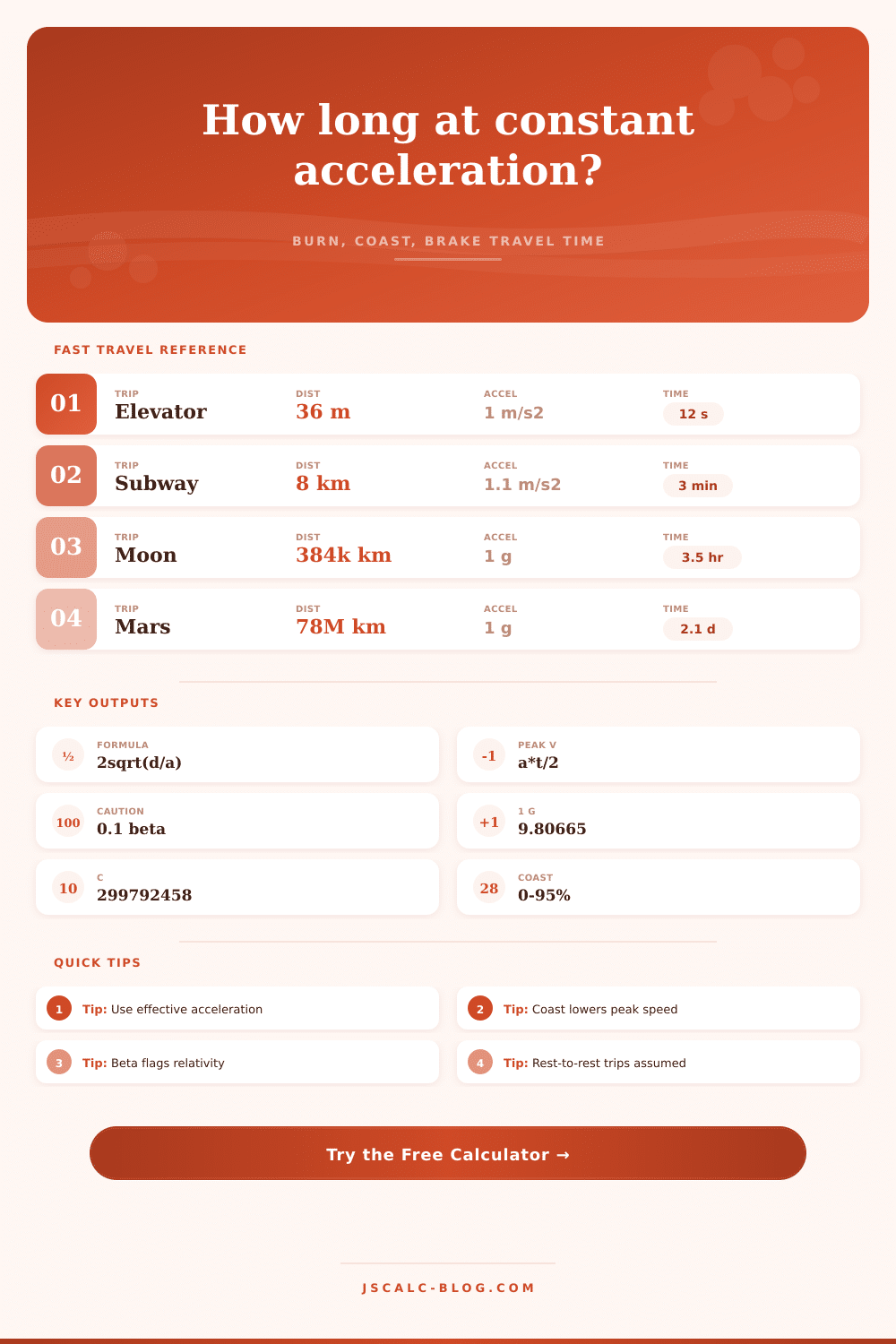
No coast: for a rest-to-rest trip with equal acceleration and braking, t = 2 × sqrt(d / a). The midpoint peak speed is v = a × t / 2.
Optional coast: the calculator assigns dburn = d × (1 - f), then uses t = 2 × sqrt(dburn / a) + dcoast / sqrt(a × dburn).
Relativity flag: beta is estimated as β = v / c. When beta reaches 0.1 or higher, the nonrelativistic result should be treated as a rough warning value.
| Reference | Acceleration | Equivalent | Typical Use | Notes |
|---|---|---|---|---|
| Gentle elevator | 0.8 to 1.2 m/s² | 0.08 to 0.12 g | Short vertical travel | Comfort is the limiting factor. |
| People mover | 0.9 to 1.3 m/s² | 3.0 to 4.3 ft/s² | Airport or campus shuttle | Often includes a long cruise or coast phase. |
| Urban rail | 1.0 to 1.4 m/s² | 0.10 to 0.14 g | Metro stop spacing | Station spacing usually dominates trip time. |
| Fast rail | 0.4 to 0.8 m/s² | 0.04 to 0.08 g | Regional routes | Lower acceleration over longer corridors. |
| Comfortable spacecraft | 9.80665 m/s² | 1.0 g | Constant-acceleration thought experiments | Power and propellant assumptions are not included. |
| High-g robotic probe | 29.4 m/s² | 3.0 g | Uncrewed conceptual travel | Structural and thermal limits matter. |
| Route or Scale | Approx Distance | Metric Input | Imperial Input | Best Profile |
|---|---|---|---|---|
| Tall building lift | 36 m | 0.036 km | 0.022 mi | Direct |
| Airport concourse | 1.2 km | 1.2 km | 0.75 mi | Long coast |
| Metro express gap | 8 km | 8 km | 4.97 mi | Long coast |
| Regional maglev example | 120 km | 120 km | 74.6 mi | Long coast |
| Low Earth orbit altitude | 400 km | 400 km | 249 mi | Direct or short coast |
| Earth to Moon average | 384,400 km | 384400 km | 238855 mi | Direct |
| Close Earth to Mars | 78 million km | 78000000 km | 48467000 mi | Direct |
| Alpha Centauri | 4.37 light years | 41300000000000 km | 25662600000000 mi | Relativity required |
| Coast Share | Burn Distance | Time Effect | Peak Speed Effect | Example: 100 km at 1 m/s² |
|---|---|---|---|---|
| 0% | 100% of trip | Fastest | Highest | 10.5 min, 316 m/s peak |
| 25% | 75% of trip | Slightly longer | 13% lower | 10.7 min, 274 m/s peak |
| 50% | 50% of trip | Moderately longer | 29% lower | 11.2 min, 224 m/s peak |
| 75% | 25% of trip | Clearly longer | 50% lower | 13.3 min, 158 m/s peak |
| 90% | 10% of trip | Much longer | 68% lower | 17.4 min, 100 m/s peak |
| Beta | Speed | Calculator Status | Interpretation | Action |
|---|---|---|---|---|
| 0.001 | 300 km/s | Usually fine | Nonrelativistic error is tiny for rough planning. | Use result normally. |
| 0.01 | 2,998 km/s | Still useful | Physics assumptions should be listed clearly. | Check mission constraints. |
| 0.1 | 29,979 km/s | Warning | Relativistic corrections become important. | Use a relativity-aware model. |
| 0.5 | 149,896 km/s | Invalid as final | Classical acceleration math is not enough. | Switch methods. |
| 1.0 | 299,792 km/s | Impossible for mass | Peak speed reaches light speed in the estimate. | Treat as a red flag only. |
But constant acceleration is straightforward right? Just throw some numbers at it, apply physics of constant acceleration, and you are finished.
Right? Wrong. Planning a trip involve balance that most folks ignore. Stopping costs the same energy and time it does for starting. Seems like simple algebra but its the devil in the details.
The Balance of Speed and Safety
When you’re accelerating or decelerating, those is just phases of your travel. That’s where a lot of folks gets lost. When they input their numbers (distances and accelerations) into the calculator above, it figure out the math and gets rid of all the noise that clouds tradeoffs between time and speed.
The trick is to understand that trade-off. Maximum efficiency come when you crank up your acceleration to a comfortabley one g for half the trip, then kill it again at the same rate for the remainder. That’s the fastest profile to get where you need to go with whatever acceleration you’ve got. It also result in the greatest maximum speed.
And here’s what many folks don’t realize: that max speed isn’t what matters; what limits you is the speed at which you have to shed that speed before you pass the finish line. The reference table illustrate that it takes a modest amount of acceleration over short distance to achieve quick travel. In physics terms, an elevator trip is a short sprint, so it doesn’t feel long, just a fraction of a minute. Why? Because it isn’t very far.
And in reality, we don’t get pure direct burns. But reality rarely allow for pure direct burns because real vehicles has limits. Structures crack from g-forces. Engines overheat.
Then comes the coast phase. Add a coast segment and you go fast until reaching a speed, then cut your thrust and drift, then brake. Your top speed drop dramatically. Total travel time goes up. Trade time for safety and comfort.
The calculator includes a slider that lets you adjust the coast percentage, showing you exactly how much time you lose by choosing to drift. For a subway ride, a 25% coast adds only seconds. On an interplanetary mission, it add days or weeks. Is it a small factor? But it matters all the same.
There are also relativity issues. Below ten percent of the speed of light, classical formulas work just fine. At around that ten percent mark things gets complicated. Mass increase and time slows down, warping the math.
To alert users that Einstein’s rules apply, where Newtonian physics won’t cut it, the tool feature a beta check for speed as a percentage of the speed of light. This helps serve as a useful guardrail so you don’t try to plan out a mission based off Newtonian physics without knowing when classical formulas no longer work. You don’t have to be an astrophysicist to understand when they don’t apply.
How fast do you accelerate? For comfort, one g is the norm (it’s just like being on earth). You won’t get that on all vehicles. A regional maglev train could probably only pull off half a g. A cargo shuttle with properly secured cargo could manage three gs.
You can dial back your theoretical maximum in acceleration margin input. Don’t use the max number if your engine has to cool down or something like that; if it pushes hard for five minutes, use the average. The calculator takes this into account. It expects you to be reasonable and tell it how much the vehicle can take. Those are the kind of calculations that set expectations.
Acceleration is hard. Space is big. Things don’t always seem so great in a spreadsheet different than they do on the big screen. If we break this down into acceleration, coasting, and braking phases, then things gets realistic. We see where our time goes. We can determine whether a quicker trip is worth enduring more stress.
These are the right equations. They’re correct math. But you should of ask the right questions for the right answers to become obvious. It’s about the plan; it’s about the physics. And the plan determines the journey.