Space Distance Between Planets Calculator
Estimate the simplified distance between two planets from their mean Sun orbit radii and heliocentric angle. Convert the result to AU, kilometers, and light-minutes, then compare closest conjunction and opposite-side opposition distances.
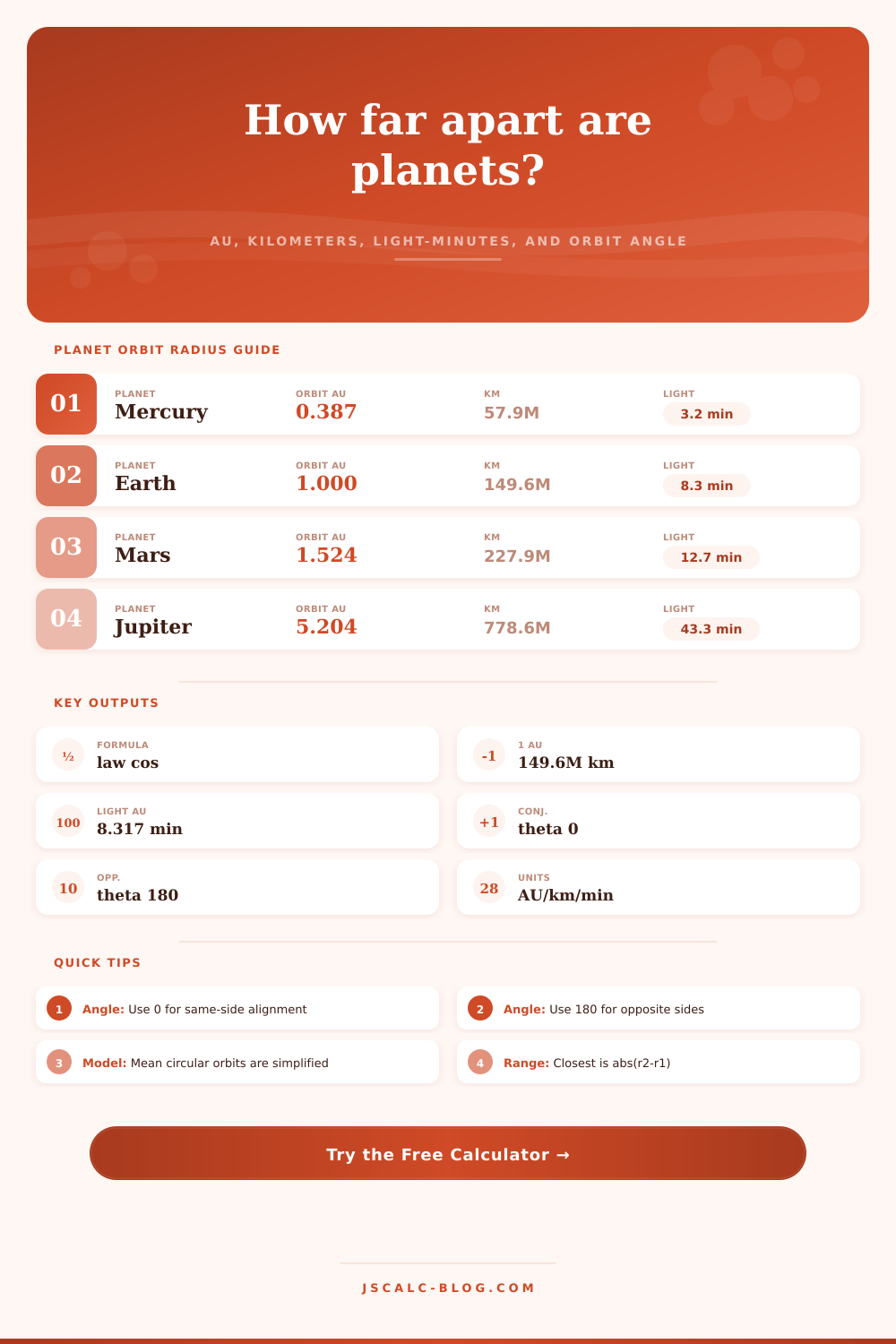
| Planet | Mean Orbit Radius (AU) | Mean Orbit Radius (million km) | Physical Radius (km) | Sunlight Time From Sun |
|---|---|---|---|---|
| Mercury | 0.387 | 57.9 | 2,440 | 3.22 light-min |
| Venus | 0.723 | 108.2 | 6,052 | 6.01 light-min |
| Earth | 1.000 | 149.6 | 6,371 | 8.32 light-min |
| Mars | 1.524 | 227.9 | 3,390 | 12.67 light-min |
| Jupiter | 5.204 | 778.6 | 69,911 | 43.28 light-min |
| Saturn | 9.583 | 1,433.5 | 58,232 | 79.68 light-min |
| Uranus | 19.191 | 2,870.7 | 25,362 | 159.58 light-min |
| Neptune | 30.070 | 4,498.3 | 24,622 | 250.08 light-min |
| Planet Pair | Conjunction / Minimum (AU) | Opposition / Maximum (AU) | Minimum (million km) | Minimum Light Time |
|---|---|---|---|---|
| Mercury to Venus | 0.336 | 1.110 | 50.3 | 2.79 min |
| Venus to Earth | 0.277 | 1.723 | 41.4 | 2.30 min |
| Earth to Mars | 0.524 | 2.524 | 78.4 | 4.36 min |
| Earth to Jupiter | 4.204 | 6.204 | 628.9 | 34.96 min |
| Mars to Jupiter | 3.680 | 6.728 | 550.5 | 30.60 min |
| Jupiter to Saturn | 4.379 | 14.787 | 655.1 | 36.42 min |
| Saturn to Uranus | 9.608 | 28.774 | 1,437.4 | 79.90 min |
| Uranus to Neptune | 10.879 | 49.261 | 1,627.4 | 90.48 min |
| Angle Theta | Geometry | Formula Shortcut | Distance Behavior | Typical Use |
|---|---|---|---|---|
| 0 deg | Same side of Sun | abs(r2 - r1) | Minimum for circular orbits | Conjunction / closest approach screen |
| 45 deg | Small separation | cos(theta) about 0.707 | Near side, but not minimum | Evening or morning sky comparison |
| 90 deg | Quarter orbit apart | sqrt(r1^2 + r2^2) | Middle-range distance | Quadrature-style comparison |
| 120 deg | Wide separation | cos(theta) = -0.5 | Closer to maximum than midpoint | Outer planet planning estimate |
| 180 deg | Opposite sides | r1 + r2 | Maximum for circular orbits | Opposition / far-side screen |
| Model Choice | What This Calculator Uses | What It Ignores | Best Reading | When To Be Careful |
|---|---|---|---|---|
| Circular mean orbit | One average Sun distance per planet | Eccentricity, inclination, exact date | Fast geometry comparison | Mars close approaches vary a lot |
| Heliocentric angle | Angle at the Sun between planets | Observer's sky angle from Earth | Correct for law-of-cosines distance | Do not treat theta as telescope separation |
| Center-to-center distance | Distance between planet centers | Atmosphere and altitude | Standard astronomy distance | Surface option is tiny at AU scale |
| Light-minute conversion | One-way light time in vacuum | Signal processing, relay delays | Good communication-lag estimate | Real missions use ephemerides |
| Conjunction and opposition | 0 deg and 180 deg circular cases | True orbital longitude and phase timing | Useful min and max boundaries | Actual closest date may not equal visual conjunction |
There’s nothing like trying to calculate how far apart everything is (what an empty place!) when trying to understand just how far apart everything is in space. From where you sit in your world, staring up at the night sky, you see clusters of planet glowing like pinpricks. Yet each planet are a lonely island floating in empty space, so deep and far away that light can take minutes to travel from one neighbor to another.
So what are all those numbers? This calculator do the math for you. It converts those theoretical points in orbit around the sun into real-life distances so you can understand just how big solar system really is. No need for trigonometry on a cocktail napkin.
How to Measure Distances in Space
That’s the starting point for the calculation: the heliocentric angle. That’s not what you observe with your backyard telescope. That’s the angle measured at the Sun between two planets. Imagine the Sun is the center of a clock face. Earth is at twelve o’clock and Mars is at three o’clock. Their angle are ninety degrees. That’s the angle this tool inputs into its calculations, and it uses this geometric fact to determine their straight-line distance in space.
Why does it matter? How things look to us here on Earth is an illusion. Two planets may seem close in the sky but be on opposite sides of the solar system. So that illusion is corrected by the angle we enter.
You’ll find the outcome displayed in three units. Planetary orbits are usually measured in astronomical units. One AU is equal to the average Earth-to-Sun distance, which is a nice clean relative measure. You can get a sense for the raw magnitude of the distance in kilometers. And then there’s light-minutes, which helps add a time frame of reference. That a message from Mars arrives on Earth after twelve minutes makes its delay something you can really wrap your head around in human terms.
The calculator outputs the base distance expressed in each of those three units. It also lets you select the unit that makes the most sense for how you think about it. This is explained in the table on the page, where it gives the mean orbit radius of each planet. The numbers are averages. Planets don’t have perfect circles for orbits; they are ellipses. Sometimes a planet is closer to the sun than other times. That’s what makes the calculation so complicated, but this calculator simplifies it by using mean radii. It assumes circular orbits for estimating purposes.
In general terms, this helps understand scale but isn’t good enough for things like mission planning. To guide a spacecraft, you’d require ephemeris data which tell you exactly where something is on a given day. But for sheer curiosity, the average is just fine.
Take, for example, the Earth to Mars relationship. Using this model, when those two bodies reach their closest point (called conjunction), they’re about fifty million kilometers from each other. During opposition, when they reach their greatest separation, the distance grows to almost four hundred million kilometers. The range is huge. This affects whether we can send spacecraft there, as well as how bright that object appears in our sky.
With this calculator, you can toggle the range between these extremes. Set the angle to zero if you want to view the minimum distance. One hundred and eighty degrees is the maximum. All others lie somewhere along the spectrum.
This does not apply to the outer planets. Because those are such vast distances, the fraction between their farthest and closest approaches isn’t as important compared to the whole distance. Jupiter is always distant. And Saturn is even more distant than that. Light time starts to matter more: A message to Saturn takes over an hour to arrive. Send one to Neptune? Four hours. That’s not time enough for real-time conversation. So they has to rely on autonomous spacecraft. The calculator shows this because it makes clear how many light-minutes you’re looking at. Space gets reduced to a sequence of communication lags.
But there’s a temptation with those numbers to think they’re fixed facts. They aren’t. The solar system is dynamic. Planets move. Angles change. Every day, the distance from Mars to Earth changes by millions of kilometers. Based off your selected angle, the tool will capture a snapshot. It will freeze the motion for that moment of clarity. That’s useful for comparison and education. It allows you to compare just how much wider the gap between Saturn and Jupiter is than the one between Earth and Mars. And it finally shows the spacing of the solar system.
Beyond that, there’s also the surface-to-surface option. This takes the center-to-center distance and subtracts out the physical radii of each planet. What you’re left with is the real-life distance between their atmospheres. This is interesting on the inner planets (it makes a difference), but negligible on the gas giants. Between the enormity of these worlds, the huge distances they span make their size nearly irrelevent. The calculator has this feature because it’s complete, but also as a reminder: Planets aren’t mathematical points in space; they have physical extent.
This knowledge changes our perspective on exploration. It reinforces just how isolated every world is from its neighbors. It explains why it takes years. Why communicating is difficult. A tool like this does all the hard math around the tricky geometry, allowing you to focus on what it means.
Try experimenting with various combinations of worlds to gain a sense of scale. What impact does shifting a few degrees have? How much time will it take for light to travel between those points? Suddenly, a flat map becomes an engaging lesson. It allows you to manipulate data and develop your own understanding of distance.
The solar system isn’t full of planets huddling together. There’s nothing but wide, still space separating everything. And crossing it requires a journey. It is a tiny speck trying to cover vast, lonely gaps. Numbers don’t lie. They show you what that journey looks like.