Synodic Period Calculator
Calculate when two orbiting bodies realign, including inner planet, outer planet, lunar phase, and custom orbital period cases.
📌 Real Presets
⚙ Orbital Inputs
Synodic Result
🧮 Formula Breakdown
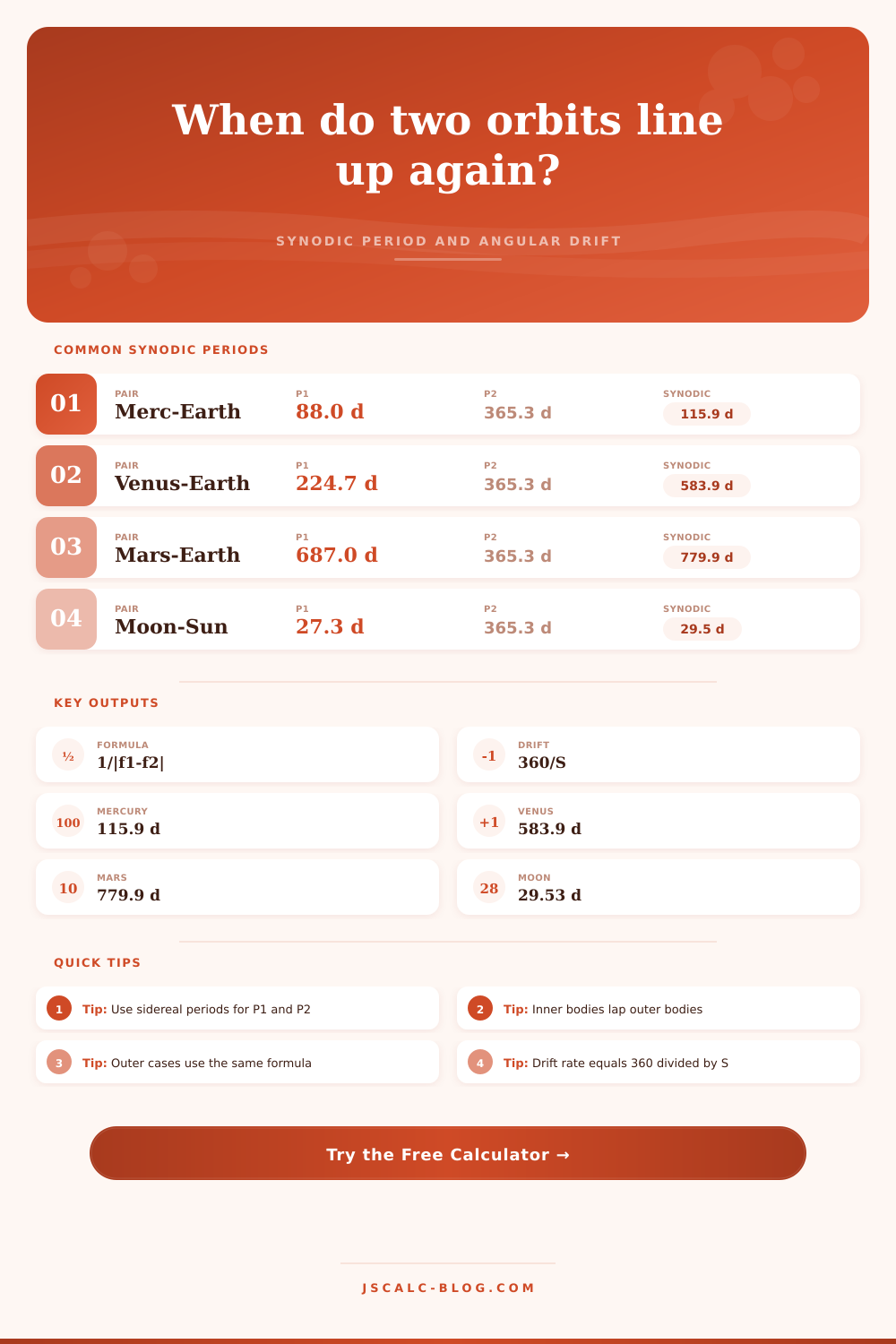
1/S = abs(1/P1 - 1/P2), then angular drift rate = 360/S
📊 Current Pair Snapshot
🗂 Inner, Outer, and Moon Comparison Grid
Inner Planet
The inner body has the shorter sidereal period, moves faster, and repeatedly laps the outer observer or reference planet.
Outer Planet
The observer or inner reference body moves faster, so alignments recur after the inner body gains one full relative circle.
Moon or Satellite
Use the satellite sidereal period and the reference body's orbital year to estimate phase repeats or sun-relative cycles.
🌐 Sidereal Period Reference
| Body | Sidereal Period | Years | Typical Use |
|---|---|---|---|
| Mercury | 87.9691 days | 0.2408 years | Inner planet cycle |
| Venus | 224.701 days | 0.6152 years | Inferior and superior conjunctions |
| Earth | 365.2564 days | 1.0000 years | Reference for planet apparitions |
| Moon | 27.3217 days | 0.0748 years | Lunar phase estimate with Earth year |
| Mars | 686.980 days | 1.8808 years | Opposition interval |
| Jupiter | 4332.589 days | 11.862 years | Annual apparition shift |
| Saturn | 10759.22 days | 29.457 years | Slow outer planet cycle |
| Neptune | 60189.0 days | 164.79 years | Very slow reference orbit |
🔭 Common Synodic Period Table
| Pair | Case | Synodic Period | Drift Rate |
|---|---|---|---|
| Mercury and Earth | Inner planet | 115.88 days | 3.106 deg/day |
| Venus and Earth | Inner planet | 583.92 days | 0.617 deg/day |
| Mars and Earth | Outer planet | 779.94 days | 0.462 deg/day |
| Jupiter and Earth | Outer planet | 398.88 days | 0.903 deg/day |
| Saturn and Earth | Outer planet | 378.09 days | 0.952 deg/day |
| Moon and Sun from Earth | Phase case | 29.53 days | 12.191 deg/day |
| Mercury and Venus | Inner pair | 144.56 days | 2.490 deg/day |
| Io and Europa | Satellite pair | 3.55 days | 101.410 deg/day |
📐 Angle Planning Table
| Target Angle | Meaning | Fraction of S | Mercury-Earth Example |
|---|---|---|---|
| 0 degrees | Conjunction or repeat alignment | 0 or 1.00 S | 115.88 days for full repeat |
| 90 degrees | Quadrature style separation | 0.25 S | 28.97 days from conjunction |
| 180 degrees | Opposition or greatest relative separation | 0.50 S | 57.94 days from conjunction |
| 270 degrees | Three-quarter relative cycle | 0.75 S | 86.91 days from conjunction |
📝 Variable Check Table
| Symbol | Meaning | Unit | Calculator Output |
|---|---|---|---|
| P1 | Sidereal period of body 1 | days or years | Converted to days |
| P2 | Sidereal period of body 2 | days or years | Converted to days |
| S | Synodic period | days and years | Primary result card |
| 360/S | Relative angular drift | degrees/day | Drift result card |
💡 Calculation Tips
According to this definition, synodic means that two objects in space is coming back into same relative relationship. In other words, Earth will catch up to a different planet and both will be on the same side of the Sun. The calculator above will run the math for you, stripping away guesswork so you can see exactly when those celestial alignments will recur.
The Sidereal vs. Synodic Period: “Sidereal” refers to the time it takes for a planet to revolve around the Sun once in relation to fixed stars. This is an absolute measure. On the other hand, a “synodic” period are relative; it varys depending off the motion of the observer (in this case, typically Earth). From our vantage point here on Earth, we’re moving as well and that alters the apparent rate at which things orbit us.
Understanding Synodic Periods
Venus, for instance, orbits the Sun every 225 days, but it doesn’t come back into alignment with Earth until another 584 days have passed. This explains why some planets isn’t visible for months or even years. It also explains how long they stay at opposition and when a telescope would see them most clearly.
To make this work you’ll want to plug in the sidereal period (how long it takes to complete one orbit) for each body. Inner planets lap outer planet, and vice versa; both ways work. So do moons. The Moon orbits the Earth in 27.3 days, yet its phases recur only after 29.5 days.
Why? Because Earth itself move relative to the Sun and the Moon has to play catch-up with new position of the Sun-Earth line. The difference may sound trivial but it isn’t: it lies at the heart of orbital dynamics. Use any other timing different than one that accounts for the motion of yourself as an observer, and you are going to be off not just by hours but weeks or months.
The math works because it’s an inverse relationship, so you don’t have to memorize the formula. The faster the orbit, the closer together two planets is in their synodic period; the slower their relative speed, the longer that period. The calculator expresses those periods as angular drift rates, i.e., how many degrees apart they’ll be from one another per day.
That lets you plan your observing: Given the drift rate, you can compute when a planet should reach opposition or quadrature. It turns orbital numbers into something practical. Another common error is to mix units. Always make sure that both time scales are in same unit before doing the math. Years tend to be best for outer giant bodies and days are typically best for inner system bodies.
The page shows a table of standard sidereal period values for Mercury through Neptune; it’s a good sanity check. If your custom input looks wildly different than what’s known for these bodies, double-check the source, since accuracy depends on quality of input data.
These cycles are used for launch windows by professional mission planners and planning sessions by amateur astronomers. Exact timing is essential for the Hohmann transfer orbit. It’s not enough just to launch your spacecraft when the planets are aligned. They must be aligned correctly to make it worth the amount of fuel required. Launch window is a hard constraint; there is no negotiating with orbital mechanics, it is defined by the time between alignments.
Here is one more point on the angular drift rate. How fast does that change? The bigger the angular drift rate the faster the angle will change. For instance Mars move slowly; maybe 1/2 a degree or so each day. Mercury moves faster at roughly three degrees a day.
That makes a difference for visibility. You can’t follow things that move really fast as easily but you get many chances. With slow ones you have to wait longer but when you do see them, they’re rock steady and easy to observe. Knowing this trade-off will help you choose what to focus on since it’s not simply whether they line up now but also how long they remains in a good position.
Remember, however, that the solar system is not static: its various objects move along intersecting paths. When you calculate those intervals, you’re essentially predicting their future location, converting motion into a timetable. That’s how you know when Venus is there; that’s why the moon happens to be where it is now; if you want to plan your own simulation or maybe go out and do some stargazing, well, the math explains it all.
And the next alignment? It’s already been decided. You simply have to find it.