Sidereal Time Calculator
Convert a Universal Time date, UT clock time, and observing longitude into Julian Date, days since J2000.0, Greenwich Mean Sidereal Time, local sidereal time, and target hour angle.
| Preset | Approx Longitude | Hemisphere | LST Shift From GMST | Typical Use |
|---|---|---|---|---|
| Greenwich Observatory | 0.0000° E | Northern | +0h 00m | Reference meridian and GMST checks |
| Mauna Kea Observatories | 155.4783° W | Northern | -10h 22m | Deep sky observing from Hawaii |
| Paranal Observatory, VLT | 70.4042° W | Southern | -4h 42m | European Southern Observatory site |
| ALMA Chajnantor Plateau | 67.7549° W | Southern | -4h 31m | Millimeter array scheduling context |
| Siding Spring Observatory | 149.0661° E | Southern | +9h 56m | Australian optical observing |
| Roque de los Muchachos | 17.8816° W | Northern | -1h 12m | La Palma telescope planning |
| Palomar Observatory | 116.8630° W | Northern | -7h 47m | California night-sky checks |
| Amundsen-Scott South Pole | 0.0000° E | Southern | +0h 00m | Polar RA and longitude demonstration |
| Tokyo City Sky | 139.6917° E | Northern | +9h 19m | Urban astronomy example |
| Quantity | Value | Meaning In Calculator | Practical Reading |
|---|---|---|---|
| Mean solar day | 24h 00m 00s UT | Civil clock day used for UT entry | The Sun returns to the meridian after one mean solar day |
| Sidereal day | 23h 56m 04s UT | Approximate star-to-meridian repeat interval | Stars transit about 3m 56s earlier each solar day |
| Sidereal rate | 1.00273791x | Sidereal hours gained per UT hour | One UT hour advances GMST by about 1h 00m 10s |
| Longitude conversion | 15° = 1h | Used in LST = GMST + longitude / 15 | One degree shifts LST by four sidereal minutes |
| J2000.0 epoch | 2451545.0 JD | Zero point for d in the GMST formula | 2000-01-01 12:00:00 UT |
| UT Offset | Julian Date | GMST | Local Sidereal Time | Target Hour Angle |
|---|---|---|---|---|
| 0h | 2461250.500 | 06:57:45 | 06:57:45 | +01:23:13 |
| Case | Longitude Term | LST Effect | Hour Angle Meaning | Planning Note |
|---|---|---|---|---|
| Greenwich | 0° / 15 = 0h | LST equals GMST | HA is GMST minus RA | Best quick check against published GMST values |
| East longitude | Positive degrees / 15 | LST is ahead of GMST | Target reaches transit earlier by UT clock | Asia and Australia commonly use positive longitude here |
| West longitude | Negative degrees / 15 | LST is behind GMST | Target reaches transit later by UT clock | Americas and Hawaii are west-negative in the formula |
| HA near 0h | LST approximately RA | Object is near local meridian | Transit, highest altitude for that date | Often a strong observing window if altitude is adequate |
| HA negative | LST less than RA | Object has not yet transited | East of the meridian | Magnitude depends on signed wrap convention |
| HA positive | LST greater than RA | Object already transited | West of the meridian | Small positive values are still close to culmination |
The Earth’s rotation with respect to the distant stars, not the sun, are called sidereal time. It keep track of how sky moves over your meridian. Its rhythm has nothing to do with your wall clock or the sun.
There are two system: solar time and sidereal time. Your watch indicate solar time. That depends on where the sun is located. Sidereal time depend on which way stars in background are facing.
How Sidereal Time Works
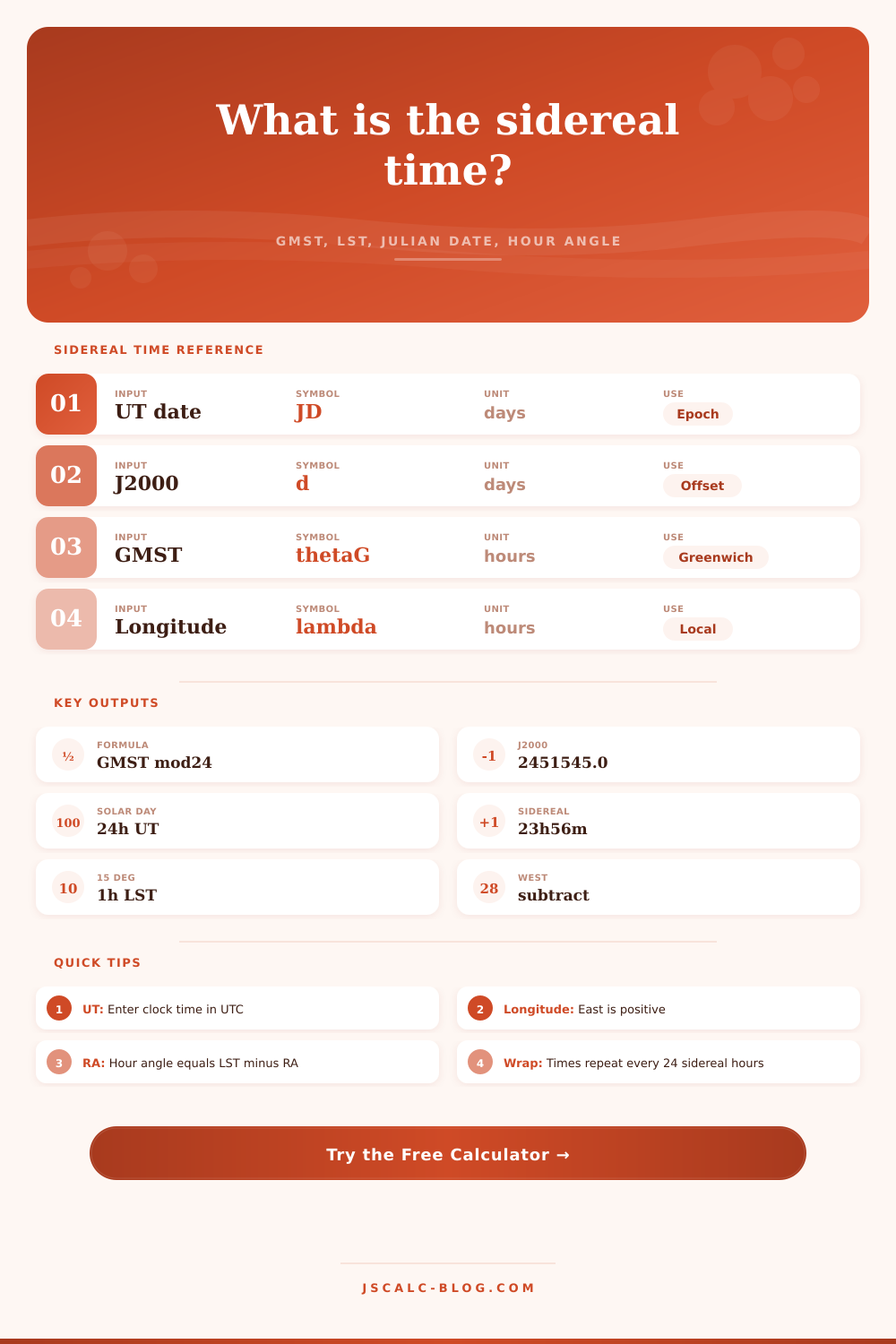
As the Earth spins, it also orbits the sun. So it has to turns a little further each day to turn back toward the sun. The extra turning amount to some four minutes. In effect, the Earth make one revolution roughly every 23 hours, 56 minutes. This is length of a sidereal day.
Most people think sky repeats itself every 24 hours. But the sky doesn’t quite repeat. It shift. It’s a small change, but it makes all the differnce for determining what constellation you see at midnight. Because of that daily four-minute shift, the constellations you see at midnight in January won’t be the same ones you see by July.
That is, you has to know where the celestial sphere is at any given moment. In other words, not only do you have to know the time (Greenwich), but also where the celestial sphere are at that time.
It starts with Universal Time. That’s the worldwide standard used to keep civil time. Next it calculate Julian Date. That’s simply the number of days that have passed since a given starting point in history. No more messing around with leap seconds and calendar years. It is just a straight line of days that provide astronomers with one universal timeline.
From there, it will compute Greenwich Mean Sidereal Time which is right ascension of those stars that cross over the prime meridian in London at any given moment. That’s the global baseline for astronomers. But you’re probably not in London. You’re somewhere else. And that’s where longitude come into play.
Enter your location into the calculator and it will spit out Local Sidereal Time. This is what matter to you and your telescope. To adjust for your location: Your local sidereal time is ahead if you’re east of Greenwich; it’s behind if you’re west. The tool add or subtracts your longitude. Get sign correct. A positive value mean east. A negative value mean west. It is simple.
This is the most common mistake. Get it wrong and you’ll seek out a star that’s already behind you. It could of still be hours before it rises. Skipping this step is made easier with the preset buttons for the major observatories. Understanding the logic give you confidence in what the tool spits back out.
This is often the last thing you want out of this process. That is the hour angle. Simply put, it’s the difference between your local sidereal time and the right ascension of the object you wish to view. In other words, it indicate how far east or west of your own meridian the object lie. If it’s zero, then the object are on the top of your meridian. Positive? Then it’s past its high point. Negative? Well then, it’s coming up.
And here is where knowing this number become important: it will tell you if you can see the object at all. If the number isn’t in your favor, perhaps you’ll have to wait. The calculator even includes a comparison grid, which displays these numbers over time. It is handy when you realize just how fast your window of opportunity close.
There is something elegant about sidereal time. This eliminate all calendar anomalies and time zones. It simplifies the sky into a single spinning clock face. There’s no need to commit to memory all of these formulas. All you has to know is how to relate the stars, your location and your clock. Leave it to the tool to supply you with the numbers; let you interpret them.
Keep in mind that the sky move much faster than your watch shows. Four minutes is where the universe realy resides. Knowing when the clock hits zero for you means catching a star at its best. The sky doesn’t wait, it keeps perfect time.