Interstellar Travel Time Calculator
Estimate Earth-frame cruise time, relativistic gamma, and traveler proper time for a constant-speed trip between stars.
✨Real Star Presets
🧮Trip Inputs
Travel Time Results
📊Live Comparison Grid
The comparison grid uses the entered distance and assumes each listed craft is already at cruise speed.
⚙Core Relativity Specs
📐Formula Breakdown
Convert distance: D is converted to light-years. One parsec is 3.26156 light-years, one light-year is about 63,241.1 AU, and one light-year is about 9.4607 trillion km.
Convert speed: beta = v / c. At beta = 0.10, the craft cruises at 10% of light speed.
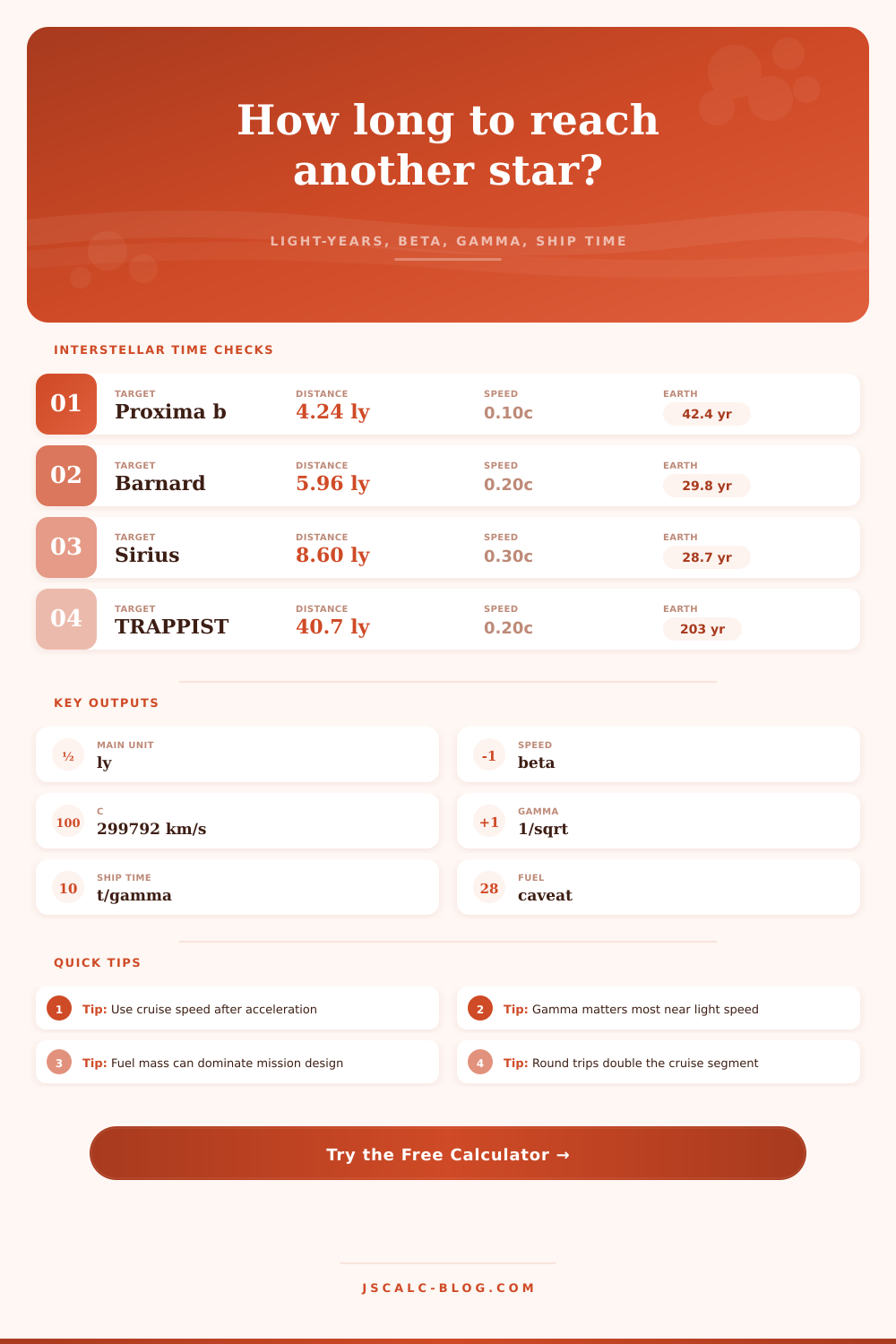
Earth-frame time: t = D / beta. Because light travels one light-year per Julian year, 4.24 ly at 0.10c takes 42.4 Earth years for the cruise segment.
Lorentz factor: gamma = 1 / sqrt(1 - beta²). This stays near 1 at low speed and climbs sharply near c.
Traveler proper time: tau = t / gamma for the constant-speed cruise segment. Acceleration, braking, shielding, navigation, and fuel mass are engineering caveats outside this simple cruise equation.
💡Calculator Notes
🌌Nearby Destination Reference
| Destination | Approx. distance | Type | Earth time at 0.10c |
|---|---|---|---|
| Proxima Centauri b | 4.24 ly | Nearest known exoplanet host | 42.4 yr |
| Alpha Centauri A/B | 4.37 ly | Nearby binary stars | 43.7 yr |
| Barnard's Star | 5.96 ly | Red dwarf | 59.6 yr |
| Wolf 359 | 7.86 ly | Red dwarf | 78.6 yr |
| Sirius | 8.60 ly | Bright nearby star | 86.0 yr |
| Epsilon Eridani | 10.5 ly | Planet-hosting star | 105 yr |
| Tau Ceti | 11.9 ly | Sun-like nearby star | 119 yr |
| TRAPPIST-1 | 40.7 ly | Compact planet system | 407 yr |
🚀Speed Benchmark Table
| Cruise speed | beta | km/s | 4.24 ly Earth time |
|---|---|---|---|
| Voyager-class fast probe | 0.000057 | 17 | about 74,700 yr |
| 0.01c | 0.010 | 2,998 | 424 yr |
| 0.05c | 0.050 | 14,990 | 84.8 yr |
| 0.10c | 0.100 | 29,979 | 42.4 yr |
| 0.20c | 0.200 | 59,958 | 21.2 yr |
| 0.50c | 0.500 | 149,896 | 8.48 yr |
| 0.90c | 0.900 | 269,813 | 4.71 yr |
⏱Relativity Factor Table
| beta | gamma | Traveler time for 10 Earth yr | Energy caveat per kg |
|---|---|---|---|
| 0.10 | 1.005 | 9.95 yr | 0.45 PJ/kg |
| 0.20 | 1.021 | 9.80 yr | 1.87 PJ/kg |
| 0.50 | 1.155 | 8.66 yr | 13.9 PJ/kg |
| 0.80 | 1.667 | 6.00 yr | 59.9 PJ/kg |
| 0.90 | 2.294 | 4.36 yr | 116 PJ/kg |
| 0.99 | 7.089 | 1.41 yr | 547 PJ/kg |
🛰Mission Profile Reference
| Profile | Legs counted | Best use | Important caveat |
|---|---|---|---|
| One-way flyby probe | 1 | Fast reconnaissance | No braking at target |
| Arrival with deceleration | 1 | Orbiter or lander | Braking energy needed |
| Crewed one-way cruise | 1 | Shipboard time comparison | Life support not modeled |
| Round-trip flyby return | 2 | Return payload timing | Course reversal not modeled |
| Crewed round trip | 2 | Earth time vs ship time | Acceleration physics omitted |
| Multi-leg relay segment | 1 | Compare one route leg | Only one leg at a time |
If you’re wondering how anyone could think a trip to the nearest star were possible, well…you don’t have to be an expert in physics to get that one. Just learn there’s no such thing as “distance” or “time” the way we imagine them while staring down at highway map.
There are about 4 light years between Proxima Centauri and our own solar system. Sounds fine, right? Until you remember a light year is the amount of time it takes light to go from point A to point B. To travel those 4 light years mean the people back home would witness a voyage lasting forty-two years (and that’s assuming you built a ship capable of traveling at a tenth the speed of light). The person inside that ship has a very different experience, but this disconnection is the core of interstellar travel planning.
How to Use the Space Travel Calculator
That is precisely what calculator above does for you when you choose your cruising speed. Everyone gets hung up on velocity. People think they can just divide distance by velocity. If they drive five miles per hour, it will take X number of hours. For something like grocery shopping it’s good enough. But it completely breaks down at high speeds. Velocity isn’t nearly the whole picture.
There is another important piece: the gamma factor. This is the factor which determine how much slower time passes for the crew compared to earth. It has no impact whatsoever at low velocities. As you start approaching half the speed of light, the difference is dramatic. The calculator figures all that math out for you. All you have to know is that the faster your travel, the less it feels like traveling. Simply, we feel like faster means a shorter trip. And while that happens subjectively, it doesn’t scale as we might expect.
Even though the presets will give you the idea, it’s really the inputs that are important here. Your choice of destination sets the baseline distance but your mission profile determine how you use it. Do you plan to do a flyby? That doesn’t require stopping. Do you want to land/orbit? You have to account for decelerating. The page has a table of references that shows how arrival time changes given those options.
Double the length of the cruise if you choose a round trip. Turning around takes a lot of energy. It isn’t just getting there. Its surviving the turn or stop.
On the other hand, the crazy part about all this is that traveling through space provides a weird gift: time dilation. Imagine we were able to construct a ship that cruised at 90% of the speed of light. From our point of view here on Earth, the journey to Proxima Centauri would last roughly four and a half years. Yet for the travelers themselvess, they’d only experience around two and a half years. That’s a huge gap.
That implies that even though the voyage may last centuries from their friends’ perspective back home, it’s still biologically possible for the colonizers to make the journey. And therein lies the great cultural clash: The voyagers come back to find an Earth that’s changed and carried on without them. The calculator shows both the traveler’s own time and the time in Earth frame, side-by-side. When you see those two numbers start to diverge, then the physics starts to seem real.
But there’s a hidden cost: fuel requirements. It’s noted in the disclaimer, but it carries a hidden weight. Kinetic energy increase exponentially with velocity. To move a craft at 10% the speed of light takes far more than ten times the energy to move it at 1%. It requires ten times the energy. And that means much, much more power density or propellant density then we have now.
That’s why many short-term designs are for small probes. These probes can be accelerated relatively cheaply. These probes has little shielding. These probes don’t require life support. Even at normal speeds, the reference material indicates that a regular probe will take tens of thousands of years to make it out to even the nearest stars.
A reminder that while speed does matter, it’s the sole currency, and right now we’re broke. That is why the tradeoffs matter. It puts a different spin on the stars. They aren’t lights in the sky, they’re destinations. These destinations has huge distances and even bigger energy and time costs. The calculator makes the math easier but it doesn’t make the engineering any simpler. You’re still going to need to calculate how to propel your mass along at relativistic speeds without turning it all to steam. You’ll still be dealing with years-long communication delays and radiation shields. But at least now you can ask yourself if it’s worth the trip.
Slide those distance and speed bars around and you can get an idea about how the rules of physics draw lines around our reach as humans. And that tension, between seeing something and reaching it, is where the promise of space travel exists.