Time Dilation on a Spacecraft Calculator
Compare Earth-frame time, spacecraft proper time, velocity, distance, gamma, and aging difference with special relativity math from JSCalc-Blog.com.
🚀Real Mission Presets
⚙Spacecraft Inputs
📊Speed Comparison Grid
🧮Formula Breakdown
| Quantity | Formula | Use in calculator | Notes |
|---|---|---|---|
| Beta | beta = v / c | Converts percent c, beta, km/s, or m/s to one speed ratio. | Must be 0 or greater and less than 1. |
| Lorentz factor | gamma = 1 / sqrt(1 - beta²) | Sets how strongly spacecraft time differs from Earth-frame time. | Gamma stays near 1 at ordinary orbital speeds. |
| Earth frame time | Earth time = ship proper time x gamma | Used when the spacecraft clock duration is known. | This is the inertial-frame elapsed cruise time. |
| Ship time | ship time = Earth time / gamma | Used when the Earth-frame mission duration is known. | This is the elapsed proper time on the spacecraft clock. |
| Distance check | distance = beta x Earth time | Compares requested route distance with speed and elapsed Earth time. | In light-years and years, light speed equals 1 ly/year. |
| Aging difference | Earth time - ship time | Shows how much less the traveler ages during the cruise. | Dwell time is added equally and does not increase the difference. |
⚡Reference Tables
Gamma by constant cruise speed
| Speed | Beta | Gamma | Ship time per 10 Earth years |
|---|---|---|---|
| Low interstellar concept | 0.010 | 1.00005 | 9.9995 years |
| Fast fusion concept | 0.050 | 1.00125 | 9.9875 years |
| Relativistic probe | 0.100 | 1.00504 | 9.9499 years |
| Half light speed | 0.500 | 1.15470 | 8.6603 years |
| Gamma equals two | 0.866025 | 2.00000 | 5.0000 years |
| Very high cruise | 0.950 | 3.20256 | 3.1225 years |
| Extreme cruise | 0.990 | 7.08881 | 1.4107 years |
| Ultra-relativistic | 0.999 | 22.36627 | 0.4471 years |
One-way distance quick lookup
| Destination | One-way distance | Earth time at 0.1c | Ship time at 0.1c |
|---|---|---|---|
| Moon average distance | 0.000000041 ly | 12.9 seconds | 12.8 seconds |
| Mars close approach | 0.0000058 ly | 30.5 minutes | 30.4 minutes |
| Neptune average orbit | 0.000474 ly | 1.73 days | 1.72 days |
| Proxima Centauri | 4.2465 ly | 42.465 years | 42.252 years |
| Barnard's Star | 5.96 ly | 59.6 years | 59.30 years |
| Sirius | 8.60 ly | 86.0 years | 85.57 years |
| Tau Ceti | 11.9 ly | 119.0 years | 118.40 years |
| Galactic center | 26000 ly | 260000 years | 258694 years |
Preset scenario comparison
| Scenario | Speed basis | Mode | Main consistency check |
|---|---|---|---|
| ISS 180-day orbit | 7.66 km/s | Earth time | Shows tiny special-relativity aging difference. |
| GPS satellite year | 3.87 km/s | Earth time | Special relativity only; gravity correction excluded. |
| Voyager-speed year | 17 km/s | Earth time | Deep-space speed remains far below beta 0.001. |
| Proxima at 0.1c | 4.2465 ly | Distance | Earth time equals distance divided by beta. |
| Tau Ceti at 0.866c | 11.9 ly | Distance | Gamma near 2 halves traveler time. |
| Andromeda at 0.999c | 2,537,000 ly | Distance | Huge route with strong time dilation. |
Unit conversions used internally
| Input | Conversion | Reason | Calculator handling |
|---|---|---|---|
| Percent c | beta = percent / 100 | Common spacecraft shorthand. | 99.9 means beta 0.999. |
| Beta | beta = beta input | Direct v/c ratio. | Must stay below 1. |
| km/s | beta = km/s / 299792.458 | Uses exact defined light speed in vacuum. | Good for spacecraft and satellites. |
| m/s | beta = m/s / 299792458 | SI speed entry. | Good for lab-scale velocities. |
| Light-years | kept as ly | Pairs directly with beta and years. | Earth years = ly / beta. |
| Astronomical units | 1 AU = 1.58125e-5 ly | Useful inside the solar system. | Converted before distance checks. |
| Kilometers | 1 ly = 9.46073e12 km | Supports local route distances. | Converted to light-years. |
💡Relativity Tips
Astronauts come home after traveling almost as fast as light; they is still young, while their grandchildren have grown old. It’s magical-sounding sci-fi stuff. But it’s pure arithmetic. When you travel fast, space and time are locked together in a rigid structure that bends. Time slows down relative to the calendar back on Earth, and the faster you go, the bigger the difference is. That’s an idea most of us pick up instinctively, even if we get tripped up on the numbers.
At human-scale speeds, the impact of relativity are extremely small. Even at the blazing speed of the International Space Station; some 8 kilometers per second, a blistering pace by human terms, it’s just milliseconds over the course of months. You’d need some seriously precise atomic clock to see any difference. Just type in how fast you’ll be going and for how long, and the calculator will do the rest. No more guesswork about unit conversions and relativistic coefficients.
How Speed Changes Time
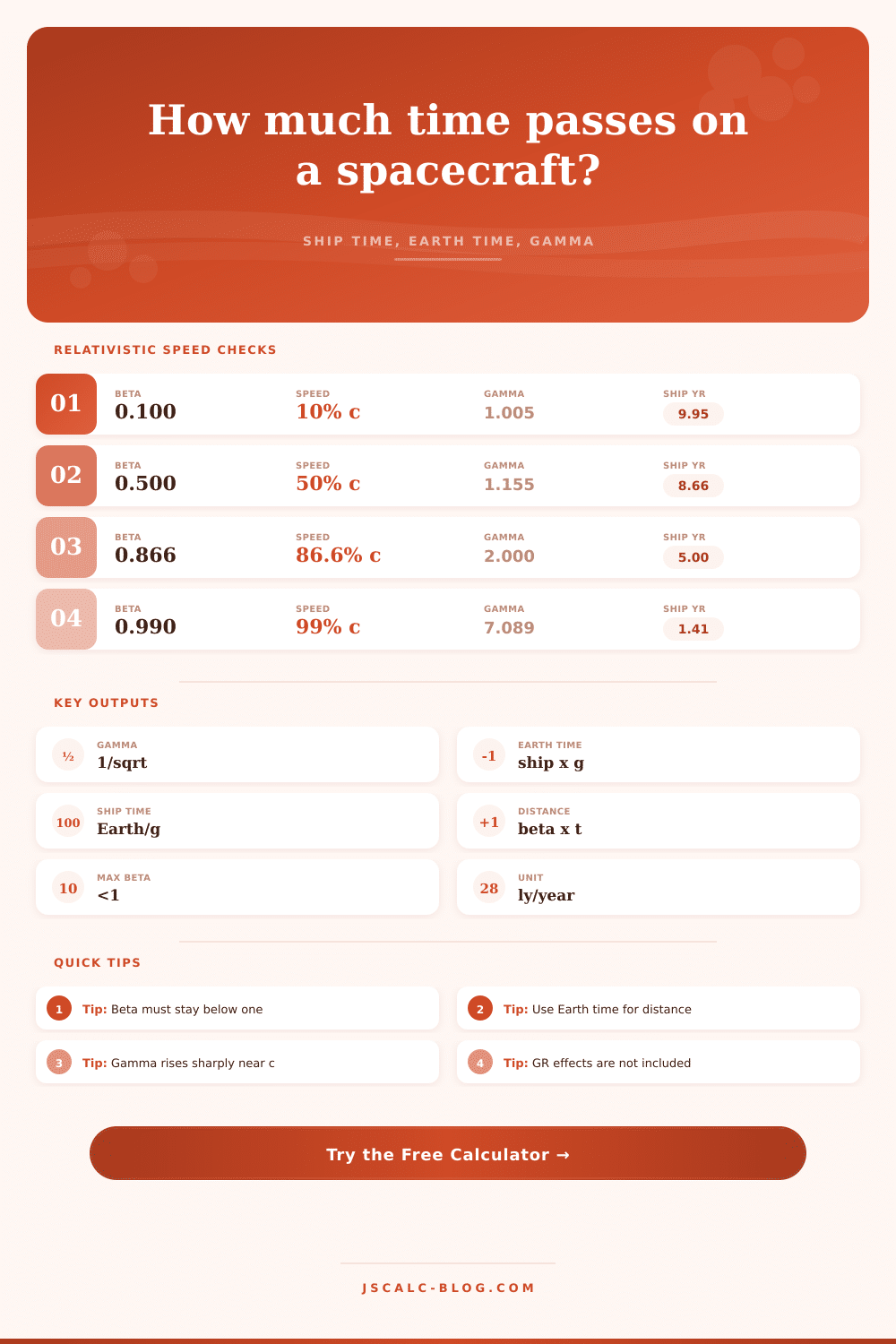
Only when you start approaching a substantial fraction of the speed of light does it realy get interesting. Physicists use the letter beta to show speed, your velocity divided by the speed of light. When you’re moving at ten percent of lightspeed, your gamma (also called the Lorentz factor) will be approximately equal to one. Time shifts so little that you and your friends at home experiences time almost exactly the same way.
Bump up to fifty percent of the speed of light, and now gamma increase to around one point one five. To the crew, ten years are experienced as eight and a half. It is notable, but far from life-altering. Then comes the steep curve, the part that makes all the difference: at eighty-six percent of the speed of light, gamma reaches two. You’ll experience time going at exactly half the rate you do on Earth. That’s a pretty dramatic pivot and the calculator makes it clear.
As speed increases, time dilation also increase. Tiny increments in speed result in huge leaps forward in time dilation. That non-linearity is what makes special relativity counterintuitive. Adding speed doesn’t add time linearly. The math runs out on you.
The tricky part is deciding which frame of reference you are using. When you enter the distance to a star like Proxima Centauri, it will calculate how long that journey would take from Earth. Less time passes for the crew. When you enter the crew’s subjective experience, it will tell you how much time has passed on Earth. That’s important when it comes to planning a mission. You may wish for the astronauts to have as short a trip as possible but at the same time, you don’t want to outlive all your friends and family.
The tool outputs the difference in aging between the two timeframes. How much more or less old you’ll be than your home timeline. To get this figure, it subtracts one timeframe from the other. In this case, the years that you’ve lost compared to your home timeline. This is laid out on the page’s reference table, which gives you common situations and shows you what the tradeoffs are going into calculating it.
In the case of a trip to the galactic center at 99% lightspeed, your gamma will shoot above seven. The crew ages only a fraction of the Earth years passing. And the distance traveled in the Earth frame follow simple kinematics. However, because length contraction is the flip side of time dilation, the travelers perceive the distance as contracted. It’s smaller than the distance they cover based off the Earth frame.
The calculator simplifies the equation by focusing solely on the time aspect. Time is usually what matters most to human traveler. The catch here is that this is based off the assumption of a constant speed cruise. Interstellar travel has an acceleration and deceleration phase which adds a lot more complexity. There’s gravity too, particularly if massive bodies are nearby. General relativity comes into play there.
This removes all those variables so we can focus solely on the pure kinematic effect of velocity. It is a sort of clean baseline. Surprisingly, it works remarkably well for getting a ballpark idea of what interstellar travel would cost in biological time.
The bottom line is that speed isn’t just about how fast you go. It is about how far from home you are willing to be. By pushing the beta up to nearly 1, you are no longer traveling through space. You are in fact skipping forward in time, leaving your current moment in the dust.