Lorentz Factor Calculator
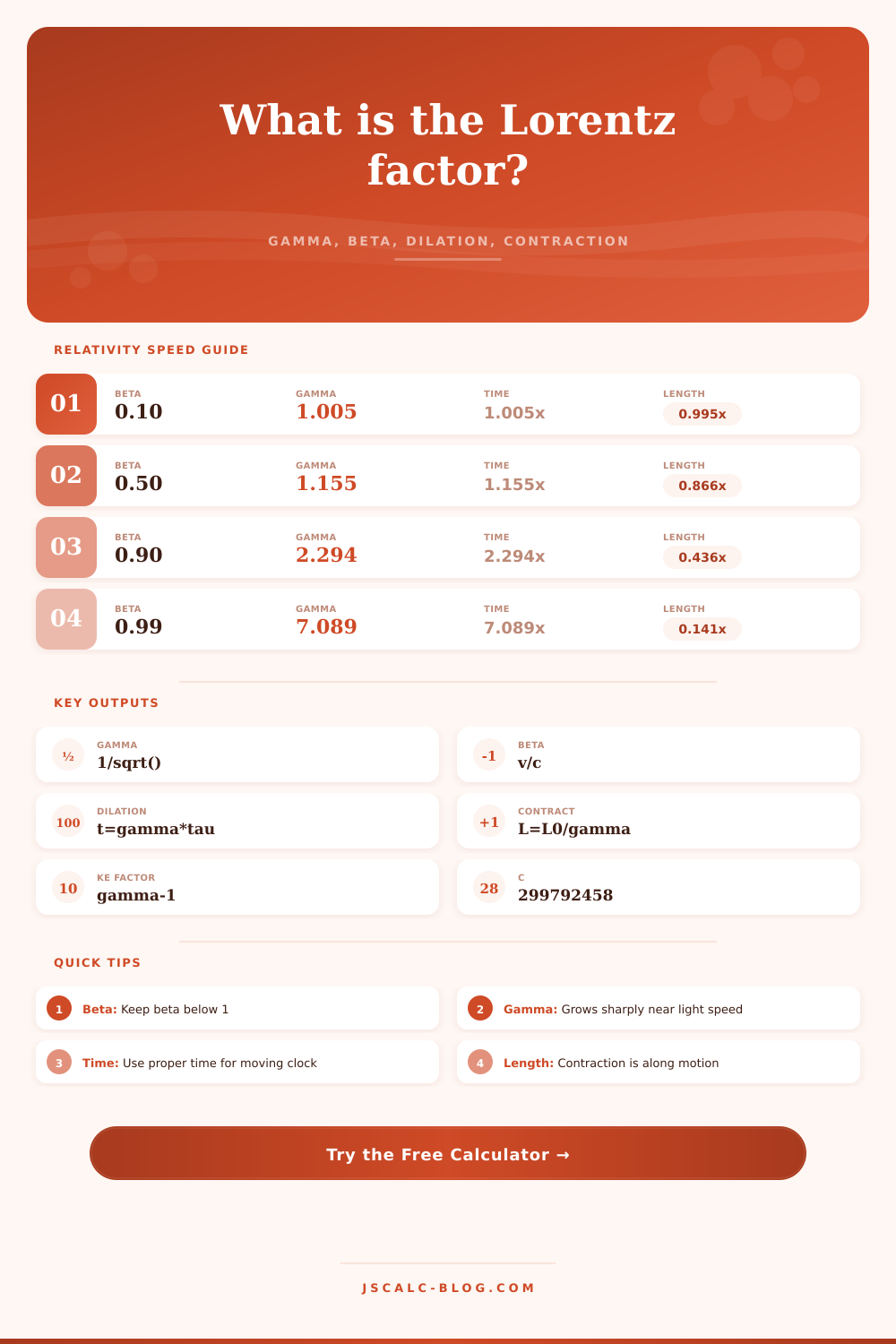
Convert a velocity into beta and the Lorentz factor gamma, then calculate time dilation, length contraction, and the kinetic-energy factor gamma minus one.
🎯Real Relativity Presets
⚙Calculator Inputs
🔢Current Relativistic Snapshot
📐Formula Breakdown
⚖Comparison Grid
🚀Preset Speed Reference
| Preset | Speed Used | Beta | Gamma | Gamma - 1 | Typical Relativity Read |
|---|---|---|---|---|---|
| Voyager 1 cruise | 17 km/s | 0.0000567 | 1.000000002 | 1.61e-9 | Relativistic correction is tiny for mission timing. |
| GPS satellite | 3.874 km/s | 0.0000129 | 1.00000000008 | 8.35e-11 | Special relativity is small but important with gravity corrections. |
| ISS orbit | 7.66 km/s | 0.0000256 | 1.00000000033 | 3.27e-10 | Clock-rate shift is measurable with precise clocks. |
| Earth around Sun | 29.78 km/s | 0.0000993 | 1.00000000494 | 4.94e-9 | Planetary speeds remain deep in the low-beta limit. |
| Parker Solar Probe | 191 km/s | 0.000637 | 1.000000203 | 2.03e-7 | Fast spacecraft, still far below particle-physics gamma. |
| 100 keV electron | 0.548c | 0.548 | 1.1957 | 0.1957 | Relativistic mass-energy effects matter in beam optics. |
| Fast cosmic muon | 0.994c | 0.994 | 9.142 | 8.142 | Lab lifetime is stretched enough for atmospheric muons. |
| 1 GeV proton | 0.875c | 0.875 | 2.066 | 1.066 | Kinetic energy is about one rest-energy unit. |
| LHC proton beam | 0.999999991c | 0.999999991 | 7453.6 | 7452.6 | Extreme collider gamma with strong length contraction. |
📊Beta, Gamma, Time, and Length Table
| Beta v/c | Gamma | Time Dilation t / tau | Contracted Length L / L0 | Kinetic Factor gamma - 1 |
|---|---|---|---|---|
| 0.01 | 1.00005 | 1.00005x | 0.99995 | 0.00005 |
| 0.10 | 1.00504 | 1.00504x | 0.99499 | 0.00504 |
| 0.50 | 1.15470 | 1.15470x | 0.86603 | 0.15470 |
| 0.90 | 2.29416 | 2.29416x | 0.43589 | 1.29416 |
| 0.99 | 7.08881 | 7.08881x | 0.14107 | 6.08881 |
| 0.999 | 22.36627 | 22.36627x | 0.04471 | 21.36627 |
| 0.9999 | 70.71245 | 70.71245x | 0.01414 | 69.71245 |
🔬Particle Rest-Energy Reference
| Object | Rest Energy | Typical Fast-Beta Example | Why Gamma Matters |
|---|---|---|---|
| Electron | 0.511 MeV | 100 keV electron, beta about 0.548 | Beam speed cannot be estimated accurately with classical formulas. |
| Muon | 105.7 MeV | Atmospheric muons near 0.994c | Time dilation explains longer lab-frame survival. |
| Proton | 938.3 MeV | 1 GeV kinetic proton, beta about 0.875 | Gamma links kinetic energy to rest energy. |
| Lead ion | large nucleus | Collider beams near c | Lorentz contraction affects electromagnetic fields. |
| Spacecraft | macroscopic | Parker Solar Probe, 191 km/s | Gamma is close to 1 even at record spacecraft speeds. |
| Neutrino | very small | Nearly c in flight | Beta can be extremely close to 1 while mass remains nonzero. |
🧭Speed Unit Conversion Reference
| Input Unit | Conversion to beta | Light-Speed Value | Best Use |
|---|---|---|---|
| Fraction of c | beta = entered value | 1 | Particle physics, textbooks, relativistic examples |
| Percent of c | beta = percent / 100 | 100% | Readable near-light-speed examples |
| m/s | beta = v / 299,792,458 | 299,792,458 m/s | Laboratory speeds and precision instruments |
| km/s | beta = v / 299,792.458 | 299,792.458 km/s | Spacecraft and orbital mechanics speeds |
| mph | beta = mph / 670,616,629 | about 670.6 million mph | Aerospace comparisons in US customary units |
💡Lorentz Calculator Tips
As things approach speed of light, they do two things: They get really, really heavy, and they experience a warped universe called the Lorentz factor. That’s the thing describing changes in space and time near the speed of light. For someone approaching the speed of light, their own clock tick normally. But from the perspective of someone standing still, it seems like their clock slows down. And this isn’t because something is wrong with the clock; it’s because of special relativity.
The math is here on the calculator, but what does all this mean? Well, you’ll have to see the world different than before. You plug in a speed. The system calculates the ratio between that speed and c, which is called beta (your speed divided by the speed of light). Because normal speeds is very small in comparison to the speed of light, beta is also very small and the Lorentz factor (or gamma) remain nearly equal to 1. That’s why when we’re commuting to work, you don’t perceive time slowing down; the effect is too slight for us to observe.
How Time and Space Change at High Speeds
As beta gets closer and closer to.9 however, gamma increases rapidy. The relationship isn’t linear. Small changes in speed towards the cosmic limit cause large jumps in gamma. It’s here the physics realy comes into play. These are called length contraction and time dilation. Together they is displayed in the calculator.
You enter an interval of proper time: how much time passes according to your clock as it moves along with you. The calculator multiplies that by gamma, which represents the time experienced by observers back home. When you travel at ninety percent of the speed of light, the gamma factor is about two point three. For someone waiting on Earth, a one-hour lunch aboard the spaceship will last two hours and eighteen minutes. Time slows down because people traveling experience less time then those sitting still. That’s why, in terms of aging, they get ahead of those who remain behind.
The reverse is true for length contraction. Along the direction that something travels, objects shrinks. You put in the proper length and the calculator spits out how short they gets. A long spaceship traveling fast enough will appear squashed from the outside. It is not because it’s being squeezed, but because that’s just how spacetime works. The dimension changes as beta approaches one, as shown in the reference table on this page.
Another important product is kinetic energy. Here’s where classical mechanics fails. The usual formula of one half mass times velocity squared doesn’t cut it. What you get is something called relativistic kinetic energy, and that is given by gamma minus one, the relativistic kinetic energy factor. At slow velocities, the factor is incredibly close to one. At high speeds, however, it becomes unbounded.
That’s what causes particle accelerators such as the Large Hadron Collider to consume massive amounts of power. As protons accelerate, their momentum rises, meaning it takes more and more energy to make them go just a bit faster. You can see how this ramps up quickly on the calculator.
One pitfall is confusing frames of reference. You need to get proper time from the moving thing. You measure proper length in the rest frame of the thing whose length is being measured. Otherwise, you’ll get it wrong. Clearly labeling what goes into each part of the tool prevents that mistake. And it does unit conversions for you, so you can enter things like miles per hour and kilometers per second and not mess up your calculations. It saves you from having to divide everything by c.
The uses of this range from practical to wild. Relativity effects has a small but crucial role for GPS satellites. If they didn’t correct for general and special relativity, the navigation data would slowly drift away, accumulating up to kilometers per day. At the other end of the spectrum, there are cosmic muons. They don’t last very long, but because they move so fast they get to spend more time in our world before decaying. Exactly how much longer? The calculator is happy to demonstrate.
Gamma makes you think differently about speed. Speed isn’t just a ratio of distance to time. Speed is a ratio of distance to time that describes how deeply you are interacting with spacetime. The closer you get to the speed of light, the more you interact with it. Your clock also ticks slower in comparison to everything else.
That’s some abstract stuff. But the calculator takes this and gives you concrete numbers. You change the inputs and instantly see what happens. Theory becomes practical understanding.
Speed isn’t limited by the speed of light; it’s defined by it. Energy and momentum are related through the Lorentz factor, which relates time as well. Everything from understanding the universe to building a particle accelerator depends on this number. All of it hinges on the relationship between light and your own velocity. For the spaceship with the clock ticking, the rest of the universe is moving at a different pace.