Relativistic Mass Calculator
Calculate Lorentz factor, historical relativistic mass, total energy, kinetic energy, and momentum from rest mass and speed. Modern physics treats invariant rest mass as the standard mass convention; this calculator reports historical relativistic mass for comparison.
🎯Relativistic Presets
⚙Inputs
🔢Current Relativity Snapshot
🧭Comparison Grid
📐Formula Breakdown
⚛Constants and Unit Reference
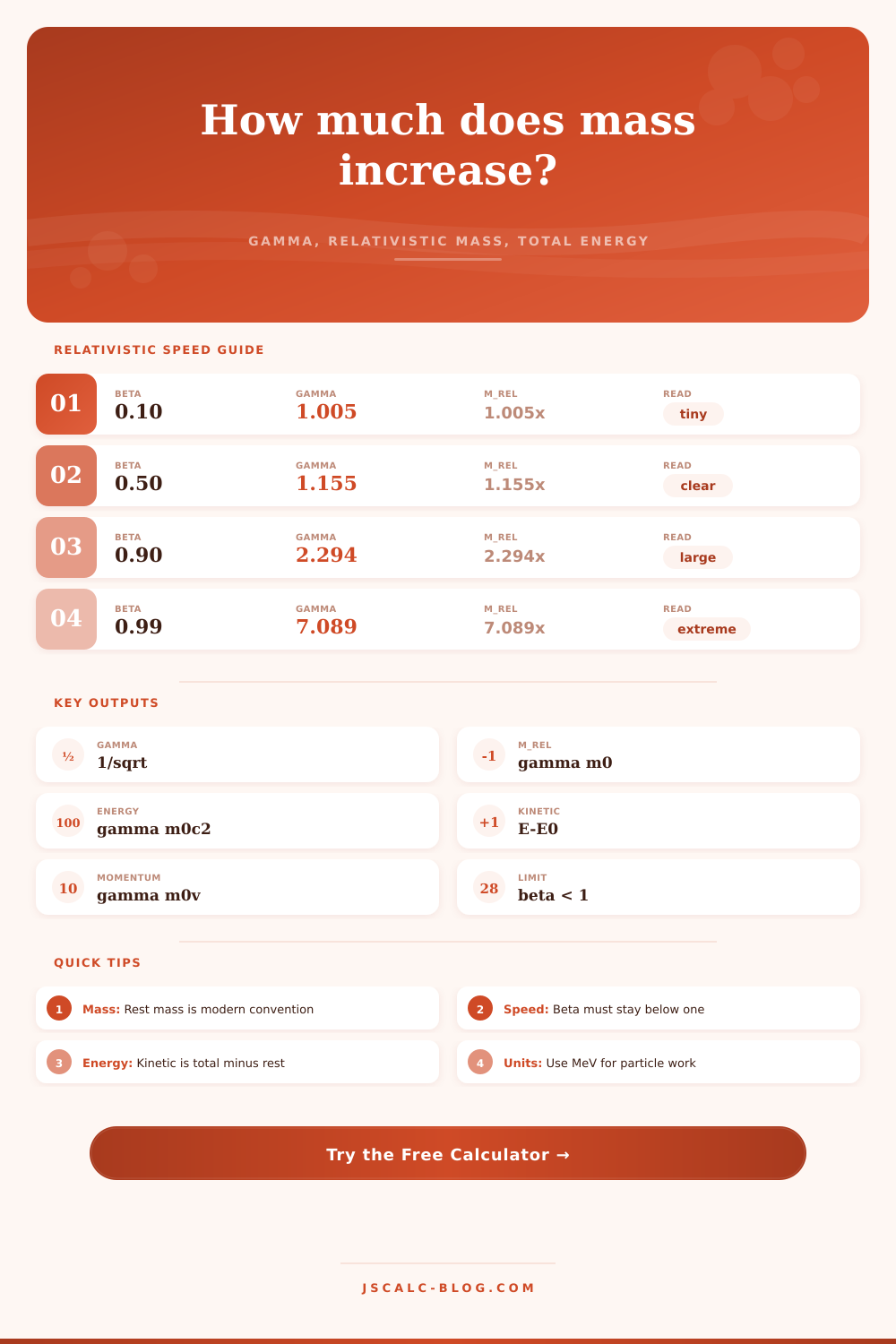
📊Gamma by Speed Reference
| Speed beta | Percent of c | Gamma | m_rel / m0 | Kinetic / Rest Energy |
|---|---|---|---|---|
| 0.01 | 1% | 1.00005 | 1.00005x | 0.00005x |
| 0.10 | 10% | 1.00504 | 1.00504x | 0.00504x |
| 0.50 | 50% | 1.15470 | 1.15470x | 0.15470x |
| 0.90 | 90% | 2.29416 | 2.29416x | 1.29416x |
| 0.99 | 99% | 7.08881 | 7.08881x | 6.08881x |
| 0.999 | 99.9% | 22.3663 | 22.3663x | 21.3663x |
| 0.999999 | 99.9999% | 707.107 | 707.107x | 706.107x |
🔬Common Rest Mass Values
| Particle or object | Rest mass | Energy unit form | kg equivalent | Typical calculator use |
|---|---|---|---|---|
| Electron | 0.51099895 MeV/c^2 | 0.000510999 GeV/c^2 | 9.109e-31 kg | Electron beams and beta examples |
| Muon | 105.658 MeV/c^2 | 0.105658 GeV/c^2 | 1.884e-28 kg | Atmospheric lifetime dilation checks |
| Proton | 938.272 MeV/c^2 | 0.938272 GeV/c^2 | 1.673e-27 kg | Cosmic rays and accelerators |
| Neutron | 939.565 MeV/c^2 | 0.939565 GeV/c^2 | 1.675e-27 kg | Nuclear particle comparisons |
| Alpha particle | 3727.38 MeV/c^2 | 3.72738 GeV/c^2 | 6.645e-27 kg | Ion beam examples |
| 1 atomic mass unit | 931.494 MeV/c^2 | 0.931494 GeV/c^2 | 1.661e-27 kg | Nucleus mass conversion |
🚀Velocity Landmark Table
| Scenario | Approx speed | Beta | Gamma | Relativistic effect |
|---|---|---|---|---|
| International Space Station | 7.66 km/s | 0.0000256 | 1.0000000003 | Too small for most mass readouts |
| Voyager 1 heliocentric | 17 km/s | 0.0000567 | 1.0000000016 | Detectable only with high precision |
| 0.1c probe concept | 29,979 km/s | 0.1000 | 1.00504 | About 0.5% mass factor increase |
| 0.5c teaching probe | 149,896 km/s | 0.5000 | 1.15470 | Relativistic terms are clearly visible |
| 0.9c particle beam | 269,813 km/s | 0.9000 | 2.29416 | Total energy more than doubles rest energy |
| 99.999999% c proton | 299,792 km/s | 0.99999999 | 7071.07 | Accelerator-scale gamma |
🧮Preset Comparison Table
| Preset | Rest mass input | Speed or kinetic input | Expected gamma | Best reading |
|---|---|---|---|---|
| Electron at 0.90c | 0.51099895 MeV/c^2 | 0.90 beta | 2.294 | Classic high-speed electron example |
| LHC proton | 0.938272 GeV/c^2 | 6500 GeV kinetic | about 6929 | Huge energy, beta extremely close to c |
| Atmospheric muon | 105.658 MeV/c^2 | 0.998 beta | 15.82 | Pairs naturally with time dilation |
| Alpha beam | 4.001506 u | 0.05 beta | 1.001 | Low relativistic correction |
| Cosmic ray proton | 0.938272 GeV/c^2 | 1000000 GeV kinetic | about 1.07e6 | Energy dominates rest mass |
| ISS speed | 419725 kg | 7.66 km/s | about 1 | Mass factor is negligible |
| Voyager 1 | 722 kg | 17 km/s | about 1 | Useful scale contrast |
| Linac electron | 0.51099895 MeV/c^2 | 50 MeV kinetic | 98.85 | Particle unit mode example |
| 0.5c probe | 1000 kg | 0.5 beta | 1.155 | Macroscopic hypothetical example |
💡Relativistic Mass Tips
First of all, if you’ve heard anything about this topic, you’re likely aware that nothing can travel faster then light. Light speed is the cosmic speed limit. But there’s less of a hard wall here, and more of a steepening hill. When you try pushing something faster and faster it doesn’t merely become slightly more difficult to do; it becomes exponentially more difficult. And that’s where we introduce relativistic mass, the link connecting our common sense with how things actualy are.
Today, we like to discuss unchanging rest mass in the world of moddern physics. For example, if I take an electron and put it in a particle accelerator and make it go very fast, its mass will remain at 0.511 MeV/c squared. No matter what speed it travels at, that mass remain constant. Historically, physicists used the term relativistic mass, which does increases with velocity. To make this work out mathematically, the calculator use both conventions. You can use it to visualize the mapping between the two ways of thinking about things. That gives you a sense of why you’ll never really get up to speed of light.
What Is Relativistic Mass?
Take the Lorentz factor, which is also called gamma. It’s the magical number that determines what your apparent mass/momentum/energy are from someone else’s perspective, compared with what it was at rest. For all practical purposes, when we’re moving around at normal speeds, value of gamma is one. Drive a car? Fly a plane? Nothing weird happens. You haven’t crossed the threshold into relativistic weirdness yet. Cross the limit of ten percent light speed, however, and you start seeing some bending of the curve. At nine-tenths the speed of light, gamma are greater than two. Now you’ve got yourself an object that has more than double its rest mass as kinetic energy.
And the inputs matter. What are the proper units? Generally you know this, MeV/c squared if it’s a particle; kilograms if it’s a macroscopic object. The speed can be expressed as a percentage, a fraction of c, or even as an amount of kinetic energy. Entering the kinetic energy in directly will reverse the calculation and determine the corresponding speed. This comes in quite handy if you’re using data from accelerators, where energy is typically the thing being measured. In other words, how fast would something have to travel to have that much energy?
But here’s something people often get wrong. Mass doesn’t convert into energy. Instead, mass is energy. The familiar c squared term tell us how they’re connected.
What happens when we accelerate a proton in the Large Hadron Collider to a speed factor of close to seven thousand? Does the proton gain more mass in its own frame? No, it doesn’t. From our perspective in the laboratory, it appear to have enormous inertia. Huge magnetic fields is needed to confine it to a circle. This is what the figures on the screen mean in practice.
These crazy numbers take on meaning when you look at the reference tables that come with the tool. Cosmic ray protons and the International Space Station makes good comparison points. One is almost entirely dominated by energy. The other has hardly any relativistic effect. And as you go through it, you realize how nonlinear the universe is. Seeing the jump from a gamma of 1.0000000003 to over a million highlight how nonlinear the universe is.
One more thing is difference between kinetic energy and total energy. The total energy of a particle is enormous (even at rest) because it contains its rest mass energy. Anything beyond that is kinetic. This is one reason why experiments in high-energy physics is designed as they are. You build detectors that will detect the part that deviates from rest state. Understanding this division helps you make sense of your output cards.
Why does this matter based off simple academic interest? Because the universe follow these rules. GPS satellites has to take into account mass dilation, which has a cousin called time dilation, to accurately position you. If they didn’t correct it, you’d be off by kilometers each day. It’s not theoretical math. It’s infrastructure.
In the end, this business with relativistic mass serve to remind us: Time isn’t a stage. Neither is space. It’s all in motion. And they play a part. When you move toward the speed of light, the “resistance” you experience is actualy the universe pushing back on you. The numbers come from the calculator above, but the story is simply how things are. And it happens to be true that you have to get heavy if you want to go fast (just part of the price of admission). You should of known that.