Length Contraction Calculator
Calculate relativistic length contraction from proper length and speed, with beta, Lorentz gamma, contraction percent, and travel-frame context in the direction of motion.
| Speed | Beta | Gamma | L / L0 | Contraction |
|---|---|---|---|---|
| 0.01c | 0.010 | 1.00005 | 99.995% | 0.005% |
| 0.10c | 0.100 | 1.00504 | 99.499% | 0.501% |
| 0.50c | 0.500 | 1.15470 | 86.603% | 13.397% |
| 0.80c | 0.800 | 1.66667 | 60.000% | 40.000% |
| 0.90c | 0.900 | 2.29416 | 43.589% | 56.411% |
| 0.99c | 0.990 | 7.08881 | 14.107% | 85.893% |
| 0.999c | 0.999 | 22.36627 | 4.471% | 95.529% |
| 0.9999c | 0.9999 | 70.71245 | 1.414% | 98.586% |
| Scenario | Approx speed | Beta | Gamma | Contraction note |
|---|---|---|---|---|
| International Space Station | 7.66 km/s | 0.0000256 | 1.0000000003 | tiny but calculable |
| GPS satellite | 3.87 km/s | 0.0000129 | 1.00000000008 | negligible length change |
| Parker Solar Probe peak | 190 km/s | 0.000634 | 1.000000201 | millimeter-scale per km |
| Voyager 1 heliocentric cruise | 17 km/s | 0.0000567 | 1.0000000016 | very small |
| Breakthrough Starshot target | 0.2c | 0.200 | 1.02062 | about 2.0% shorter |
| LHC proton beam | 0.999999991c | near 1 | about 7,454 | extreme particle frame |
| Unit | Internal conversion | Typical use | Calculator handling |
|---|---|---|---|
| meter | 1 m | objects, tracks | base length unit |
| kilometer | 1,000 m | orbits, routes | converted to meters |
| mile | 1,609.344 m | long routes | converted to meters |
| light-year | 9.4607e15 m | stellar distances | kept as proper distance |
| fraction c | v = beta c | relativity examples | beta used directly |
| percent c | beta = percent / 100 | near-light speeds | must be below 100% |
| Quantity | Formula | Meaning | Frame note |
|---|---|---|---|
| Beta | β = v / c | speed as a fraction of light speed | same relative speed for both frames |
| Gamma | γ = 1 / sqrt(1 - β²) | Lorentz factor | starts at 1 and grows near c |
| Contracted length | L = L0 / γ | moving length along travel direction | only seen from the other inertial frame |
| Contraction percent | (1 - L/L0) x 100 | fractional shortening of L0 | zero when v = 0 |
| Travel context | route length = L0 / γ | traveler sees the external route shortened | proper time pairs with shortened route |
imagine that there’s a train travelling at normal speeds. Imagine that when it’s stationary its carriages is as long as we’d expect them to be. Now imagine that you start pushing the train ever closer to the speed of light. As you increase the train’s speed, the carriages will shorten. But it is not because they crumple up. It is not because they collapse. They get shorter in the direction they’re travelling. That is what we call length contraction. And it happens because of special relativity.
Special relativity challenge your daily intuition. Space and time aren’t rigid. That vague idea becomes some solid numbers through the tool.
How Length Changes at High Speeds
First off, set the correct length. That’s what it measures when it’s standing still. What’s its real size? Before any relativity go on? It could be the length of the particle beam, or the ship passing through, or the length of tunnel. Enter it in light years, in meters, in kilometers. But here’s the catch: It’s the length in the frame where it’s not moving. If you’re figuring out how small a starship looks from Earth, then the starship’s own rest length is the one you want to use.
Then you enter in velocity. Here’s where it becomes an interesting calculation. The calculator accept any unit, including fractions of the speed of light or even meters per second. All the physics really cares about is how fast you’re going relative to the speed of light. This is referred to as beta by physicists, which stand for the ratio of your velocity to the speed of light. Since it’s a ratio, beta is dimensionless (a number ranging from zero to one). So if you move at ten percent of the speed of light, that means beta equals zero point one.
That tiny number doesn’t seem like much and the contraction won’t be very noticeable. But beta isn’t linear. As you approach one, the effects start becoming increasingly dramatic.
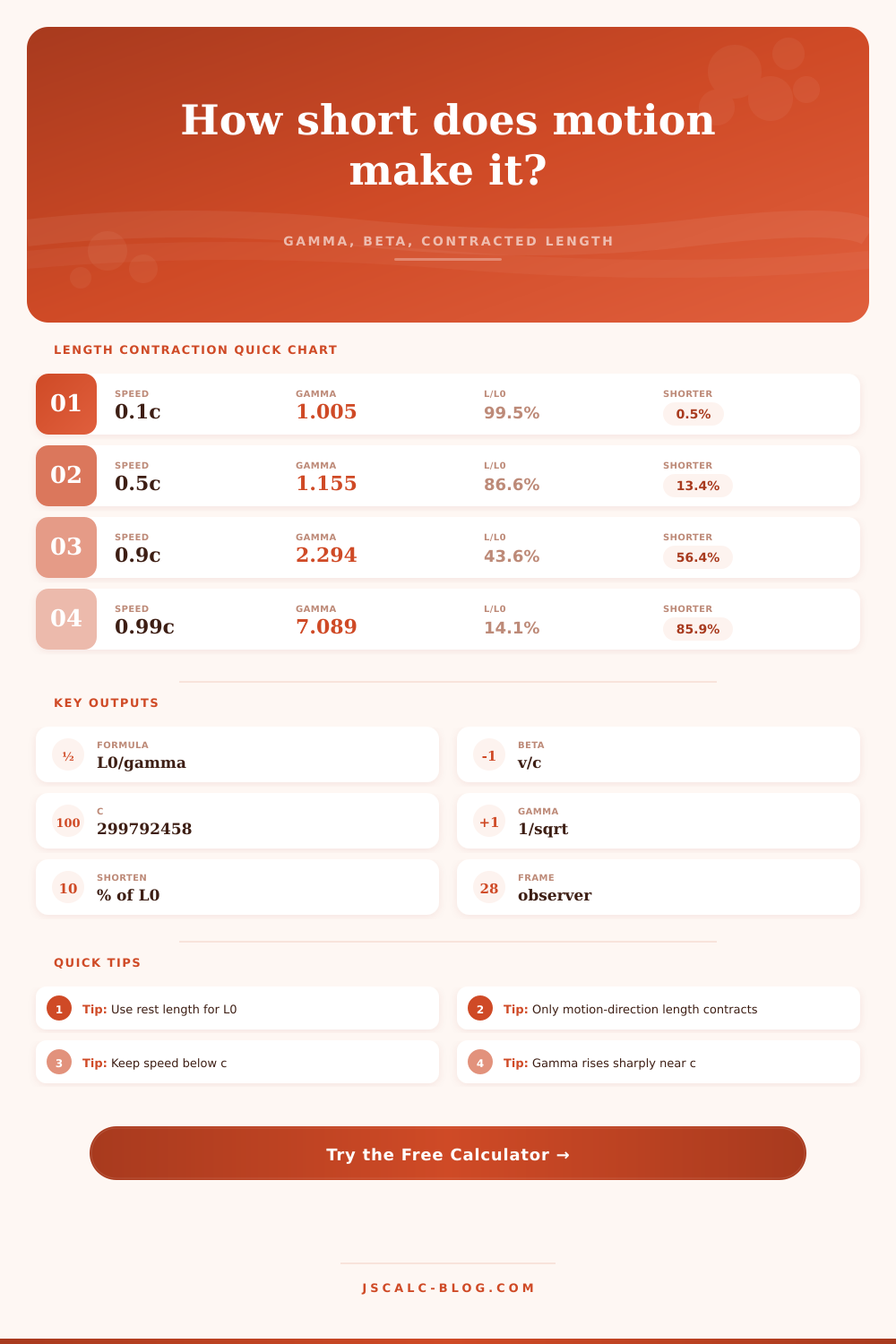
Which brings us back to the Lorentz factor: Gamma. It is the number that is the math behind it all. When you are standing still, gamma equals one. As you begin moving, the value increase gradually. But the closer you get to the speed of light, gamma takes off. As gamma gets higher, it cut down your proper length even more. This makes you appear contracted. How much does it cut? As fast as you travel, the bigger the number the divisor (the top number) is, the less the answer will be. So the chart of references show how quickly gamma rises.
At half the speed of light, there isn’t much change. The object hasn’t changed significanty. But at ninety-nine percent of light speed, the object shrink to about fourteen percent of what it used to be. It is a huge change with only a slight rise in speed.
This means it contracts, but only in the direction it’s traveling. Width and height are unaffected. If a speeding ball were to pass by, it would turn into an ellipsoid. It is flattened on its axis of motion. This directional aspect is key to understanding what is going on here. The universe isn’t going to shrink around you from every side. It’s going to shrink out in front of you.
That’s where the calculator fits in, too, helping connect the dots from ideas to real-world use. Want to figure out how long it takes cosmic muon to reach us here on Earth? Done. Wonder what an interstellar trip would look like? Also done. The variables stay the same. It’s why they provide a set of presets that let you dive right into familiar situations like particle accelerators or the International Space Station. Get a sense for just how small the effect is at our scale versus extreme physics.
This means you have to release your notions about space as a static stage for action. Space is dynamic; it respond to motion. And those figures you calculate aren’t merely mathematical ideas. They’re a reflection of one of the most profound changes possible: that when moving fast enough, different observers experience different measures of reality. When you know that space can stretch or squeeze based off your velocity, then the equations don’t seem so arbitrary. They become a guidebook to the universe’s true nature at higher speeds. You should of checked it sooner.