Gravitational Time Dilation Calculator
Calculate the local clock factor near a mass, convert local elapsed time to far-away coordinate time, and compare two radii with Schwarzschild-radius checks.
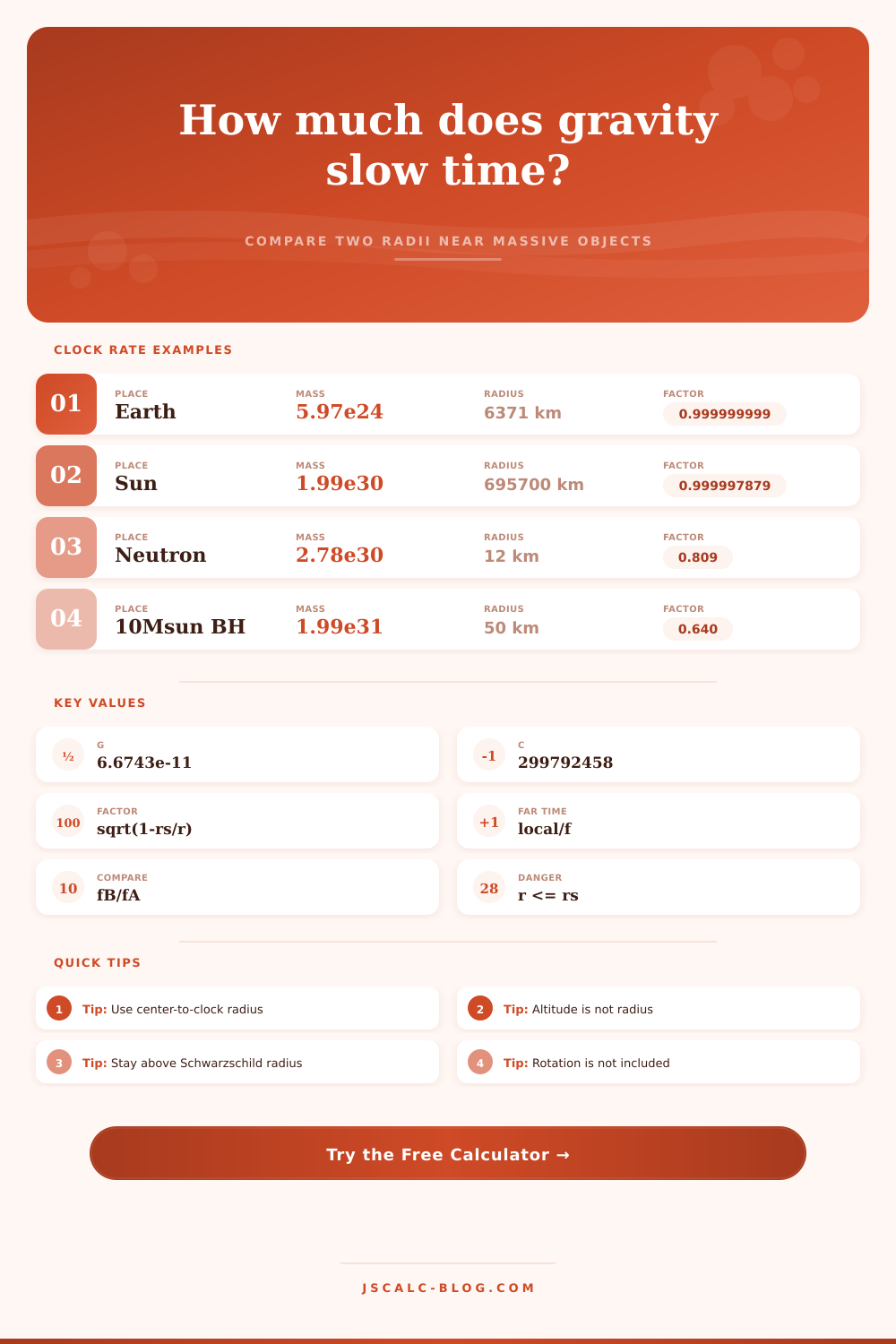
Local clock factor: f(r) = sqrt(1 - 2GM/(r*c^2)). The radius r must be the center-to-clock distance in meters.
Far-away time: far time = local time / factor. A clock far from the mass accumulates more time than a lower clock at radius A.
Two-radius comparison: t_B = t_far * f_B, so B - A = t_B - t_local. The rate ratio is f_B / f_A.
Warning boundary: r_s = 2GM / c^2. If either radius is at or below r_s, the Schwarzschild exterior clock factor is not real.
| Object | Mass (kg) | Reference radius | Schwarzschild radius | Surface factor |
|---|---|---|---|---|
| Earth | 5.97219e24 | 6,371 km | 8.87 mm | 0.999999999304 |
| Moon | 7.342e22 | 1,737.4 km | 0.109 mm | 0.999999999969 |
| Mars | 6.4171e23 | 3,389.5 km | 0.953 mm | 0.999999999859 |
| Jupiter | 1.89813e27 | 69,911 km | 2.82 m | 0.999999979830 |
| Sun | 1.9885e30 | 695,700 km | 2.95 km | 0.999997877 |
| 1.4 solar-mass neutron star | 2.7839e30 | 12 km | 4.13 km | 0.809 |
| Radius as multiple of r_s | Clock factor | Far time for 1 local day | Far clock gain | Use note |
|---|---|---|---|---|
| 100 r_s | 0.994987 | 1.00504 days | 7.27 minutes | Weak compact-field check |
| 20 r_s | 0.974679 | 1.02598 days | 37.4 minutes | Common distant black-hole example |
| 10 r_s | 0.948683 | 1.05409 days | 77.9 minutes | Strong but outside horizon |
| 3 r_s | 0.816497 | 1.22474 days | 5.39 hours | Very strong field |
| 1.5 r_s | 0.577350 | 1.73205 days | 17.6 hours | Near-horizon caution |
| 1.01 r_s | 0.099504 | 10.0499 days | 9.05 days | Extremely close to boundary |
| Clock location | Center radius | Factor | Gain vs sea level per day | Typical interpretation |
|---|---|---|---|---|
| Sea level model | 6,371 km | 0.999999999304 | 0 | Baseline in this table |
| Everest summit | 6,379.848 km | 0.999999999305 | About 0.09 ns | Higher clock runs slightly faster |
| ISS orbit radius | 6,779 km | 0.999999999346 | About 3.6 ns | Gravity term only |
| GPS orbit radius | 26,560 km | 0.999999999833 | About 45.7 microseconds | Gravity term in GPS timing |
| Geostationary radius | 42,164 km | 0.999999999895 | About 51.0 microseconds | Higher orbit, weaker gravity |
| Far-away clock | Very large | Near 1 | About 60.1 microseconds | Coordinate-time limit |
Factors are extremely close to 1, so differences usually appear in nanoseconds or microseconds per day.
Higher radius means weaker gravity, so a satellite clock gains time relative to a lower static clock.
White dwarfs and neutron stars can show measurable seconds or hours over long local intervals.
Near the Schwarzschild radius, the factor approaches zero and the far-time conversion grows rapidly.
This isn’t the usual twin paradox that always grabs the headlines… The version involving gravity is actualy the one that keeps your phone working. Instead this is a more practical version of the same thing: Your phone wouldn’t work without it. After all, you probably believe that time move at the exact same rate everywhere. But it doesn’t.
The more massive an object is, the greater its gravity and the more it distorts space and time. This means clocks runs slower when they’re nearer to gravity. That’s not so noticeable here on Earth, but it can be really dramatic around a black hole. The Schwarzschild factor are accounted for by the calculator above, which also reads those equations as the amount of time elapsed from one point to another within a gravitational field.
How Gravity Changes Time
The biggest misconception is that height equals radius (gravity is based off distance from the center of mass, not height off the ground). It turns out that when you’re standing on top of Mount Everest, you’re actualy further from the center of Earth than if you were standing at sea level, which means your clock runs fast because the gravitational force is smaller. It sounds like a small amount, but it adds up. GPS satellites has to factor in how orbiting slows time down and how being far from the center of the earth speeds it up. The engineers need to get this just right to ensure that your navigation app can work in minutes.
In the reference table, you can also see how planets is different than stars. The time dilation factor is almost exactly equal to one for Earth, where weak gravity barely slows time down. But get close to a neutron star, which packs solar masses into a city-sized sphere, and the math gets crazy. Their incredibly strong surface gravity slow time so that a clock ticks along at just 80% the rate it does out in deep space. This means hours turn into days and days turns into years, all thanks to shape of a dense universe and not some science fiction idea.
As a side note: The Schwarzschild radius is also the point of no return for a black hole, the hard limit of this calculation. If your input radius reaches the Schwarzschild radius (or goes beneath it), the calculator will alert you, since the horizon is where outside solution to Einstein’s field equations breaks down. You cannot get a meaningful time ratio by plugging in a number within the event horizon using this static model. It’s only meant for use by observers outside the trap.
In fact, it compares local time to theoretical observer infinitely far away. This observer become the anchor for all local clocks and their coordinate time. With the presets, you can see what effect mass concentration play on the outcome. For instance, even though Jupiter is huge, the density is low, which means that the time dilation near the cloud tops isn’t too dramatic. Then compare that with a white dwarf, which is much less massive than the Sun, yet packed into an Earth-sized volume, in which case the time dilation are considerable.
The point: It’s not just about bulk; it’s also about density, and the tighter you squeeze it, the steeper the gravity well. At base of that well, time runs slow. With this calculator, you get to explore how steep that slope is for anything you want. It’s just a few equations that don’t require that you remember any constants or should of know how to take out the square root for yourself. You only really need to know what each input represents.
The first one is radius, which is distance from the center. The second is mass, which is where the force come from. The third is the ratio between coordinate time and proper time. It’s like looking through a window at the nature of reality. And the math is harsh, yet the results tells us that time can change. Time isn’t absolute. Time is intimately connected with the stuff surrounding it.