Schwarzschild Radius Calculator
Calculate event horizon radius, compressed density, light crossing time, and size comparisons from mass using the Schwarzschild solution.
Schwarzschild Results
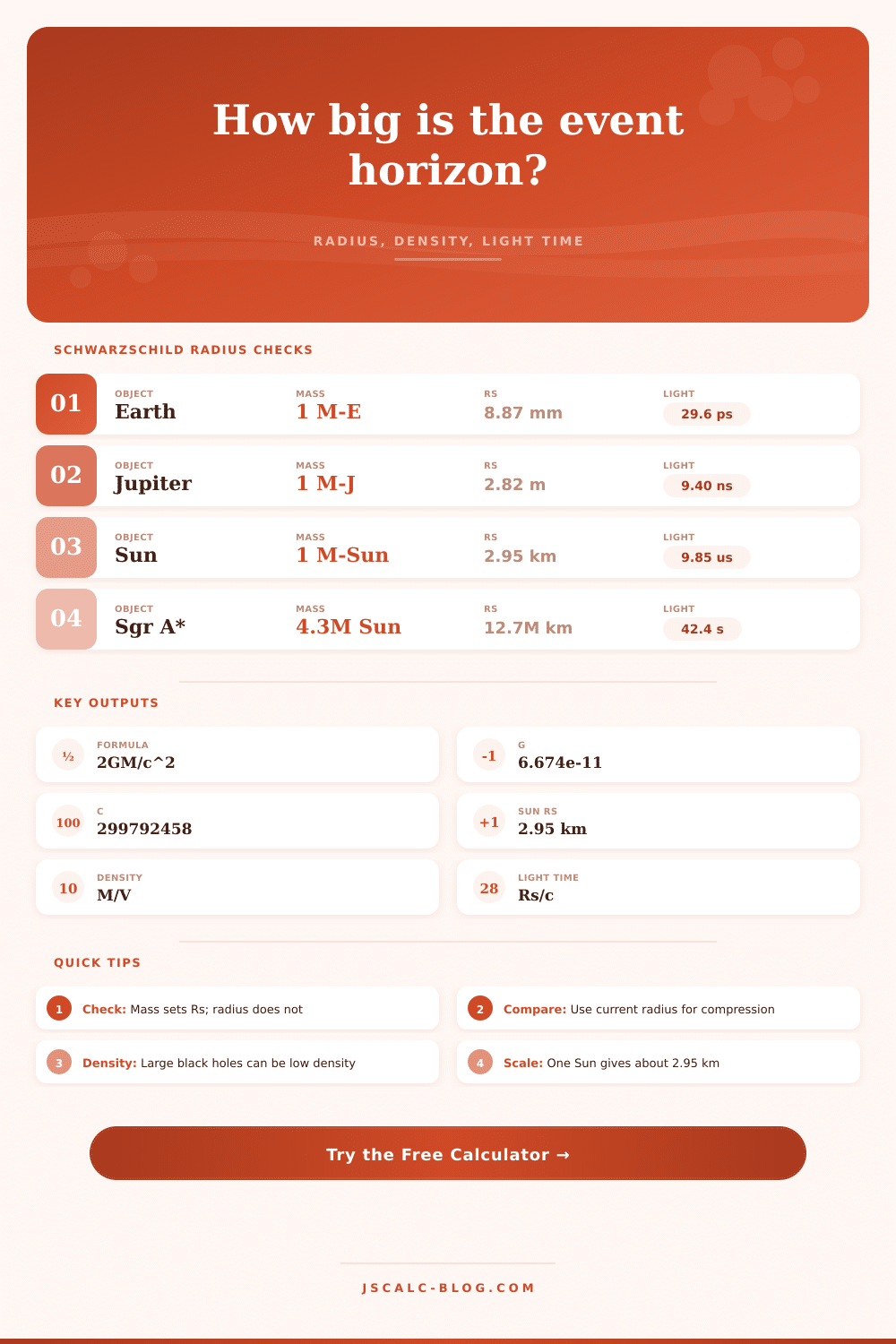
Rs = 2 × G × M / c²
- Rs is the Schwarzschild radius: the non-rotating, uncharged black hole event horizon radius.
- G = 6.67430 × 10^-11 m³ kg^-1 s^-2.
- M is object mass converted to kilograms.
- c = 299,792,458 m/s, so light crossing time for the radius is Rs / c.
- Density at Rs uses M / (4/3 × pi × Rs³), treating the event horizon as a sphere for scale comparison.
| Object | Mass Used | Schwarzschild Radius | Current Radius | Compression Ratio |
|---|---|---|---|---|
| Moon | 7.342 × 10^22 kg | 0.109 mm | 1,737 km | about 1.59 × 10^10 |
| Earth | 5.9722 × 10^24 kg | 8.87 mm | 6,371 km | about 7.18 × 10^8 |
| Jupiter | 1.89813 × 10^27 kg | 2.82 m | 69,911 km | about 2.48 × 10^7 |
| Sun | 1.98847 × 10^30 kg | 2.95 km | 695,700 km | about 235,000 |
| Sirius A | 2.063 solar masses | 6.09 km | 1.711 solar radii | about 195,000 |
| Betelgeuse | 16.5 solar masses | 48.7 km | 764 solar radii | about 10.9 million |
| Black Hole | Mass Estimate | Rs Radius | Diameter | Light Time Across Diameter |
|---|---|---|---|---|
| Cygnus X-1 | 21.2 solar masses | 62.6 km | 125 km | 0.000418 s |
| Sagittarius A* | 4.297 million solar masses | 12.7 million km | 25.4 million km | 84.7 s |
| M87* | 6.5 billion solar masses | 19.2 billion km | 38.4 billion km | 35.6 hours |
| TON 618 | 40.7 billion solar masses | 120 billion km | 240 billion km | 9.3 days |
| Mass Unit | Kilograms | Schwarzschild Radius | Best Use |
|---|---|---|---|
| 1 kilogram | 1 kg | 1.49 × 10^-27 m | Small physics scale checks |
| 1 lunar mass | 7.342 × 10^22 kg | 0.109 mm | Moon and large satellite examples |
| 1 Earth mass | 5.9722 × 10^24 kg | 8.87 mm | Rocky planet comparisons |
| 1 Jupiter mass | 1.89813 × 10^27 kg | 2.82 m | Gas giants and exoplanets |
| 1 solar mass | 1.98847 × 10^30 kg | 2.95 km | Stars and stellar black holes |
| 1 billion solar masses | 1.98847 × 10^39 kg | 19.7 AU | Supermassive black holes |
| Object | Density at Rs | Everyday Comparison | Scale Note |
|---|---|---|---|
| Earth mass | 2.04 × 10^30 kg/m³ | Far beyond neutron star density | Tiny radius makes density enormous |
| Sun mass | 1.84 × 10^19 kg/m³ | Above nuclear density scale | Density falls as mass rises |
| 10 solar masses | 1.84 × 10^17 kg/m³ | Neutron-star-like scale | Typical stellar black hole range |
| Sagittarius A* | 9.98 × 10^5 kg/m³ | Dense but not nuclear-density | Huge radius lowers average density |
| M87* | 0.436 kg/m³ | Near ordinary gas density | Average density can look low |
| TON 618 | 0.0111 kg/m³ | Very thin air scale | Massive horizon volume dominates |
Imagine the Earth as a marble. Then imagine crushing that glass globe down to size of a sugar cube. Its mass wouldn’t change by much. It would be squished down into single point of infinite density. Gravity has it all there. This is what a black hole is; the idea of the Schwarzschild radius. And it isn’t an indicator of a black hole’s size, exactly; it’s an indication of how tiny something has to get before it traps light forever.
With this simple tool, you can plug in any object from the Moon to huge monsters at galaxy centers and get their event horizons right in front of your eyes. It’s a surprisingly simple formula. Take the gravitational constant, multiply it by mass, then divide by square of speed of light. The arithmetic on the exponent is messy but the calculator will do that for you.
What is a Black Hole?
Where it gets interesting is in knowing what the answer represents. People think that larger black holes form from larger objects and that makes sense. They think that large black hole must be more dense, too. That’s not true. In fact, the more massive the black hole, the less dense it becomes. If you have a black hole the size of the Sun, it would have a three kilometer radius. Inside that sphere, everything is incredibly dense.
But if you go to a huge black hole containing billions of solar masses, the event horizon stretches out into millions of kilometers. This happens so quickly that within that horizon, average density may be lower than water. This means you might actualy be able to float. However, as soon as you get closer to the center, that will no longer be true.
As you change mass input, note what happens to the light crossing time. That’s a subtle yet powerful measure. Light will take microseconds to cross radius for a stellar-mass black hole. For Sagittarius A*, the black hole at the center of our galaxy, it takes more than a minute. For TON 618, one of the biggest known objects, it takes almost ten days.
You see here one of the key tradeoffs in astrophysics. Mass isn’t only a matter of size. It’s a matter of how much you distort spacetime. You can use this tool to compare those timescales and get a feel for the sheer vastness that’s going on. It converts a number into a duration you can visualize.
This also applies when you want to test your intuition. Plug in mass of Jupiter and see what an enormous density results. Then try the mass of M87*. That’s about the density of air. Students is always surprised by that. Why? Because volume goes as the cube of the radius. But the radius increases linearly with the mass. So the volume increases cubically as the radius grows, while the mass only increases linearally. The mass can’t keep up with the volume; therefore the average density must decrease.
You don’t have to derive this math yourself. The calculator shows you the relation. People often get tripped up on the meaning of the radius input. They think that they can feed in normal radius of an object and discover whether or not it has become a black hole. Yes, the tool can compare radii but will show you a compression ratio. In the case of Earth, you’d have to compress it by hundreds of millions times its size. In the case of the Sun, number is larger still. At our scale, we’re nowhere near turning into black holes. Gravity trying to pull us together is far too weak compared to forces keeping us apart.
For example, there’s a whole menu of other objects you can experiment with. And then there’s the middle range: the stellar black holes, such as Cygnus X-1, which are just dense enough to compress and destroy any nearby star yet small enough to fit within a city. Then there is the supermassive ones (the truly amazing ones). These are the ones that form the anchor around which billions of stars orbit in galaxies. The tool is bridging this range, showing how the same physics works at both ends of it. From a galaxy down to a marble.
This is a look at gravity’s geometry. This calculator takes away all the dramatics of science fiction and shows you only the cold hard numbers of general relativity. To enjoy what it does, you don’t have to understand the tensor calculus behind it. All you really need to know is that matter warps space, and space has its limits: It will bend only so far before it snaps. The event horizon is that snapping point. It’s the line beyond which nothing comes back. Whatever it is, size of a galactic core or density of a star. The rule holds true: The limit is defined by mass. Nothing escapes it.
And the numbers? They speak the language of why. That little sugar cube called Earth is a good reminder of that: Gravity, unchecked, is ruthless.