Tidal Force Calculator
Estimate differential tidal acceleration, tidal force, near-side versus far-side gravity, and Roche-limit context for a stretched object near a massive primary.
✦Real Presets
⚙Inputs
Calculated Tidal Effect
📊Selected Body Specs
🧮Formula Breakdown
🌍Reference Body Table
| Attracting body | Mass (kg) | Mean radius | Mean density | Surface gravity |
|---|---|---|---|---|
| Moon | 7.342 × 10²² | 1,737 km | 3.34 g/cm³ | 1.62 m/s² |
| Sun | 1.9885 × 1030 | 695,700 km | 1.41 g/cm³ | 274 m/s² |
| Earth | 5.9722 × 1024 | 6,371 km | 5.51 g/cm³ | 9.81 m/s² |
| Mars | 6.4171 × 10²³ | 3,390 km | 3.93 g/cm³ | 3.71 m/s² |
| Jupiter | 1.8982 × 1027 | 69,911 km | 1.33 g/cm³ | 24.79 m/s² |
| Saturn | 5.6834 × 1026 | 58,232 km | 0.69 g/cm³ | 10.44 m/s² |
| 1 Solar-Mass White Dwarf | 1.9885 × 1030 | 6,400 km | 1,800,000 g/cm³ | 3.24 × 10⁶ m/s² |
| 10 Solar-Mass Black Hole | 1.9885 × 1031 | 29.5 km | 1.86 × 10¹⁰ g/cm³ | 1.53 × 10¹² m/s² |
📏Common Distance Lookup
| Scenario | Center distance | Primary | Useful length scale | Why it matters |
|---|---|---|---|---|
| Earth to Moon | 384,400 km | Earth or Moon | 1.8 m human | Classic everyday lunar tide comparison |
| Earth to Sun | 1 AU | Sun | 1.8 m human | Solar tide is weaker than lunar tide on Earth |
| ISS from Earth center | 6,779 km | Earth | 109 m station | Small gravity gradient across orbiting hardware |
| Io from Jupiter | 421,700 km | Jupiter | 3,643 km moon | Strong geological tidal heating environment |
| Phobos from Mars | 9,376 km | Mars | 22.5 km moon | Inside a long-term orbital decay setting |
| Saturn main rings | 120,000 km | Saturn | 10 m clump | Roche-zone ring material example |
🔀Comparison Grid
📚Roche Coefficient Table
| Model | Coefficient k | Best for | Interpretation |
|---|---|---|---|
| Rigid satellite | 1.26 | Strong coherent moon or rock | Material strength helps resist disruption |
| Fluid satellite | 2.44 | Ocean, molten, rubble-like aggregate | Common conservative Roche estimate |
| Weak cometary body | 2.9 | Low-strength icy rubble | Extra margin for fragile structure |
| Custom caution | Varies | Irregular spinning objects | Spin, shape, cohesion, and orbit alter breakup |
💡Useful Checks
🔢Scale Reference Table
| Tidal acceleration | Equivalent force on 80 kg | Typical reading | Notes |
|---|---|---|---|
| 10-12 m/s² | 8 × 10-11 N | Extremely small | Common for human-scale solar system examples |
| 10-8 m/s² | 8 × 10⁻⁷ N | Still tiny | Detectable only by sensitive instruments |
| 10-4 m/s² | 0.008 N | Small | Noticeable only in delicate free-fall contexts |
| 1 m/s² | 80 N | Severe | Large stretching acceleration across the object |
| 103 m/s² | 80,000 N | Extreme | Near compact-object flyby scale |
If you were standing on the Moon’s surface, you’d be looking back at Earth. It is a beautiful blue world suspended in the darkness. It appears so far away. Now jump off that cliff. Would you float into space? No. Instead, you’d start falling towards the moon. Your head would fall more slowly then your feet, because your lower body are closer to the surface.
That’s tidal force. It stretches out planets. It sculpts moons. Even stars is shaped by it. Tidal force is simply the rate of change in gravity per unit distance. The steeper the curve, the greater influence. It pulls things together or rips them apart.
Understanding Tidal Forces
So we’ve developed a calculator (above) to take care of those calculations for your particular situation. You don’t have to wonder which conversion factor or coefficient goes where. You do, however, want to know what each input represents so you can get good results out of the calculator.
One of the most frequent errors I see involves confusing center-to-center distance with surface height. Remember that gravity come from the center of mass. For example, when computing the tide on a satellite circling Mars, you’ll include radius of Mars in addition to altitude of the satellite. Otherwise, your answer will come out too large. Why? Because your r value isn’t right. You’re not as far from center of mass as you imagined.
How does this help? We included an option on the tool that lets you choose distance units that make up for such offsets. That way, you’re getting a good r value.
From there, it’s all about the length of your thing. The amount of tidal acceleration you get depends on how spread out your mass is along the line to main body. So, if you are standing up vertically on Earth, you stretch more from the Moon than if you are lying down. Why? Because your vertical length aligns with gravitational gradient (how quickly gravity changes over distance). The calculator asks for this length and then uses it to find difference in acceleration over that length. From there, it multiplies that by your mass and returns the force.
Because the gravitational gradient (the direction in which gravity increases) lines up with your vertical length. The calculator requests this length and then use it to determine the differential acceleration over that length. From there, it multiplies that by your mass and returns the force.
For a human on Earth, this force is small. Less than weight of a grain of sand. But for spacecraft with solar panels extending hundreds of meters? Then the forces adds up. And they add up on moons like Io, which is squeezed by Jupiter. Here the forces are geological engine.
Moving over to the Roche limit part of the tool, we get a different view on survival. It is not in terms of how much force acts upon a particular object. Instead, at what point will an object’s own gravity no longer be enough to hold it together against tidal forces of a larger object? Here, your choice of coefficient is crucial. How close to its parent body can a solid rock object stay intact? That is different than a loose rubble pile or even a more fluid object.
For planets and moons, the value used by the calculator (fluid bodies) is a Coefficient of 2.44. That is the conservative estimate. If you are simulating a weak asteroid or maybe a comet, then you may wish to increase this further. They lack any internal strength to stand up to the pull.
But what do all these numbers mean? The outputs put them in context. A tidal acceleration of $10^{-12}$ m/s² is small. Like, really small. It is an extremely weak force. But scaled up to a black hole or a white dwarf, that gradient is violent. Near a stellar-mass black hole, there would be enough difference in gravity between your toes and your head to spaghettify you. And this happens well before you get near the event horizon.
You can switch out different presets on the tool to show you how sensitive these tides are to distance. Gravity decreases with the square of distance. That means the gradient, which is already something crazy, decreases by the cube. Since gravity drops off with distance, doubling your distance actually makes the tidal force much weaker. It multiplies it eightfold.
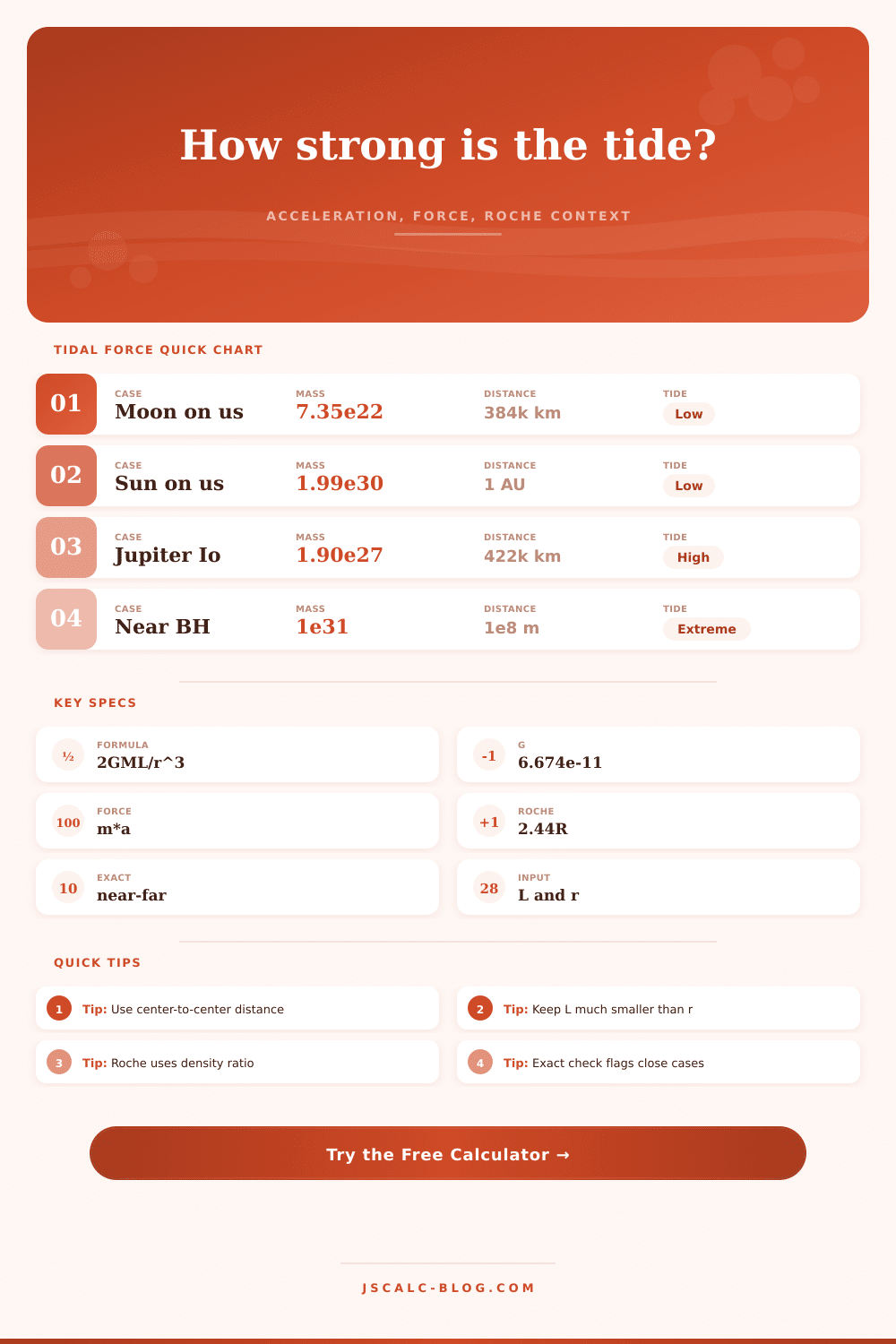
The reference tables accompanying the tool let you do a sanity check on what you’re putting in. The mass, density, etc. Of the main bodies is listed here. And that helps explain why Jupiter has such a strong hold over its moon Io compared to how Earth holds onto our Moon. It’s not all about mass; it’s also about density and proximity. Io is deep into Jupiter’s gravity well. The Moon is comparatively far out. The combination leads to tidal forces that create intense volcanic and heating activity on Io. That’s a direct effect of those tides.
But you aren’t really looking for the right answer with this tool. More like grasping how strong the gravity gets. It is for scientists building spaceships. It is also for writers wanting to write some science fiction. It is for anyone who wonders why the ocean has tides. Same principles apply.
There are all sorts of invisible pulls throughout the universe. Some squeeze things and pull them apart. That make things stretch. If you understand the Roche limit, force, and acceleration context, you get to see what structure underneath the chaos is. You can learn how to make abstractions like gravity come alive. It is a reminder that the most far-off forces has very real, physical consequences. The same gradient that causes the moon to shatter is the same one that brings up the tide on your beach. And the same one that powers the lights of distant stars.