Hill Sphere Radius Calculator
Estimate the gravitational sphere of influence for planets, moons, dwarf planets, asteroids, and exoplanets using periapsis, eccentricity, and mass ratio.
Hill sphere estimate
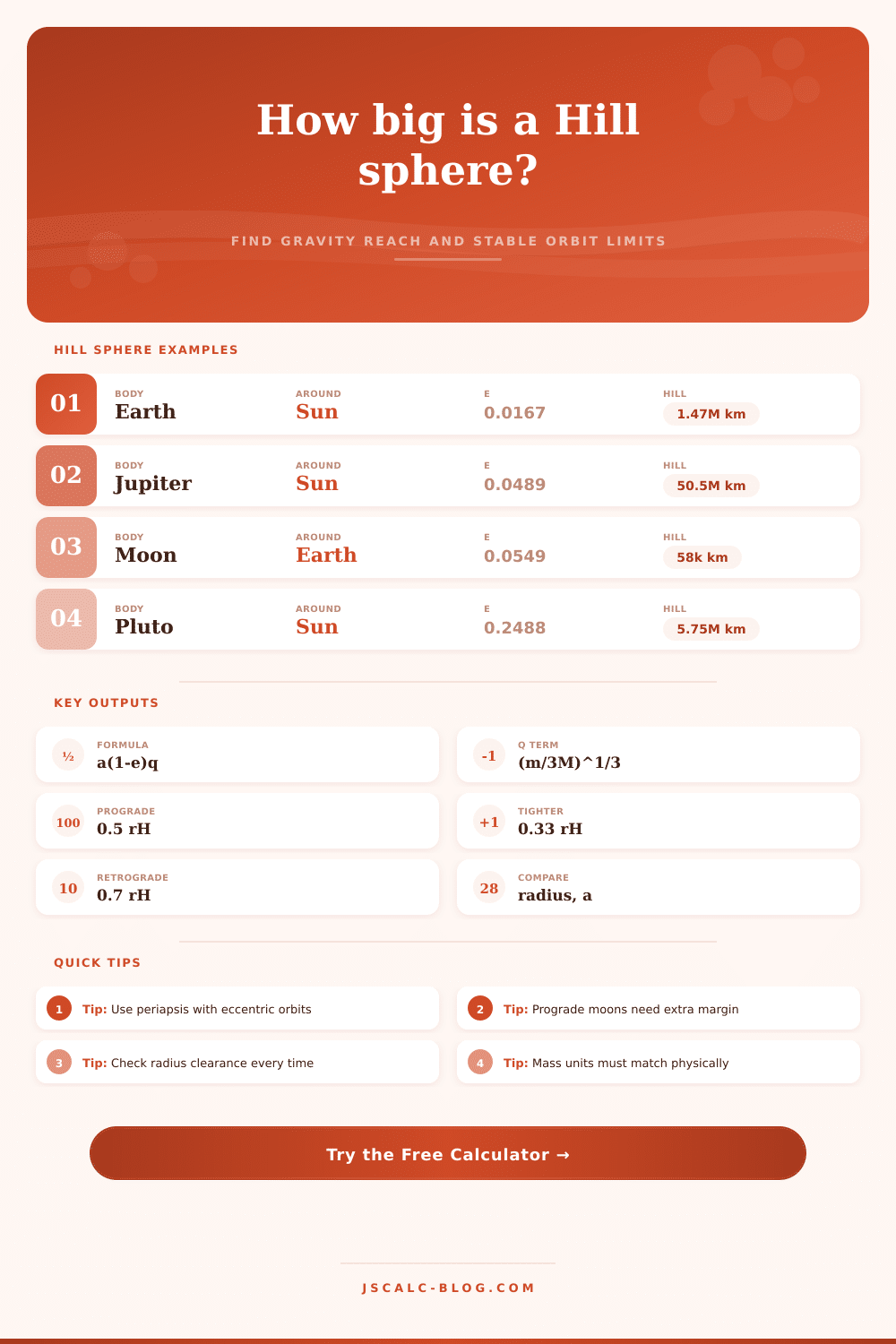
rH = a(1-e) (m / 3M)1/3
The calculator first converts masses and distances to common units, finds periapsis distance a(1-e), applies the cube-root mass term, then compares rH with the body's radius and the original orbital radius.
| Orbiting body | Primary | Eccentricity | Approx rH using a(1-e) | rH / body radius |
|---|---|---|---|---|
| Mercury | Sun | 0.2056 | 175,000 km | 72x |
| Venus | Sun | 0.0068 | 1,000,000 km | 165x |
| Earth | Sun | 0.0167 | 1,470,000 km | 231x |
| Mars | Sun | 0.0934 | 982,000 km | 289x |
| Jupiter | Sun | 0.0489 | 50,500,000 km | 722x |
| Saturn | Sun | 0.0565 | 61,800,000 km | 1,025x |
| Neptune | Sun | 0.0087 | 115,000,000 km | 4,670x |
| Pluto | Sun | 0.2488 | 5,750,000 km | 4,840x |
| Fraction | Use case | Interpretation | Best for |
|---|---|---|---|
| 0.25 rH | Compact conservative limit | Extra clearance from perturbations | High-eccentricity systems |
| 0.33 rH | Long-term prograde margin | Useful first-pass moon zone | Habitability screens |
| 0.50 rH | Common prograde estimate | Broad practical outer scale | Solar system comparisons |
| 0.70 rH | Retrograde upper estimate | Retrograde orbits can extend farther | Dynamical experiments |
| Quantity | Symbol | Value used | Notes |
|---|---|---|---|
| Solar mass | M sun | 1.98847e30 kg | Default stellar mass unit |
| Earth mass | M earth | 5.9722e24 kg | Planet and moon comparisons |
| Jupiter mass | M jupiter | 1.89813e27 kg | Gas giant and exoplanet inputs |
| Astronomical unit | AU | 149,597,870.7 km | Average Earth-Sun distance |
| Mile | mi | 1.609344 km | Converted internally to km |
| Output | Calculation | What it compares | How to read it |
|---|---|---|---|
| Hill sphere radius | a(1-e)(m/3M)^1/3 | Orbiting body's gravity reach | Larger means a wider satellite region |
| Stable moon limit | fraction x rH | Practical satellite orbit scale | Use smaller fractions for stricter screens |
| Hill / body radius | rH divided by radius | Gravity reach versus surface size | Low values leave little clearance |
| Hill / orbital radius | rH divided by a | Sphere size versus orbital distance | Usually a small percentage |
When we think about gravitational force of a planet, it’s easy to think of it as basic sphere. Imagine that there’s a transparent bubble and all of the moons and other debris clings to the parent world. In reality, it’s more complicated. Depending on distance of a planet from its primary star; and mass of that star, the gravitational effect vary and so does its shape. The eccentricity of orbit even comes into play here.
What we call the Hill sphere refers to the region around a planet where gravity force of the planet exceed that of the central star. And guess what? That’s not theoretical either; it explains why a planet retain a moon (or doesn’t). It also explains if a satellite will be lost forever in outer space.
Understanding the Hill Sphere
This boundary has easy math. It’s a function off the distance between two bodies and their masses compared to each other. Put in the planet and star mass. Put in orbital semi-major axis. The tool will do the math and spit out a kilometer radius.
But what does that mean? What does that number mean practicaly? That’s where oddness of orbit comes into play. Not all orbits is circular. In fact, most aren’t. The gravity of star exerts more force on planet as it approaches its closest point. The pull of the star shrink the Hill sphere at that moment. Using the average distance may overestimate stability. This means people makes wrong assumptions about whether a satellite could stays in orbit over time.
Determine what portion of the Hill sphere is usable for stable moons. For this, we need fraction that can be used for a stable orbit. According to research, moons will remains stable in roughly half the Hill radius when they are prograde. Prograde means that moon orbits in the same direction as rotation of the planet. When it’s retrograde, it may remain stable until it reaches about 70% of the radius. Using the calculator, you can change this fraction and visualize how this affect the available space. It might not seem like much, but it makes a huge differance. After all, you want your satellite to survive for billions of year. Otherwise, tidal forces will strip the satellite away.
Another way to understand the Hill radius is to compare it to planet’s physical radius. When the Hill sphere is big compared to planet, then we know there is plenty of space to have lots of moons. We will have room for rings and orbital infrastructure too. When ratio is small, then we know it will be a cramped place. Gravitational disturbances can easily pushes satellites out of their orbits.
The table on the page are a reference. You’ll see that Jupiter has a huge sphere which holds its complex moon system. Mercury have a tiny sphere with not much room for any natural satellites. Knowing these ratios helps us explain how some worlds doesn’t have any moons at all. And others has lots of them.
Students can use it. Worldbuilders can use it. Anyone interested in how the solar system work can use it. It’s no longer necessary to memorize constants. You don’t have to fret over mismatched units, e.g., kilograms vs. Solar masses. Just enter the numbers and the gravitational range is revealed.
Why doesn’t Mars have big moons? What would an actualy habitable zone look like on a fictional planet? How could I create a realistic one? Questions like these is answered with context provided by the Hill sphere. It connects the math of orbits to the real-world structures in our solar system.
The Hill sphere is about limits. It marks the end of where a planet’s gravity holds control. And exploring those limits help you understand the balance that maintains order in the solar system. It reveals relationship among time, distance, and mass. It shows why certain worlds holds onto their moons while others drop theirs. With these numbers you can see those bounds, making abstract physics into concrete understanding.