Roche Limit Calculator
Estimate the tidal disruption distance for fluid and rigid satellites, then compare it with a real orbit and altitude above the primary surface.
Roche limit result
The fluid version assumes the satellite cannot support itself with internal strength, so tidal forces dominate once it comes within this center-to-center distance.
The rigid approximation is smaller because the satellite has structural strength. Both formulas use the same density ratio and primary radius.
Altitude above surface = Roche limit - primary radius. Safety margin = current center-to-center orbit - selected Roche limit.
| Scenario | Primary density | Satellite density | Fluid limit | Common interpretation |
|---|---|---|---|---|
| Earth with Moon-like rock | 5.51 g/cm³ | 3.34 g/cm³ | 18,400 km | Far inside the Moon's present orbit. |
| Earth with icy comet | 5.51 g/cm³ | 0.60 g/cm³ | 33,900 km | Low-density bodies disrupt farther out. |
| Mars with Phobos-like moon | 3.93 g/cm³ | 1.88 g/cm³ | 10,300 km | Phobos orbits close enough to compare carefully. |
| Saturn with icy moon | 0.69 g/cm³ | 0.93 g/cm³ | 127,000 km | Close to the broad ring region. |
| Jupiter with rocky moon | 1.33 g/cm³ | 2.00 g/cm³ | 148,000 km | Well inside Io's orbital distance. |
| Sun with comet nucleus | 1.41 g/cm³ | 0.60 g/cm³ | 2.23 million km | Sungrazers can be tidally stressed. |
| Primary body | Mean radius | Mean density | Useful Roche note |
|---|---|---|---|
| Earth | 6,371 km | 5.51 g/cm³ | Dense primary, so low-density satellites get large limits. |
| Moon | 1,737 km | 3.34 g/cm³ | Useful for small artificial-or-natural orbit checks. |
| Mars | 3,390 km | 3.93 g/cm³ | Relevant for Phobos-style close satellite comparisons. |
| Jupiter | 69,911 km | 1.33 g/cm³ | Large radius dominates despite moderate mean density. |
| Saturn | 58,232 km | 0.69 g/cm³ | Classic ring and icy-satellite Roche example. |
| Uranus | 25,362 km | 1.27 g/cm³ | Good check for medium-density icy moons. |
| Neptune | 24,622 km | 1.64 g/cm³ | Useful for Triton-like captured moon comparisons. |
| Sun | 695,700 km | 1.41 g/cm³ | Use for approximate comet disruption distances. |
| Satellite material | Typical density | Best model | Calculator use |
|---|---|---|---|
| Loose comet nucleus | 0.4 to 0.8 g/cm³ | Fluid | Weak, porous, and easily tidally distorted. |
| Water ice moon | 0.9 to 1.2 g/cm³ | Fluid or both | Good for Saturn-ring-adjacent estimates. |
| Porous rubble pile | 1.3 to 2.0 g/cm³ | Fluid | Asteroids with weak cohesion often use this side. |
| Rock and ice mix | 1.8 to 2.7 g/cm³ | Both | Common for outer solar system moons. |
| Silicate rock | 3.0 to 3.5 g/cm³ | Rigid or both | Useful for Moon-like rocky bodies. |
| Iron-rich body | 5.0 to 8.0 g/cm³ | Rigid | High density pulls the limit inward. |
| Output | Definition | Positive value means | Negative value means |
|---|---|---|---|
| Roche limit d | Distance from primary center | Orbit outside this distance is beyond the selected limit. | Not applicable; d is always positive for valid inputs. |
| Altitude above surface | d - R_primary | Limit is outside the visible surface. | Limit falls inside the primary body. |
| Safety margin | Orbit center distance - d | Orbit is outside the selected Roche limit. | Orbit is inside the selected Roche limit. |
| Buffered margin | Orbit - d × buffer | Orbit clears the extra caution band. | Orbit is close after adding the chosen buffer. |
These estimates are classical approximations. Rotation, orbital eccentricity, material strength, tidal heating, and non-spherical shapes can shift real disruption behavior.
When one thinks about a satellite orbiting a planet on a normal orbit, think again: what happens if tidal forces get too high? If gravity of the planet is strong enough, then the satellite will fly apart (this is called the Roche limit). The gravitational pull on the satellite becomes stronger than the hold of its own gravity keeping it together. It’s responsible for breaking up comets close to the Sun and even for explaining why some planets like Saturn has rings and not large moons. It all depends on how strong the satellite is internally versus how strong the gravity are.
It gives us the numbers. What do they mean? Context matters. Density is key. How does it compare? That depends on its density compared to the main body. Because Earth is so dense, we have a very steep gravitational gradient. That means the near side of the satellite feel a much greater force of pull from the earth as compared with the far side. That differential in pull causes tidal stress that can overwhelms the satellite’s self-gravity.
What Is the Roche Limit?
Then there is the center-to-center distance, the space between each object’s center. Most think this is altitude above surface. No, no, no! You must subtract out the radius of the primary to get actual altitude.
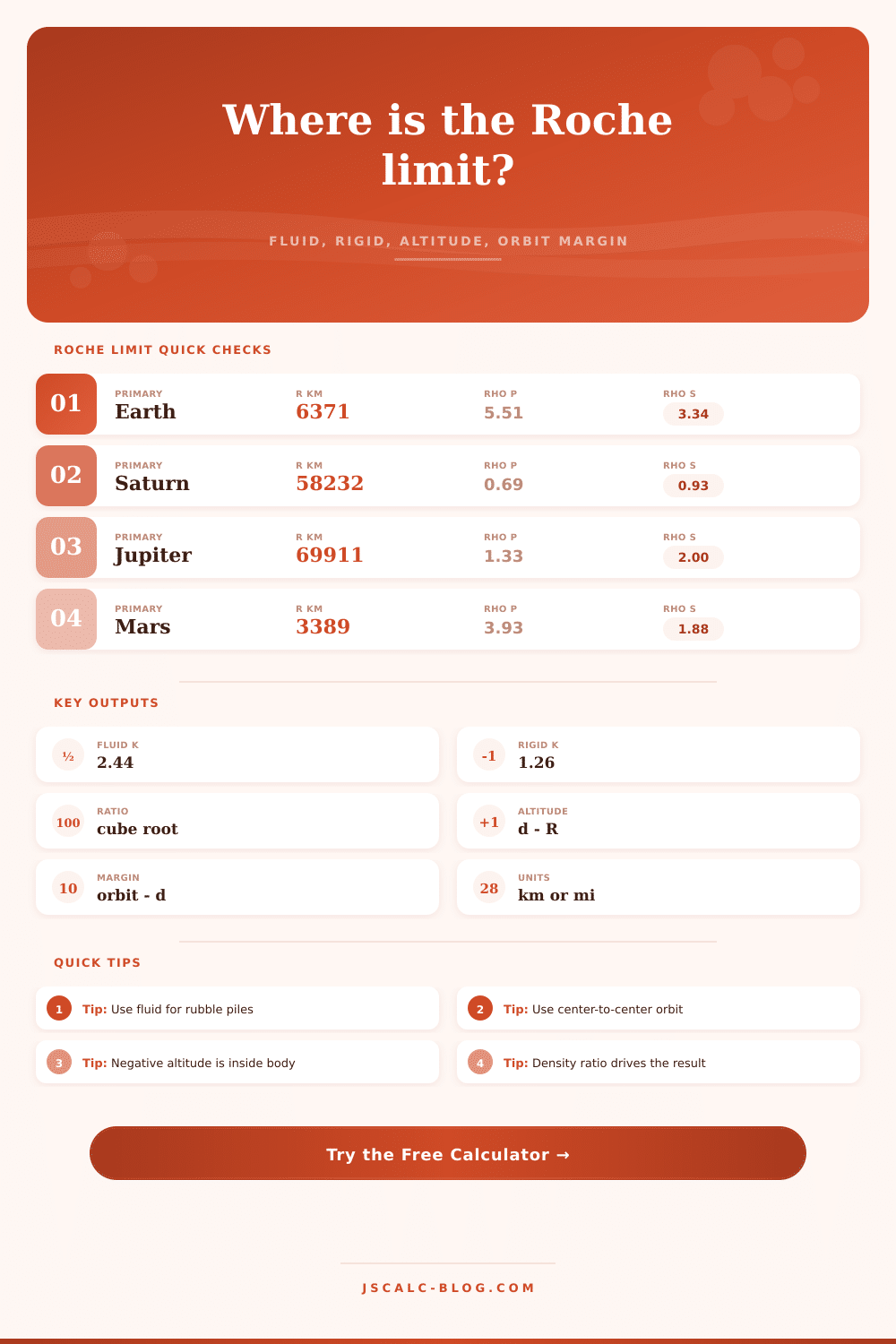
But there’s a big difference between rigid and fluid limits. Basically, the rigid limit gives about 1.26 as its coefficient. This limit applies to solid objects that has some structural integrity. For example, a solid rock will endure more tidal stretching then a random pile of ice. The fluid limit (with a coefficient of 2.44) apply to an object that’s essentially a pile of rubble held together by gravity alone. In that instance, tidal forces handily take over after the satellite passes the limit.
This is important. If you treat a rubble-pile asteroid as rigid, you would of concluded it is safe, but in reality it will break apart. The physics of Saturn are quite evident here. The planet’s rings reside within the fluid Roche limit of ice. If a moon passed through there it would be ripped apart, forming the rings as its debris spread out.
You can experiment with other situations, from interactions between white dwarfs to the Earth-Moon system. In the case of Earth, the Roche limit for a rocky satellite is well within the Moon’s current orbit, making our satellite stable. But in the case of a low-density comet near Earth, the Roche limit reaches out much further. The distance between these main bodies is determined by their density ratio, as shown in reference table.
The real world complicates things in ways that simple equations don’t account for. The satellite’s rotation help support itself through centrifugal force, causing the limit to shift outwards. Eccentric orbits imply the satellite could be stable at its furthest point, but destroyed at its closest. Internal structures may soften with tidal heating, transforming what was once rigid into something fluid as time passes. It makes the Roche limit more a danger zone than an impenetrable wall.
Plug in the radius and density values and you’ll have a baseline idea of where it starts getting dicey. It’s a tool that will help visualize how much room you have in an orbit. A little leeway isn’t a bad idea if it means that you’re on the edge of what’s allowed. Whether it is for artificial satellites or spacecraft designed to orbit other bodies, there can be a difference between being stable and getting destroyed by millimeters rather than thousands of kilometers. Do you know where you stand? Are you safe? Or are you about to get gravity-disassembled?
Gravity is a sculpting force. Gravity is the tearing force. It is not simply a holding force, but an influence on form. It is a force in space that shapes and tears. The math reveals tension and then release. It is Saturn’s rings, or a planned scene. Hold together? Or break apart? And so the math tells us where the line is. And knowing the line helps you know which side of it your object is on.