Gravitational Potential Energy in Orbit Calculator
Compare orbital potential energy, delta U, circular kinetic energy, and total orbital energy between two radii around a selected central body.
Orbit energy results
| Central body | Mass (kg) | Mean radius (km) | GM, mu (m³/s²) |
|---|---|---|---|
| Earth | 5.9722e24 | 6,378.1 | 3.9860e14 |
| Moon | 7.342e22 | 1,737.4 | 4.9049e12 |
| Mars | 6.4171e23 | 3,389.5 | 4.2828e13 |
| Jupiter | 1.8982e27 | 69,911 | 1.2669e17 |
| Sun | 1.9885e30 | 695,700 | 1.3271e20 |
| Venus | 4.8675e24 | 6,051.8 | 3.2486e14 |
| Mercury | 3.3011e23 | 2,439.7 | 2.2032e13 |
| Saturn | 5.6834e26 | 58,232 | 3.7931e16 |
| Quantity | Formula | Meaning | Sign check |
|---|---|---|---|
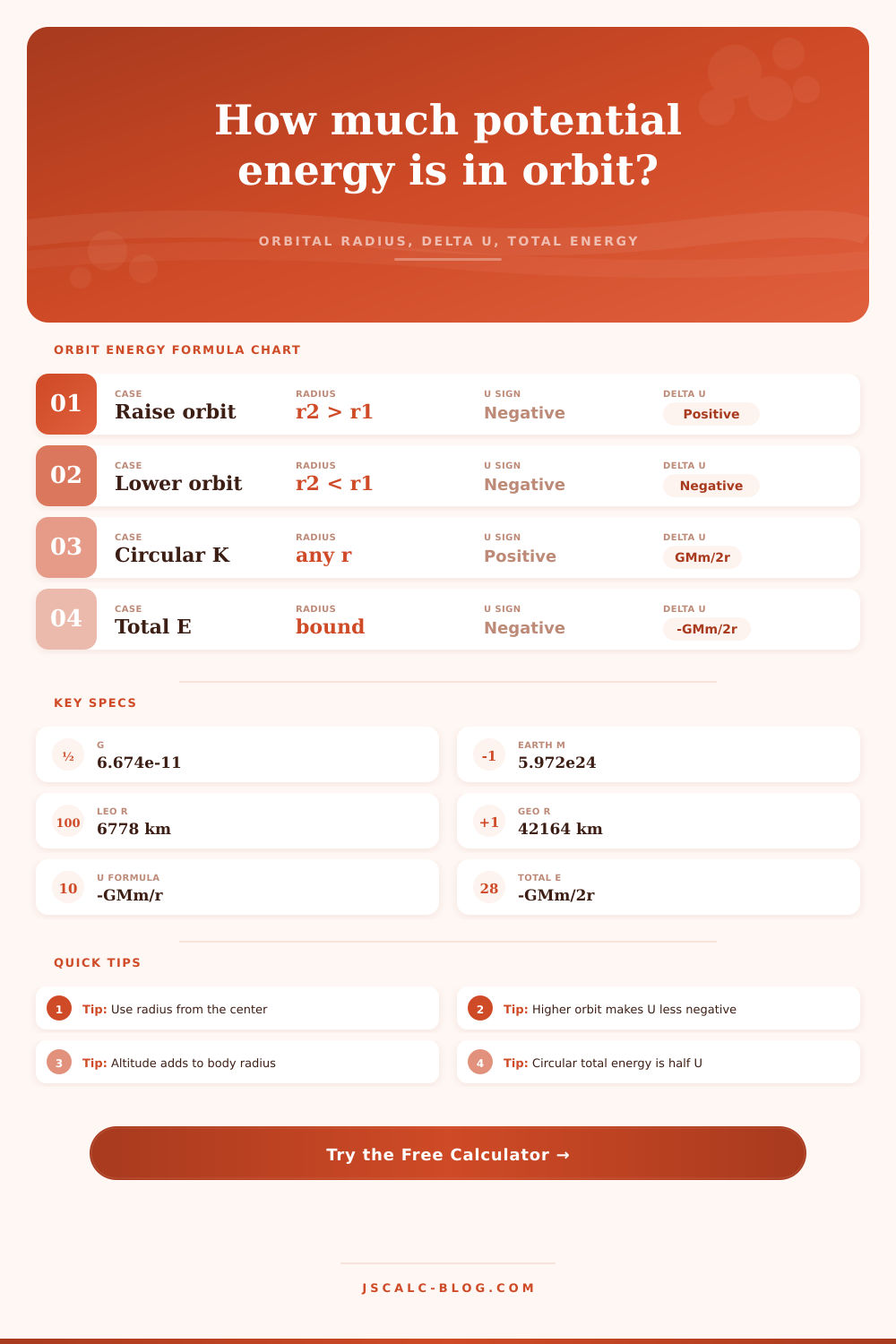
| Potential energy | U = -G M m / r | Energy relative to zero at infinity | Always negative for bound radii |
| Delta potential | Delta U = U2 - U1 | Change between two orbital radii | Positive when radius increases |
| Circular kinetic | K = G M m / (2r) | Kinetic energy for a circular orbit | Positive |
| Total circular energy | E = -G M m / (2r) | Mechanical energy K + U | Half of U |
| Circular speed | v = sqrt(GM/r) | Speed for a circular orbit at radius r | Falls as r increases |
| Escape from circular orbit | Delta E = G M m / (2r) | Extra energy to reach zero total energy | Equals circular kinetic energy |
| Orbit example | Altitude | Radius from center | U per 1,000 kg | Circular speed |
|---|---|---|---|---|
| Low Earth orbit | 400 km | 6,778 km | -5.88e10 J | 7.67 km/s |
| Sun synchronous | 700 km | 7,078 km | -5.63e10 J | 7.50 km/s |
| Medium Earth orbit | 20,200 km | 26,578 km | -1.50e10 J | 3.87 km/s |
| Geostationary | 35,786 km | 42,164 km | -9.45e9 J | 3.07 km/s |
| Lunar distance | 384,400 km | 390,778 km | -1.02e9 J | 1.01 km/s |
| Central body | Move | Mass | Approx delta U |
|---|---|---|---|
| Earth | 400 to 420 km | 1,000 kg | 1.73e8 J |
| Earth | 400 to 700 km | 1,000 kg | 2.49e9 J |
| Earth | LEO to GEO | 1,000 kg | 4.94e10 J |
| Moon | 100 to 3,000 km | 10,000 kg | 1.73e10 J |
| Mars | 300 to 400 km | 1,000 kg | 3.20e8 J |
| Jupiter | 5,000 to 80,000 km | 1,000 kg | 8.83e11 J |
Built for JSCalc-Blog.com with SI physics constants and direct orbital-energy equations. Real mission-like presets are simplified to circular-radius comparisons.
We usually think of gravity as a force that pulls us down. But it is more complex than that; it is actualy the opposite of what you would expect.
Sending up a satellite isn’t like lifting an object that are constantly being weighed down by its own gravity. We’re climbing away from a deep well of potential. Every kilometer higher require a different kind of effort.
Understanding Gravity and Orbital Energy
This change, and knowing how to model it. Makes the difference between a feasible mission plan rather than just a shot-in-the-dark guess.
Plug in your altitude and your mass into the calculator, and let it crunch the numbers for you. No need to bother with conversions or coefficients… The calculator takes care of that part.
Where it gets interesting is when you start understanding what all these number mean. But gravitational potential energy are negative. Always. And we set it so that zero energy is infinitely far away. At that point gravity doesn’t have any hold over you.
You need to put some energy into it to get there. If you are above surface of the earth (like a satellite in Low Earth Orbit) then your energy level is not as bad as someone on the ground. But it’s still very much below zero.
As you raise your orbit that potential energy becomes less and less negative. People gets confused about this. They think raising means getting more energy. In physics terms that’s correct, but now you’re climbing out of a deep valley towards a flatter plain. The difference is positive. Total remains negative until you escape completely.
And think about the energy. How much of it is potential and how much is total? The virial theorem state that if an object is in a stable orbit its kinetic energy will be exactly one-half the magnitude of the potential energy. For a circular orbit kinetic energy is half the magnitude of potential energy.
But what does this imply about the total mechanical energy? Well, since we know it’s negative and potential is twice the total energy, then… Yep, still negative. And it equals half the potential.
So, to get off the planet, you require enough energy to go from whatever your current energy level is to having zero total energy. This means adding enough energy to what you already have to remove your binding energy.
The tool includes options to look at all of this and see the full picture. You can also toggle back and forth between looking at changes in potential alone. You can even look at escape requirements and kinetic.
Why should you care about the difference when planning out burns? A little nudge to increase your apogee might look cheap in terms of potential. If you’re wanting to circularize there once you’ve increased your apogee you’ll need to account for the decrease in speed as well.
Notice all the preset in the interface. To reach a bit higher up from where International Space Station is, it only takes a little bit of extra power. Take the same mass out into Geostationary Orbit though, and the cost goes through the roof.
It’s less about how much altitude you move, and more about the radius. The formula is 1/r², which is the inverse off the distance from the center of the Earth. If you double the distance from the center, the strength of the potential is cut in half.
That geometric relationship is why the cost of getting into deep space goes up exponentially. You’re not just battling against gravity; you’re battling against the shape of the energy well itself.
The reference data has some real-world applications as well. We’re used to the parameters of Earth. But now we can use this calculator to find values for Mars, the Sun, and even Jupiter.
Yes, the same principles apply. The scales is very different, though. Because of its mass, it takes a lot more energy to get to orbit around Jupiter. On paper, orbital mechanics appear to be roughly the same.
The trick is getting the right radii and units. If you’re working with surface height, then always include the radius of the body. Otherwise, the inverse-square logic gets thrown out the window and gives you results that seem reasonable but aren’t possible.
It’s about managing budgets of energy. If you’re an engineer sizing a propulsion system or a student double-checking your homework, the trade-off is obvious. Good coverage come from higher orbits. Reaching them requires a lot of energy. Accessing lower ones is cheap. Keeping them requires constant reboosts.
The math couldn’t be simpler. The meaning could not be more profound.
Position costs you fuel. Each joule matters. Remember that negative sign. It is not just a mathematical formality. It is a reminder that orbit is an active state. It’s a delicate balance between flying and falling.
See the well. Once you’ve seen it, you’ll never un-see it.
You should of seen it sooner.