Gravitational Acceleration Calculator
Calculate local gravity from mass, radius, and altitude with JSCalc-Blog.com, then compare the result to Earth gravity and no-drag falling motion.
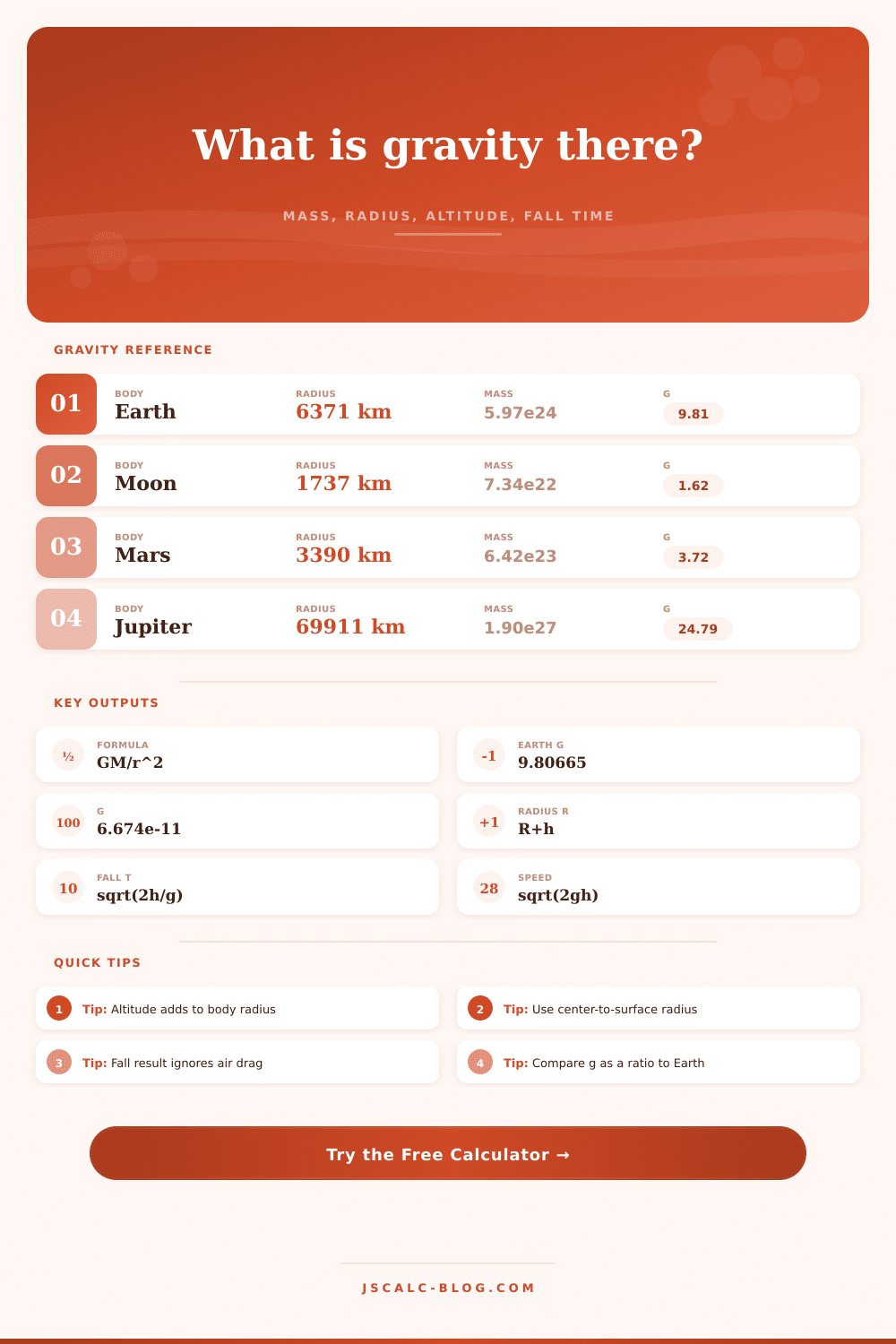
Core equation: g = G × M / r², where G = 6.67430 × 10⁻¹¹ N m²/kg².
Altitude handling: r is the distance from the body center, so r = body radius + altitude. At high orbit altitude, gravity falls because r is squared.
Optional fall model: t = sqrt(2h/g) and v = sqrt(2gh). These no-drag values are best for vacuum, thin atmosphere, or quick physics comparisons.
| Body | Mass (kg) | Mean radius | Surface g | Earth ratio |
|---|---|---|---|---|
| Mercury | 3.3011e23 | 2,439.7 km | 3.70 m/s² | 0.38x |
| Venus | 4.8675e24 | 6,051.8 km | 8.87 m/s² | 0.90x |
| Earth | 5.9722e24 | 6,371.0 km | 9.82 m/s² | 1.00x |
| Moon | 7.342e22 | 1,737.4 km | 1.62 m/s² | 0.17x |
| Mars | 6.4171e23 | 3,389.5 km | 3.73 m/s² | 0.38x |
| Jupiter | 1.8982e27 | 69,911 km | 25.92 m/s² | 2.64x |
| Saturn | 5.6834e26 | 58,232 km | 11.19 m/s² | 1.14x |
| Uranus | 8.6810e25 | 25,362 km | 9.01 m/s² | 0.92x |
| Neptune | 1.02413e26 | 24,622 km | 11.28 m/s² | 1.15x |
| Earth altitude case | Altitude | Center radius | Approx g | Earth standard |
|---|---|---|---|---|
| Sea level mean radius | 0 km | 6,371 km | 9.82 m/s² | 1.00x |
| Mount Everest summit | 8.849 km | 6,379.849 km | 9.79 m/s² | 1.00x |
| Cruise aircraft | 11 km | 6,382 km | 9.79 m/s² | 1.00x |
| ISS orbit height | 408 km | 6,779 km | 8.67 m/s² | 0.88x |
| GPS satellite height | 20,200 km | 26,571 km | 0.56 m/s² | 0.06x |
| Geostationary height | 35,786 km | 42,157 km | 0.224 m/s² | 0.023x |
| Symbol | Meaning | SI unit | Calculator source | Important note |
|---|---|---|---|---|
| G | Gravitational constant | N m²/kg² | Fixed constant | 6.67430e-11 |
| M | Body mass | kg | Mass input | Not object mass |
| R | Mean body radius | m | Radius input | Center to surface |
| h | Altitude or fall height | m | Altitude and fall fields | Context matters |
| r | Gravity radius | m | R + altitude | Squared in formula |
| g | Acceleration due to gravity | m/s² | G × M / r² | Local result |
| No-drag fall case | Gravity used | 10 m fall | 100 m fall | Speed at 100 m |
|---|---|---|---|---|
| Moon surface | 1.62 m/s² | 3.51 s | 11.1 s | 18.0 m/s |
| Mars surface | 3.72 m/s² | 2.32 s | 7.33 s | 27.3 m/s |
| Earth standard | 9.80665 m/s² | 1.43 s | 4.52 s | 44.3 m/s |
| Jupiter reference | 24.79 m/s² | 0.90 s | 2.84 s | 70.4 m/s |
Think about it: Gravity is something you consider to be pretty much constant. Like your fridge humming in the background, right? Because you live on a single planet, at a given height, it seem unchangeable.
But realy gravity is a negotiation; it depend on how far you are from a certain mass. And that changes drasticly depending on your position. This gravitational acceleration calculator above do all the negotiating for you. Without having to crack open a physics book, you can switch out Earth for Jupiter, sea level for the summit of Everest, etc., etc. The calculator transform those abstract constants into concrete numbers you can use.
How Gravity Works and How to Use the Calculator
What is the core of the calculation? Newton’s universal law. And what’s the essence of Newton’s universal law? It’s a simple ratio: Take the mass of the thing pulling on you and divide it by the distance from its center, squared. (That squared bit are the crucial part.) Double your distance from the thing’s center, and you don’t simply half the gravity; you quarter it. Which is why height matter so much.
You’d think space travelers floating around in orbit would be weightless because they’ve outrun Earth’s gravitational pull. But that’s a myth. According to the calculator, gravity at the International Space Station’s altitude are still about 90 percent as strong as it is at the surface. They’re floating up there not because the pull isn’t there, but because they’re falling. Get that difference, and you get a different sense of how orbital mechanics work.
Be careful when using the tool to notice the radius input. Don’t get confused. Radius isn’t the same thing as diameter. Also, don’t forget that it refers to distance from center to the outside edge. Get that number in incorrectly and your answer will be off by a factor of four. That’s a pretty big margin for error.
To compensate for that, the calculator add the radius of the body to whatever height you give it. In other words, it tells you how far you are from the body’s center of mass. That’s the distance necessary to calculate gravity at cruising altitude versus surface gravity. For a mountain climb, there’s not that big of a drop. As you venture further into space, however, it gets pretty deep. The table of references on the page spells that out nicely. You can see that although you’re climbing over the exact same amount of mass, the gravity thins out the higher up you go.
What does this mean? How do we compare it? We can use the fall time calculators to get an idea. If you fell from one hundred meters on the Moon, it would of take you eleven seconds. If you did so on Jupiter, your bones would shatter into nothing in less than three seconds. Since the tool doesn’t account for air resistance, the comparison stays clean. That’s an idealization. When you think about real-world falling, the actual atmosphere matter a lot. But the underlying gravity, the gravitational acceleration… Is what sets the table. It tells you how hard the universe wants to suck you down.
From there, we get things like: orbital periods, escape velocities, and even shapes of planets themselves. Earth serves as an excellent comparison to Titan, Ceres or any other body. Ceres has barely enough mass to hold onto a thick atmosphere, whereas gas giants is pressed down with forces so great they could crush a sheet of steel. By simply adjusting the radius and mass fields, you can tweak the values yourself to see how those extremes play out in the calculator.
Play around with it! Make a hollow moon, make a super-Earth, see how the results shift. It’s a sandbox for your curiosities. No need to re-derive the equation yourself. That’s all done for you here. All you must understands are the inputs. What does each one mean? Mass is the anchor. Radius is the lever. Altitude is the adjustment.
In the end, however, gravity isn’t a static background. It’s a dynamic field; it changes depending where we put our feet. It’s weaker at the top of a mountain and stronger at the bottom of a valley. On Venus, it acts one way, and on Mars another entirely. Those variables gets crunched by the calculator above. They become clear output. But what matters most is how it helps us build intuition: that our weight isn’t something intrinsic to ourselves, but a relationship between ourselves and everything else in the universe. Eventually, when we step off the curb, it’s not just the ground that catches you. Across millions of kilometers of distance, mass of the planet stretches itself and reaches out to pull us back home.