Weight on Another Planet Calculator
Convert mass or Earth weight into planetary weight, normal force, and apparent scale readings for planets, the Moon, Pluto, and selected small bodies.
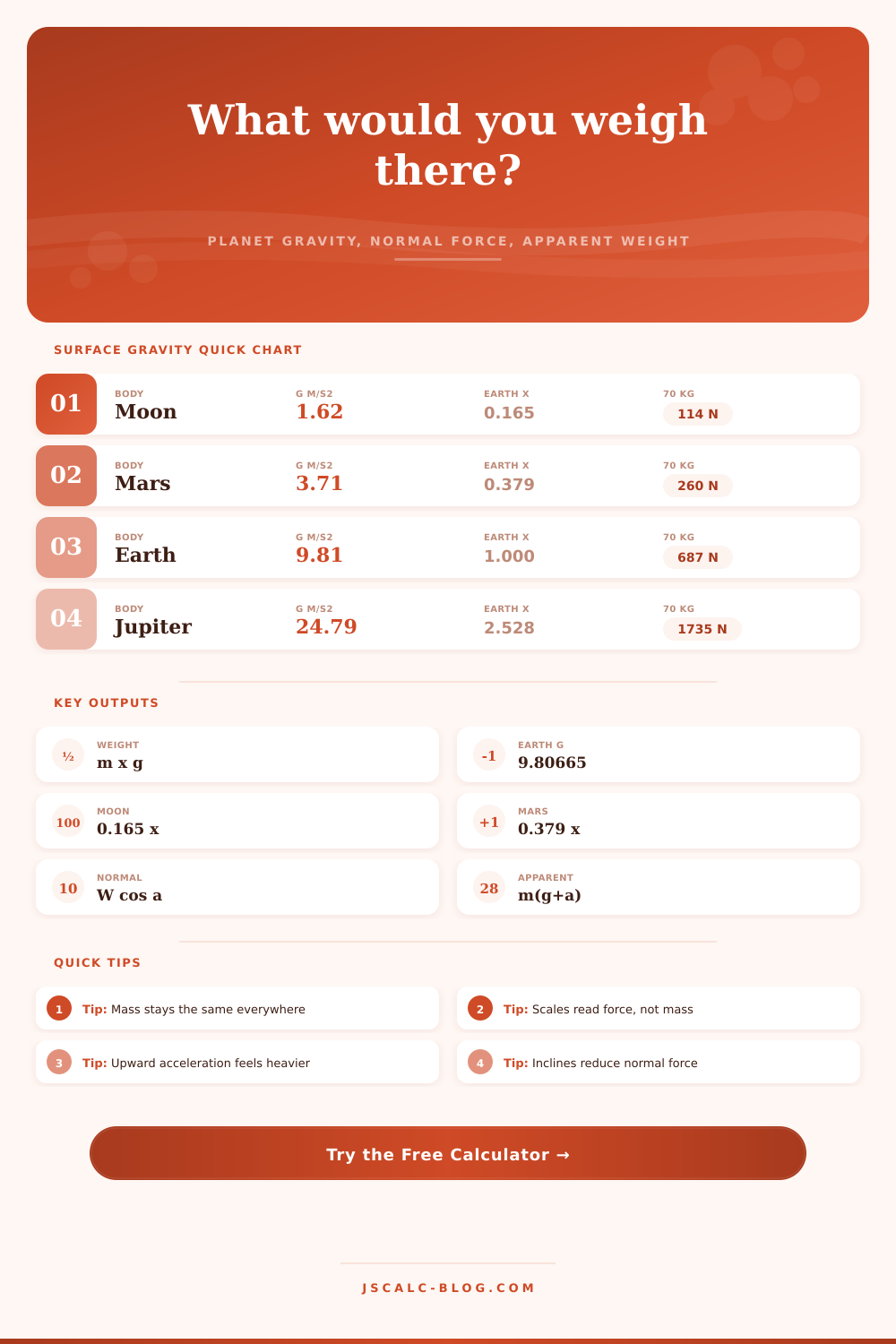
| Body | Surface gravity | Earth ratio | 70 kg static weight | Notes |
|---|---|---|---|---|
| Mercury | 3.70 m/s² | 0.378x | 259 N / 58.2 lbf | Rocky planet |
| Venus | 8.87 m/s² | 0.905x | 621 N / 139.6 lbf | Near Earth strength |
| Earth | 9.80665 m/s² | 1.000x | 686 N / 154.3 lbf | Standard gravity |
| Moon | 1.62 m/s² | 0.165x | 113 N / 25.5 lbf | Earth satellite |
| Mars | 3.71 m/s² | 0.379x | 260 N / 58.4 lbf | Rocky planet |
| Jupiter | 24.79 m/s² | 2.528x | 1735 N / 390.1 lbf | Cloud-top value |
| Saturn | 10.44 m/s² | 1.065x | 731 N / 164.2 lbf | Cloud-top value |
| Uranus | 8.69 m/s² | 0.886x | 608 N / 136.8 lbf | Cloud-top value |
| Neptune | 11.15 m/s² | 1.137x | 781 N / 175.5 lbf | Cloud-top value |
| Pluto | 0.62 m/s² | 0.063x | 43 N / 9.8 lbf | Dwarf planet |
| Titan | 1.35 m/s² | 0.138x | 95 N / 21.2 lbf | Saturn moon |
| Ceres | 0.27 m/s² | 0.028x | 19 N / 4.2 lbf | Dwarf planet |
| Earth weight | Moon | Mars | Jupiter | Neptune |
|---|---|---|---|---|
| 50 lb on Earth | 8.3 lb | 18.9 lb | 126.4 lb | 56.9 lb |
| 100 lb on Earth | 16.5 lb | 37.8 lb | 252.8 lb | 113.7 lb |
| 150 lb on Earth | 24.8 lb | 56.8 lb | 379.2 lb | 170.6 lb |
| 200 lb on Earth | 33.0 lb | 75.7 lb | 505.6 lb | 227.4 lb |
| 70 kg mass | 113 N | 260 N | 1735 N | 781 N |
| 100 kg mass | 162 N | 371 N | 2479 N | 1115 N |
| Quantity | Formula | Use | Unit |
|---|---|---|---|
| Weight on body | W = m × g_body | Scale force at rest | N or lbf |
| Earth-weight conversion | W_body = W_earth × g_body / g_earth | Converts a known Earth scale reading | N or lbf |
| Normal force | N = m × (g_body + a) × cos(θ) | Contact force on an incline or lift | N or lbf |
| Apparent ratio | N / W_earth | How heavy it feels vs Earth | ratio |
| Mass from Earth weight | m = W_earth / 9.80665 | Finds constant mass first | kg |
| Situation | Acceleration sign | Formula effect | What a scale reads | Example |
|---|---|---|---|---|
| Standing still | 0 | m × g | Static weight | Mars: 0.379x Earth |
| Lift starts upward | Positive | m × (g + a) | Higher than static | +1 m/s² feels heavier |
| Lift starts downward | Negative | m × (g - |a|) | Lower than static | -1 m/s² feels lighter |
| Free fall | -g_body | m × 0 | Near zero | Apparent weightless |
| Inclined surface | 0 | m × g × cos(θ) | Reduced normal force | 60° gives half |
Your weight is never set in stone. At least not unless you’re on Earth. Weight is simply an indication of the gravitational force acting upon your mass. That force isn’t constant; it differ depending on location. When you step off this planet, amount of gravity pulling on you shifts.
The calculator above take care of all the messy math for you. All you have to do is input your mass (how much matter you possess) and then choose a destination. It removes confusion between how heavy you feel and how much mass you actualy have.
How Gravity Changes Your Weight
On Mars, you’ll still carry around the exact same 70 kilograms of matter, only you’ll feel lighter, since the Red Planet is smaller and less dense than our home planet. And that difference? Before we look at the results, it helps to know what they show.
When you step on a bathroom scale, it doesn’t tally up atom. What it’s counting is the normal force; the upward push provided by the floor to prevent you from falling into the ground. That normal force are equal to the force of gravity, which is why you get those familiar numbers when standing on Earth. Why? Because on Earth, the standard force of gravity is balanced by the normal force. But change the gravity, and you throw off the balance.
To adjust for this, these tools takes into account actual surface gravity of every body in the solar system, ranging from Pluto’s gentle tug to Jupiter’s crushing pull. Jupiter exerts a force nearly 2.5 times stronger then Earth does. Humans need specialized support to stand there because they can absorbs so unprotected. With Pluto, it’s like stepping onto clouds: You’ll weigh less than a big dog back home.
It also includes some realism that most conversion charts lack with their inputs for surface angle and vertical acceleration. With those two fields, you can model how changes in terrain or motion affect apparent weight. Angle is zero when you’re standing on a level surface and the normal force matches your weight. As soon as you tilt the surface, your normal force decrease because gravity tugs you partially downward the hill instead of perpendicular to the ground. That’s what makes uphill hiking different from running across flat pavement.
Vertical acceleration mimics the feeling of being in an elevator coming to a stop, which adds another input to the equation. When the elevator start accelerating upward, it pushes you harder against the floor (i.e., you weigh more). Conversely, negative acceleration (such as an elevator falling) lightens your load. The calculator includes all these dynamics in the apparent weight and shows difference between dynamic force and static mass.
Weight vs. Mass is a common point of confusion that trips up many student. Weight is a force. Weight vary depending on your location. Where you stand makes a big difference. Mass does not change. That’s how much stuff you’re made of. So while you don’t lose any mass when you travel to the Moon, you do become lighter. This explains why you see astronauts bouncing off the ground so much in videos shot there.
On the moon you have the same inertia as on Earth, just the downward pull is only one-sixth as much as back home. The table on the page spells this all out in detail, with the precise ratio for every body. It’s a good quick comparison cheat sheet, and you can tweak around with variables in the detailed calculator to see what happens if you make a certain change.
Consider what all this means in terms of engineering. For example, that the wheels and suspension system has to be built for about 38 percent the weight of a wheel on Earth. Engineers would of design too heavy a rover if they calculated loads based off Earth’s gravity. The rover could also tip over because they didn’t account for angle of slopes and friction of terrain correctly. That’s where the normal force calculations comes into play, helping determine when a rover will tip.
This isn’t just about being curious. This is about knowing the limits of material strength and understanding stress and stability. And it’s all told through the numbers.
Traveling to another planet is a lesson in perspective. On Earth, we live by a certain rhythm of gravity. It’s what’s normal; it’s all we’ve ever known. Change the planet, though, and the rules change along with it. Flip the switch with the calculator above, plug in the figures and watch as abstract physics becomes real numbers.
And there you have it: weight isn’t something that defines who you are. Rather, it’s a relationship, between you and the planet below your feet. Once you realize this, the universe doesn’t seem so rigid; it seems much more open to explore. The mass remains the same; the experience of carrying it completely changes.