Launch Window Duration Calculator
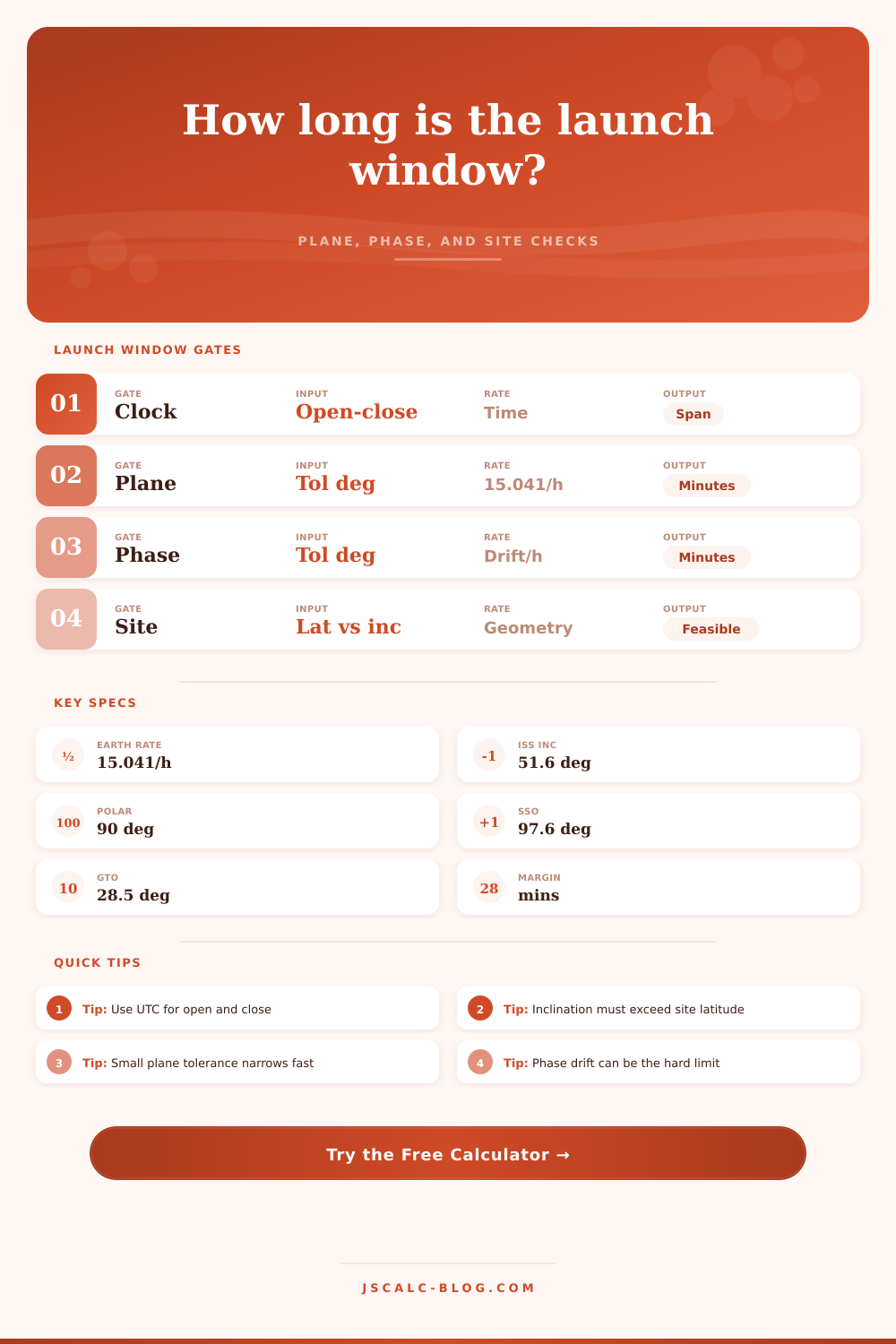
Estimate a practical launch window from UTC open and close times, orbital plane tolerance, phase angle drift, and launch site latitude versus target inclination.
Formula breakdown
| Launch site | Latitude | Direct minimum inclination | Common use |
|---|---|---|---|
| Kennedy Space Center | 28.61 deg N | 28.61 deg | LEO, ISS, lunar, interplanetary |
| Vandenberg SFB | 34.74 deg N | 34.74 deg | Polar and sun-synchronous orbit |
| Wallops Island | 37.94 deg N | 37.94 deg | ISS cargo and medium inclination |
| Guiana Space Centre | 5.24 deg N | 5.24 deg | Equatorial, GTO, and LEO |
| Baikonur Cosmodrome | 45.96 deg N | 45.96 deg | ISS and high-inclination LEO |
| Tanegashima Space Center | 30.39 deg N | 30.39 deg | LEO, GTO, lunar missions |
| Mahia Peninsula | 39.26 deg S | 39.26 deg | LEO, SSO, responsive launches |
| Pacific Spaceport Kodiak | 57.43 deg N | 57.43 deg | Polar and high-inclination missions |
Minimum inclination here is the simple spherical geometry rule for direct insertion. Range safety, doglegs, performance, and azimuth restrictions can narrow the real choice.
| Plane tolerance | One-side time | Two-sided gate | Typical interpretation |
|---|---|---|---|
| 0.10 deg | 0.40 min | 0.80 min | Very tight instantaneous plane target |
| 0.25 deg | 1.00 min | 1.99 min | Tight rendezvous or narrow RAAN allowance |
| 0.50 deg | 1.99 min | 3.99 min | Common quick-estimate rendezvous gate |
| 1.00 deg | 3.99 min | 7.98 min | Moderate steering or target tolerance |
| 2.00 deg | 7.98 min | 15.96 min | Flexible LEO plane allowance |
| 5.00 deg | 19.94 min | 39.89 min | Broad plane opportunity before other limits |
| Preset | Site | Inclination | Plane tol | Phase drift |
|---|---|---|---|---|
| Kennedy ISS cargo | Kennedy | 51.64 deg | 0.35 deg | 12.0 deg/hour |
| Kennedy lunar TLI | Kennedy | 28.50 deg | 3.00 deg | 4.0 deg/hour |
| Vandenberg SSO | Vandenberg | 97.60 deg | 0.80 deg | 2.5 deg/hour |
| Wallops Cygnus | Wallops | 51.64 deg | 0.45 deg | 10.0 deg/hour |
| Guiana GTO | Guiana | 6.00 deg | 5.00 deg | 1.5 deg/hour |
| Baikonur ISS | Baikonur | 51.64 deg | 0.30 deg | 12.0 deg/hour |
| Tanegashima LEO | Tanegashima | 31.00 deg | 1.25 deg | 3.0 deg/hour |
| Rocket Lab SSO | Mahia | 97.60 deg | 0.65 deg | 2.0 deg/hour |
| Kodiak polar | Kodiak | 90.00 deg | 0.90 deg | 2.2 deg/hour |
| Step | Formula | Units | Meaning |
|---|---|---|---|
| Clock span | close minus open, add 24 h if needed | minutes | Published or operational open-close interval |
| Plane gate | 2 × plane tolerance / 15.041 | hours | Earth rotation carries the launch site through the desired plane |
| Phase gate | 2 × phase tolerance / drift rate | hours | Time before relative phase angle exceeds the allowed band |
| Feasibility | target inclination ≥ absolute site latitude | degrees | Simple direct-injection inclination geometry check |
| Practical duration | minimum gate minus margin | minutes | Shorter of clock, plane, and phase windows after fixed margin |
Think about the rocket on the pad at that moment. The fueled, cold engines is waiting for command to fire. He is waiting for the mission planner who gaze at the turning globe under his feet.
The launch window isn’t some mere slot on a calendar. It’s an infinitesimal crossing point between orbital geometry and celestial mechanics. Miss the phase and you waste fuel. Miss the plane and you miss the mark.
Why Timing Is Hard for Rocket Launches
Input your constraints; let the calculator do its complex math. Translate your abstract angular tolerances into actual minutes of opportunity. The time factor is typicaly the first one. You have range safety, or you have some weather report that tells you when to start, then you have an end time.
However, that timeframe isn’t always helpful. A five minute window sounds manageable until you realize the orbital plane are moving against you. (Orbital plane.) Until you think about how fast the Earth spin. Fifteen degrees per hour. So, every second you’re not firing a rocket, the launch site is rotating through new inertial planes and you need to line up that rotation with the plane of your target orbit.
Enter: the tool. It takes the plane tolerance you give it and transforms it into a timeline. If you want your orbit to be within a tenth of a degree, you’re looking at less than a minute. Which is why people don’t understand: the reason your clock has such a big opening is because most people assume they can take their time. They don’t account for the fact that plane alignment is where the bottleneck happens.
And then there’s the phase angle. How far along is the target in its orbit compared to you? For example, when trying to catch up with International Space Station, you want to launch at a particular place in your own orbit so you can line up with it. The phase drift rate indicates how rapidly that window of opportunity are shrinking. The higher the number, the faster it is getting out of position for an intercept.
Divide the phase tolerance by the phase drift rate and you get your hard limit. In this case, with two-minute phase gates and four-minute plane gates, your actual window are two minutes. That doesn’t depend on how long the clock has been open. Shortest gate wins.
Another aspect of realism is the latitude of site. You can’t just blast off and head right into an orbital inclination less than the latitude of your launch site. Why? That’s basic spherical geometry. From forty five degrees north in Baikonour, there is no way to reach ten degrees of equatorial inclination without doing some huge and very fuel hungry plane change.
The page has a handy reference table that shows this for major spaceports. It serves as a reminder that geography constrains what you can do. Work within your location. The tool will check if what you want to do is feasible for you. It warns you about impossible combinations before you spend time figuring out how long it takes to achieve something you can’t realy get into orbit.
That said, this grounding in theory is helped by preset missions. For example, consider Kennedy ISS cargo mission and the reason for the narrow window. You need precise rendezvous. That means a small plane tolerance. Objects in LEO travels quickly, which leads to high phase drift. Compare that to a lunar trajectory. You have time to adjust post-injection, so you can have a much wider plane tolerance. The Moon travels slowly relative to Earth. This leads to a broader phase window. Understanding all of those tradeoffs is more important then memorizing the formulas.
Finally, consider the operational margin. Rockets gets delayed in real life. The weather hampers it. They take more time during pre-launch checks than expected. You need to subtract a couple minutes (or less) off your theoretical max to find the practical window. This is the margin between hope and planning. The one that will show you the narrowest of all these gates. This is the one that eliminates the excess, the time you simply cannot waste.
You should of planned for this. And that’s where the launch schedule comes in: when you see one, keep in mind that date shown is the maximum possible opportunity. In reality it’s probably far tighter than that. It depends on planet rotating at the same time your target is in position. The calculator does the calculations for you, but the concept holds. You’re attempting to insert a needle into the spinning eye of a hurricane.
Knowing what constraint is binding will give you an appreciation for why certain launches can be hours off, while others only need seconds. It turns the countdown into more than just a countdown; it becomes a chart of orbital accuracy.