Telescope Resolving Power Calculator
Estimate Dawes limit, Rayleigh criterion, wavelength diffraction, and whether the night’s seeing or your aperture sets the real detail limit.
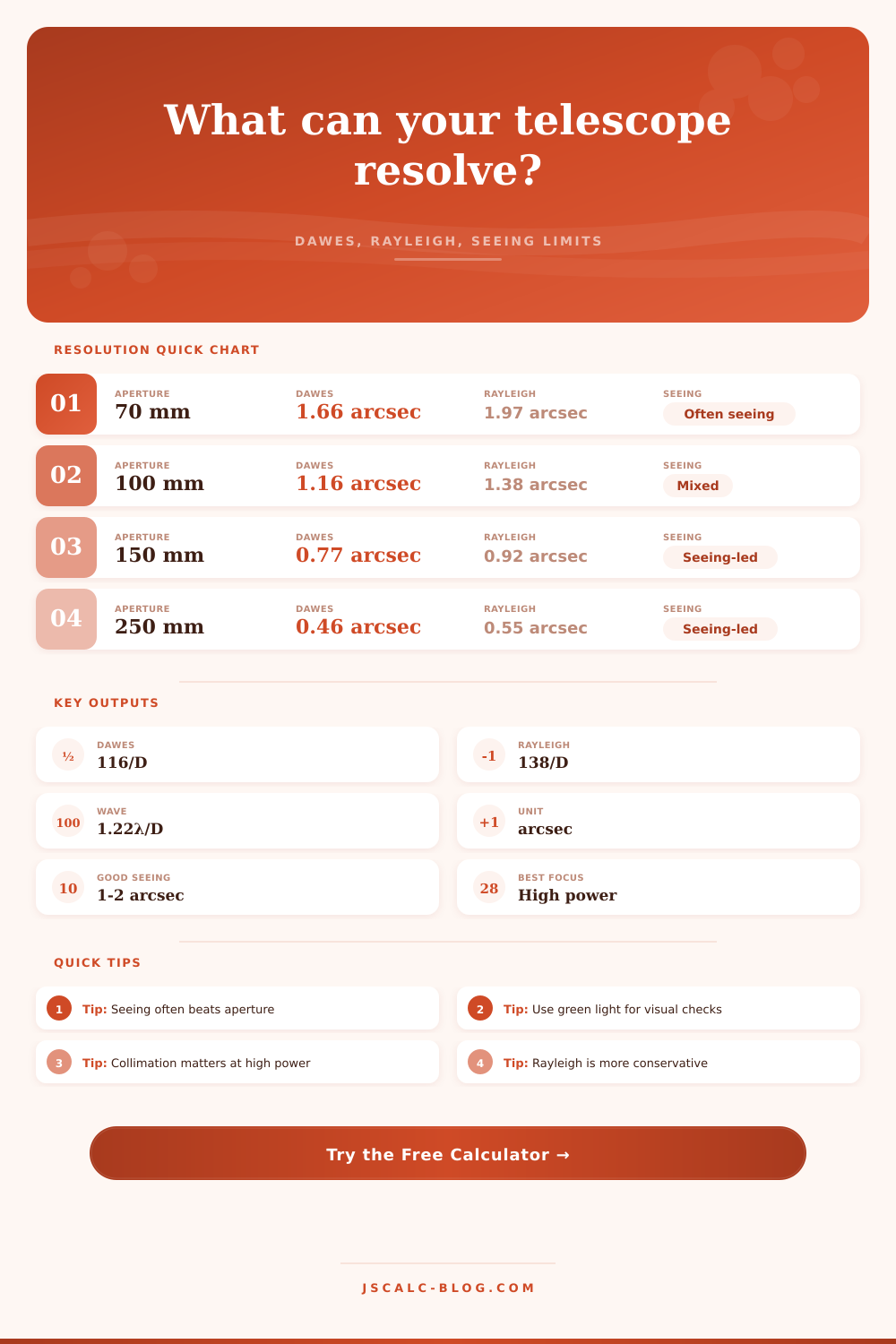
Dawes limit: Dawes limit = 116 / aperture_mm arcsec. It is an empirical double-star split rule and is optimistic for real-world extended detail.
Rayleigh criterion: Rayleigh ≈ 138 / aperture_mm arcsec. It is the common visual diffraction benchmark for a circular aperture.
Diffraction radians: diffraction radians = 1.22*lambda/D, where lambda is wavelength in meters and D is aperture in meters. Arcseconds = radians × 206265.
Seeing comparison: the practical visible detail is usually the larger number: telescope diffraction after penalties or the entered atmospheric seeing.
Ideal telescope-only limits in green light; real nights may be broader because of seeing, focus, cooling, and collimation.
| Aperture | Dawes Limit | Rayleigh | 550 nm Diffraction | Typical Reality |
|---|---|---|---|---|
| 60 mm | 1.93 arcsec | 2.30 arcsec | 2.31 arcsec | Often aperture-limited |
| 80 mm | 1.45 arcsec | 1.73 arcsec | 1.73 arcsec | Mixed on fair nights |
| 100 mm | 1.16 arcsec | 1.38 arcsec | 1.38 arcsec | Seeing matters |
| 150 mm | 0.77 arcsec | 0.92 arcsec | 0.92 arcsec | Usually seeing-limited |
| 200 mm | 0.58 arcsec | 0.69 arcsec | 0.69 arcsec | Needs steady air |
| 250 mm | 0.46 arcsec | 0.55 arcsec | 0.55 arcsec | Mostly seeing-limited |
| 300 mm | 0.39 arcsec | 0.46 arcsec | 0.46 arcsec | Rarely fully used |
| 400 mm | 0.29 arcsec | 0.35 arcsec | 0.35 arcsec | Exceptional seeing needed |
| Seeing | Visual Impression | Aperture That Matches Rayleigh | Best Use |
|---|---|---|---|
| 0.5 arcsec | Excellent mountain air | 276 mm | Planetary, close doubles |
| 0.8 arcsec | Very steady | 173 mm | High power detail |
| 1.0 arcsec | Good | 138 mm | Lunar and planets |
| 1.5 arcsec | Fair to good | 92 mm | Moderate high power |
| 2.0 arcsec | Common suburban | 69 mm | General observing |
| 3.0 arcsec | Soft or turbulent | 46 mm | Low to medium power |
| 4.0 arcsec | Poor | 35 mm | Wide fields, bright targets |
| Band | Wavelength | Effect On Resolution | Common Use |
|---|---|---|---|
| Blue visual | 450 nm | Smaller Airy disk | Bright stars, rare steady seeing |
| Green visual | 550 nm | Standard visual reference | Dawes and Rayleigh checks |
| Red H-alpha | 656 nm | About 19% broader than green | Solar and nebula imaging |
| 742 nm IR pass | Broader diffraction | Often steadier in turbulence | Planetary lucky imaging |
| 850 nm IR | Much broader diffraction | Can calm poor seeing | Lunar and planetary cameras |
| Target | Useful Limit | Magnification Cue | What To Watch |
|---|---|---|---|
| Double stars | Dawes can apply | 40x to 60x per inch | Equal brightness splits easier |
| Moon | Rayleigh is practical | 25x to 50x per inch | Low Sun angle improves contrast |
| Jupiter | Seeing dominates | 25x to 45x per inch | Wait for steady moments |
| Mars | Seeing and altitude | 30x to 50x per inch | Small disk needs good focus |
| Nebulae | Surface brightness | Low to medium power | Resolution is not the only limit |
| Lucky imaging | Diffraction plus sampling | Pixel scale matters | Stack the sharpest frames |
It’s the backyard telescope that will reveal storms on Jupiter, and the double stars appear so close together they’re practically touching. And it’s big enough; the sky’s dark enough; your eyes are adjusted to the gloom. But then you peer into the eyepiece; and all you see is a blur. The optics contains the detail, but they’re full of something that refuses to be driven out by the focus. Amateur astronomers knows this familiar disappointment. It isn’t a device problem. Instead, it is an ignorance of the laws of physics that define what we can and cannot see.
Where most people get frustrated is in the gap between what equipment offers on paper versus how well it perform. Aperture is something manufacturers like to sell because it’s simple to say how much light your scope will gather. What they don’t often tell you is that the air above you behaves more like a chaotic lens than anything else and smears out fine details. The calculator above runs this math for you, balancing these two forces with each other.
How to Get Better Views from Your Telescope
All it needs is your telescope’s diameter and an estimate of the atmospheric seeing conditions to compare them. That’s important: it allows you to determine if telescope is the bottleneck or not. But these are numbers with a story behind them; a little astronomy history to help you make sense of it all.
The Dawes limit refers back to nineteenth century and an astronomer who was able to divide double stars with his unaided eye. It’s an optimistic practical rule: a benchmark number for visual observers who wish to determine whether or not they can separate two nearby star. More strictly based off physics, specifically, diffraction, the Rayleigh criterion calculates the point at which the center of one star’s image overlaps the first dark ring of another. In other words, this is more conservative estimate of what we can reliably see with our eyes.
Wavelength comes into play as well. Because the human eye is most sensitive to green light (wavelength of 550 nanometers), that’s taken as standard reference. Since blue light has a shorter wavelength, it would have a smaller diffraction disk and thus sound better for resolution. But our eyes are less sensitive to blue and shorter wavelengths is affected by atmospheric turbulence worse. Theoretical limits may be sharper in blue but atmospheric noise and poor contrast will probably be your fate.
The other thing is central obstruction. In reflectors, there’s a secondary mirror that blocks some of the incoming light. That lowers contrast and also just ever-so-slightly expands the diffraction pattern. If you’re looking at a Newtonian reflector or a Schmidt-Cassegrain, the tool factor in this effect by lowering the predicted resolution accordingly. A refractor (since it has no central obstruction) will technically resolve a bit higher than an equal-aperture reflector, assuming they’re both completely collimated.
Seeing is the great equalizer. A huge telescope won’t do that much better on a night when there are two arcseconds of seeing. Before your telescope’s mirror catches sight of a star, the atmosphere has already smeared it. That’s the reality check the calculator give you.
Look at the diffraction limit of your telescope. Compare it to the seeing limit. If the seeing limit is bigger, then the atmosphere is limiting what you see. Raising the magnification just makes the smear bigger. Turn down the power and savor the sight instead. Fighting against the air is a battle best lost.
That’s why more experienced observers opt for smaller apertures when observing planets. For instance, while a 10-inch Dobsonian telescope can grab tons of light for objects in space, sometimes you won’t see as much detail on Mars with that instrument different than what you might see through a five-inch refractor on an unstable night. Because the atmosphere is less prone to instability and heat distortion, the smaller scope is less impacted. It’s not just about size of the glass; it’s about the quality of the light path.
The last bit of the puzzle is collimation and cooling. If the tube is not cooled down yet (from sitting in the garage) or if the mirrors aren’t aligned properly, even the finest of optics wouldn’t do any good. You should of checked that first. You can enter your estimate of how well collimated it was as well as how much heat there might be on the tube and the software simulate those conditions.
Remember that observing begins with some preparation. Cool down the scope, see if it’s aligned, give the air time to settle. The battle of weather versus physics is one for resolving power. The sky sets the conditions; you get the telescope. If you understand the trade-offs, you can set reasonable expectations. You can appreciate what’s in front of you instead of chasing after some phantom detail out past the current limits of the atmosphere. It’s not about splitting stars; it’s about enjoying the clarity that this moment allows.
With a steady air, your telescope will show you things that seem nearly impossible. Until then, patience is your best accessory.