Eyepiece Focal Length Calculator
Find the eyepiece focal length for a target magnification, then check exit pupil, true field of view, field stop estimate, and useful-power fit.
Your Eyepiece Match
Eyepiece focal length = telescope focal length / desired magnification / Barlow factorExample: a 1200 mm telescope at 200x with a 2.0× Barlow gives 1200 / 200 / 2.0 = 3.0 mm.
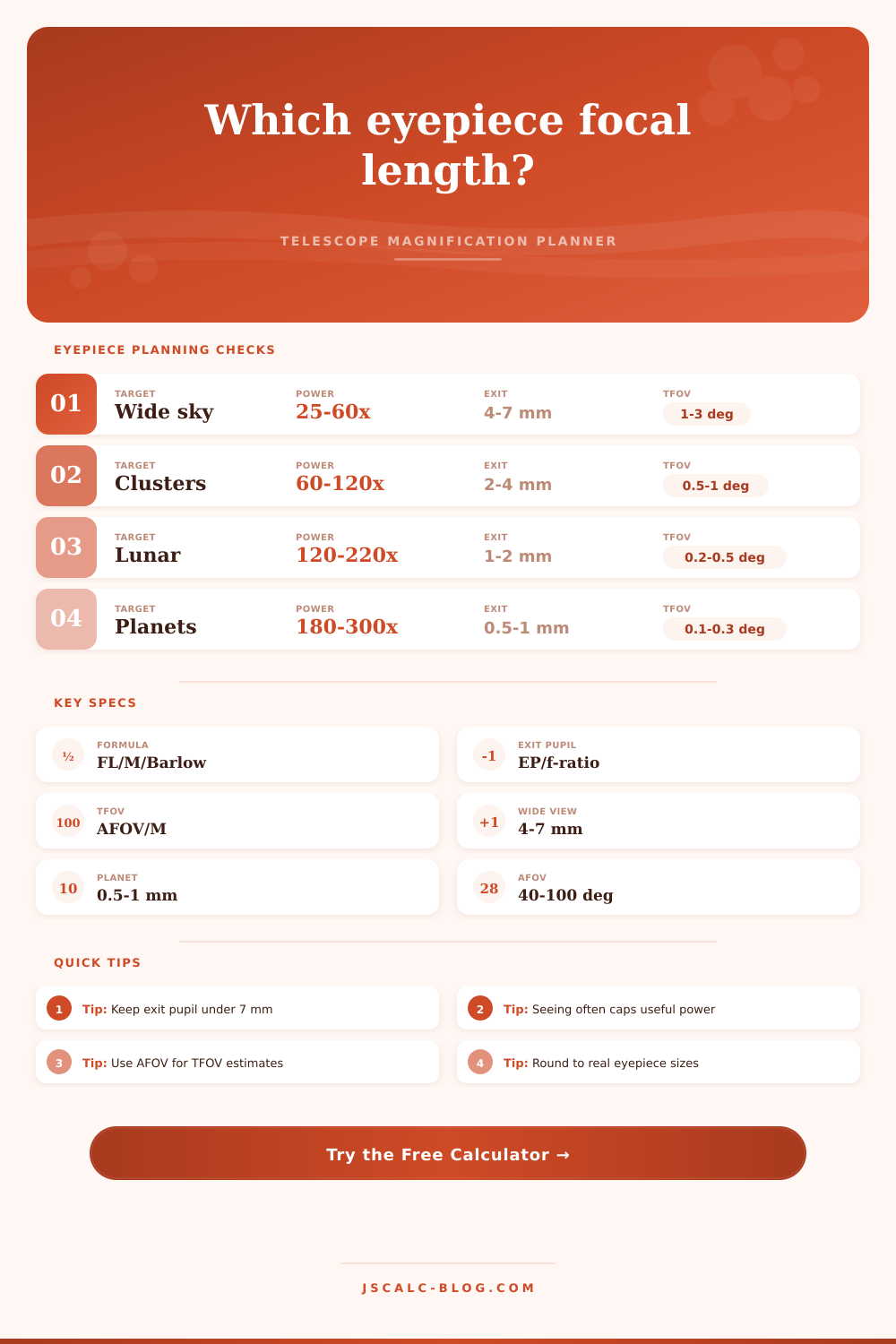
Exit pupil = eyepiece focal length / f-ratioThis estimates the beam diameter leaving the eyepiece. Large deep-sky views often use 4-7 mm; planetary views often use 0.5-1.5 mm.
TFOV estimate = apparent field of view / desired magnificationA 60° apparent field at 200x estimates 0.30°, or about 18 arcminutes of sky.
| Telescope type | Typical focal length | Typical f-ratio | Eyepiece planning note |
|---|---|---|---|
| 80 mm short refractor | 400-500 mm | f/5-f/6 | Excellent for 20x-80x sweeping; short eyepieces reach lunar detail quickly. |
| 130 mm tabletop Dob | 650 mm | f/5 | A 5-7 mm eyepiece often lands in a useful lunar and planetary range. |
| 150 mm Newtonian | 750-1200 mm | f/5-f/8 | Moderate focal lengths cover clusters while 4-8 mm handles high power. |
| 8 inch Dobsonian | 1200 mm | f/6 | Wide, mid, and high-power eyepieces around 30 mm, 12 mm, and 6 mm are common. |
| 8 inch SCT | 2032 mm | f/10 | Long focal length gives high power with comfortable 8-25 mm eyepieces. |
| 127 mm Maksutov | 1500-1540 mm | f/12 | Best matched to lunar, planet, and double-star powers with moderate eyepiece sizes. |
| Exit pupil | View character | Common targets | Planning caution |
|---|---|---|---|
| 6-7 mm | Maximum brightness | Milky Way fields, very large nebulae | May waste light if your dark-adapted pupil is smaller. |
| 4-5 mm | Bright wide field | Large open clusters, finder views | Needs a low-power eyepiece and enough focuser field. |
| 2-3 mm | Balanced detail | Globulars, galaxies, Moon framing | Often the most flexible deep-sky range. |
| 1-1.5 mm | High contrast detail | Moon, planets, compact nebulae | Seeing and collimation become more obvious. |
| 0.5-0.8 mm | Very high power | Planets, double stars, small lunar features | Dim image; best for steady nights and sharp optics. |
| Below 0.5 mm | Extreme magnification | Special double-star work | Usually too dim for routine observing. |
| Eyepiece class | AFOV used | TFOV at 100x | TFOV at 200x | Viewing character |
|---|---|---|---|---|
| Orthoscopic | 40° | 0.40° | 0.20° | Narrow, sharp center, useful for planets. |
| Standard Plossl | 50° | 0.50° | 0.25° | General-purpose field with simple planning math. |
| Dual ED | 60° | 0.60° | 0.30° | Comfortable mid-wide view for tracking by hand. |
| Wide angle | 68° | 0.68° | 0.34° | Popular low-power and deep-sky framing range. |
| Ultrawide | 82° | 0.82° | 0.41° | Longer drift time in non-tracking mounts. |
| Hyperwide | 100° | 1.00° | 0.50° | Immersive field; edge correction matters more. |
| Target type | Typical power | Useful exit pupil | Suggested AFOV | Field note |
|---|---|---|---|---|
| Large nebulae and star fields | 20x-60x | 4-7 mm | 68°-100° | True field matters more than raw magnification. |
| Open clusters | 40x-120x | 2-5 mm | 60°-82° | Frame the object with some dark sky around it. |
| Globular clusters | 100x-220x | 1-2 mm | 60°-82° | More power can resolve stars if the sky is steady. |
| Lunar detail | 120x-250x | 0.8-1.5 mm | 50°-82° | Terminator shadows tolerate more magnification. |
| Planets | 150x-300x | 0.5-1.2 mm | 40°-82° | Atmospheric steadiness is the main limiter. |
| Double stars | 180x-400x | 0.4-1 mm | 40°-68° | Useful for separation tests when focus is precise. |
The cold night has you standing out with frost creeping down telescope tube. Looking through the finder scope, do you even have the right glass in your hands? Whether it’s large nebulae that want big fields of view or little planets that crave surgical magnification, there’s something up there for everyone in the sky.
There’s no way to carry all your eyepieces, so how do you know which one to use? Above is a calculator that does the math for you when you input your telescope specs and power you want. You won’t have to do conversions or guess at coefficients anymore.
How to Choose the Right Eyepiece
What’s it mean? It is not just a number. That number tell you how much of the object you can see and what your eye can take in. Most people miss this key point: the smaller the difference between your telescope’s focal length and your eyepiece’s focal length, the higher magnification.
So if you have a short telescope, use a short eyepiece. If you have a long one, use a very long one (and get more comfortabley). This is why an eight inch Dobsonian feel differently than an eight inch Schmidt Cassegrain. The first one’s focal length is short, the second one’s is long. You take the same eyepiece, a twenty millimeter; and see how little magnification it provides in the Dob, versus decent power in the SCT with the same eyepiece.
That’s what the tool does, explains it simply so you don’t have to divide anything in your head while trying to fend off the breeze. The game changers are called Barlows. They’re like a multiplier. You can use longer, less expensive eyepieces and make them work at higher magnifications.
When you have a two times Barlow in there, the calculator will divide your telescope focal length by the Barlow factor first. Then it will solve for the eyepiece. That’s what lets you use a 12 millimeter eyepiece at the same power as a 6 millimeter one with a much brighter image and a large exit pupil.
That’s the thing people don’t get about high power. High power doesn’t always mean dim, tiny views; it just does when you don’t pay attention to the Barlow. The Barlow lets you reach the required magnification for Saturn or Jupiter. It also maintains a manageable eyepiece focal length so it isn’t too small for comfortable viewing.
The silent killer is the exit pupil. This is the diameter of the beam of light coming out of the eyepiece into your eye. Too big, your eye doesn’t get it all and the image gets dimmer. Too small and your eye can’t see the fine details and contrast in the air is killed.
Most planetary work occurs around a point five to one millimeter range while deep sky objects tend to thrive in the couple to five millimeter range (see the reference table on the page). Based off your telescope’s focal ratio the calculator computes what your exit pupil will be. If it tells you it’s eight millimeters, you’re wasting light. At zero point two millimeters, you’re chasing ghosts. Stick to the middle ground where the optics and your eyes agree.
For deep sky observing in particular, field of view matters, and really true field of view matters. If the object doesn’t fit into the view, then a high magnification won’t do you any good. That’s why the calculator divides the apparent field of view of the eyepiece by the magnification.
With an apparent field of a hundred degrees at fifty times magnification, you get a true field of two degrees, which is large enough to frame the Andromeda Galaxy with some of the surrounding sky. At the same power but with a forty degree apparent field, you would only see the core because your true field is only forty eight arcminutes. This allows you to choose the right apparent field width to frame your target without having to use a tracking mount to center it.
The last boss is Seeing Conditions. You can’t calculate what conditions are like. There’s no way a calculator can predict the atmosphere. Even if the sky is clear, bad seeing conditions will make the view look like boiling soup at high power.
The tool has an input for seeing conditions to remind you that there are practical limits here too. The best eyepiece won’t save you from a shaky air. Instead of struggling with a blurry high power view, drop down in power to enjoy a wider, sharper view. Plan for the best, expect the average.
When you put all of this together you go from guessing to seeing. The sky doesn’t reward those who only own the gear but rather those who understand the light. You should of used the calculator more often.