Telescope Focal Ratio Calculator
Calculate telescope f-number from focal length and aperture, reverse-solve aperture, adjust for reducers or Barlows, and compare imaging speed against f/10.
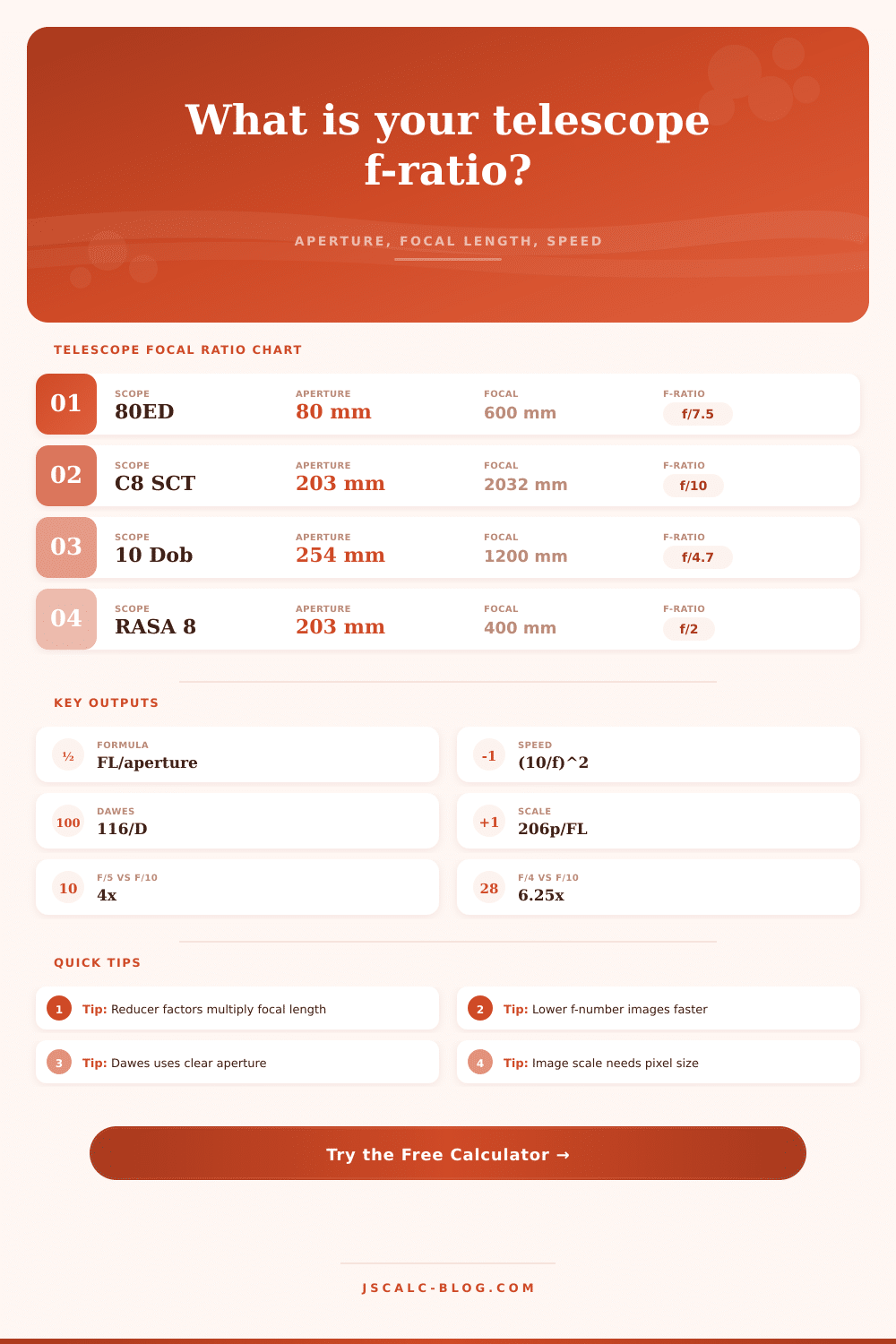
Focal ratio: f/# = focal length / aperture. A 600 mm focal length with an 80 mm aperture gives 600 / 80 = f/7.5.
Aperture from focal ratio: aperture = focal length / f-ratio. A 1000 mm telescope at f/5 requires 1000 / 5 = 200 mm aperture.
Optical factor: effective focal length = native focal length x reducer or Barlow factor, so the effective f-ratio changes by the same factor when aperture stays fixed.
Imaging speed: relative speed vs f/10 = (10 / effective f-ratio)2. Lower f-numbers collect the same surface brightness in less time.
Resolution: Dawes limit = 116 / aperture in mm. Rayleigh at the selected wavelength is approximately 251.64 x wavelength_nm / aperture_mm milliarcseconds.
| Telescope Type | Aperture | Native Focal Length | Native Focal Ratio | Typical Use |
|---|---|---|---|---|
| 80 mm ED refractor | 80 mm | 600 mm | f/7.5 | Wide-field visual and imaging |
| 102 mm APO refractor | 102 mm | 714 mm | f/7.0 | Lunar, clusters, nebulae |
| 6 inch imaging Newtonian | 150 mm | 750 mm | f/5.0 | Fast deep-sky imaging |
| 10 inch Dobsonian | 254 mm | 1200 mm | f/4.7 | Visual galaxies and nebulae |
| 8 inch Schmidt-Cassegrain | 203 mm | 2032 mm | f/10.0 | Compact long focal length |
| 127 mm Maksutov-Cassegrain | 127 mm | 1500 mm | f/11.8 | Lunar and planetary detail |
| 8 inch RASA astrograph | 203 mm | 400 mm | f/2.0 | Very fast wide-field imaging |
| 60 mm guide refractor | 60 mm | 240 mm | f/4.0 | Guiding and wide views |
| Effective f-ratio | Speed vs f/10 | Equivalent f/10 Exposure | Same Signal Exposure |
|---|---|---|---|
| f/2.0 | 25.00x faster | 300 s at f/10 | 12 s at f/2 |
| f/3.0 | 11.11x faster | 300 s at f/10 | 27 s at f/3 |
| f/4.0 | 6.25x faster | 300 s at f/10 | 48 s at f/4 |
| f/5.0 | 4.00x faster | 300 s at f/10 | 75 s at f/5 |
| f/6.3 | 2.52x faster | 300 s at f/10 | 119 s at f/6.3 |
| f/7.5 | 1.78x faster | 300 s at f/10 | 169 s at f/7.5 |
| f/10.0 | 1.00x baseline | 300 s at f/10 | 300 s at f/10 |
| f/12.0 | 0.69x slower | 300 s at f/10 | 432 s at f/12 |
| Aperture | Dawes Limit | Rayleigh 550 nm | Common Class |
|---|---|---|---|
| 60 mm | 1.93″ | 2.31″ | Guide or travel refractor |
| 80 mm | 1.45″ | 1.73″ | Small ED refractor |
| 102 mm | 1.14″ | 1.36″ | Four inch refractor |
| 150 mm | 0.77″ | 0.92″ | Six inch reflector |
| 203 mm | 0.57″ | 0.68″ | Eight inch SCT |
| 254 mm | 0.46″ | 0.55″ | Ten inch Dobsonian |
| 305 mm | 0.38″ | 0.45″ | Twelve inch reflector |
| Optical Factor | Effect on Focal Length | Effect on Focal Ratio | Common Telescope Context |
|---|---|---|---|
| 0.33x reducer | Multiplies by 0.33 | f/10 becomes f/3.3 | Small-chip SCT video work |
| 0.50x reducer | Multiplies by 0.50 | f/10 becomes f/5.0 | Electronically assisted astronomy |
| 0.63x reducer | Multiplies by 0.63 | f/10 becomes f/6.3 | Classic SCT deep-sky setup |
| 0.75x reducer | Multiplies by 0.75 | f/7 becomes f/5.25 | Refractor flatteners or reducers |
| 0.80x reducer | Multiplies by 0.80 | f/6 becomes f/4.8 | Common imaging refractor reducer |
| 1.50x Barlow | Multiplies by 1.50 | f/5 becomes f/7.5 | Moderate lunar magnification |
| 2.00x Barlow | Multiplies by 2.00 | f/5 becomes f/10 | Planetary imaging and visual use |
| 3.00x Barlow | Multiplies by 3.00 | f/5 becomes f/15 | High magnification planetary work |
Your telescope’s tube has some print somewhere that lists it’s focal ratio. That’s your speed limit when it comes to light.
Your telescope’s focal ratio is a simple division. Divide your telescope’s focal length by its aperture, that number represents the relative speed at which photons is hitting your camera sensor. It determines your image scale, your exposure time and frequently, your sanity in the middle of chilly dark astrophotography session.
What is Focal Ratio and Why It Matters
To make it easy, we have a calculator here (above) that does all the math for you based off the size of your mirrors or lenses. That way, you don’t waste time wondering if a reducer realy speeds up your set-up.
Keep in mind: Focal ratio has nothing to do with how much light your scope gathers. That’s completely dependent upon aperture. The aperture stay unchanged and adding reducers or Barlows does not affect it. However, they change the effective focal length which alters the f-ratio.
For instance, if you have a f/5 scope and add a two times Barlow, now you’re doing f/10 imaging. It do cut the field of view in half. You must double the exposure time to get the same signal to noise ratio. It is a straight trade-off.
On that note, the page has a handy reference table that shows that when you take a classic SCT and apply a zero point six three times reducer, you go from a f/10 cumbersome instrument to a significantly more managable f/6.3 imaging machine. Sometimes the difference is between getting that core of a galaxy in ten minutes versus waiting around for an hour for the same amount of data.
It’s nice to see how conditions can add some extra wrinkle that no amount of simple math can account for. For example, perhaps you have a scope that will resolve something down to half an arcsecond? But maybe atmosphere at home blurs everything to a star to three arcseconds so that added resolution won’t help anyway.
Now you can enter your usual seeing conditions and the tool will tell you the scale of the images it will generate and whether your pixels is oversampled or undersampled for your local conditions. Too much sampling creates noise, too little means wasted resolution. It’s less science than art, which is why finding the sweet spot is as much about patience then perfection.
Theoretical limits to sharpness include Dawes limit and Rayleigh criterion. These will tell you how close together two object must be to theoretically resolve them with your optics if the seeing was perfect. The reality is that central obstructions, collimation error, and cooling of the optics often make the image softer long before the atmosphere come into play. A good collimated mirror beats an out of alignment perfect optic every time.
This helps you visualize those tradeoffs immediately. The tool comes preloaded with several presets that show how a super fast f/2 astrograph compares to say, a standard refractor at f/7.5. Fast means active cooling and strict need for guiding because the depth of field is razor thin. Slow optics is forgiving but punish you with long nights.
In the end, then, it’s just a matter of fitting your tools to your goal: Slow f-ratios and big magnifications works well for planetary observing… They’ll pull out fine detail. Wide field, speedy optics are good for nebula hunting… Catch that faint glow while there’s still time because soon enough the sky will be light.
No single number works best, just the one that does the job you set yourself to do. Once you know how ratio interacts with aperture and length, that static figure on the side of your telescope becomes an active planning aid for making the most of every clear night. It’s a simple bit of mathematics but its consequences for your clear nights are great. You should of known your ratio means your timeline.