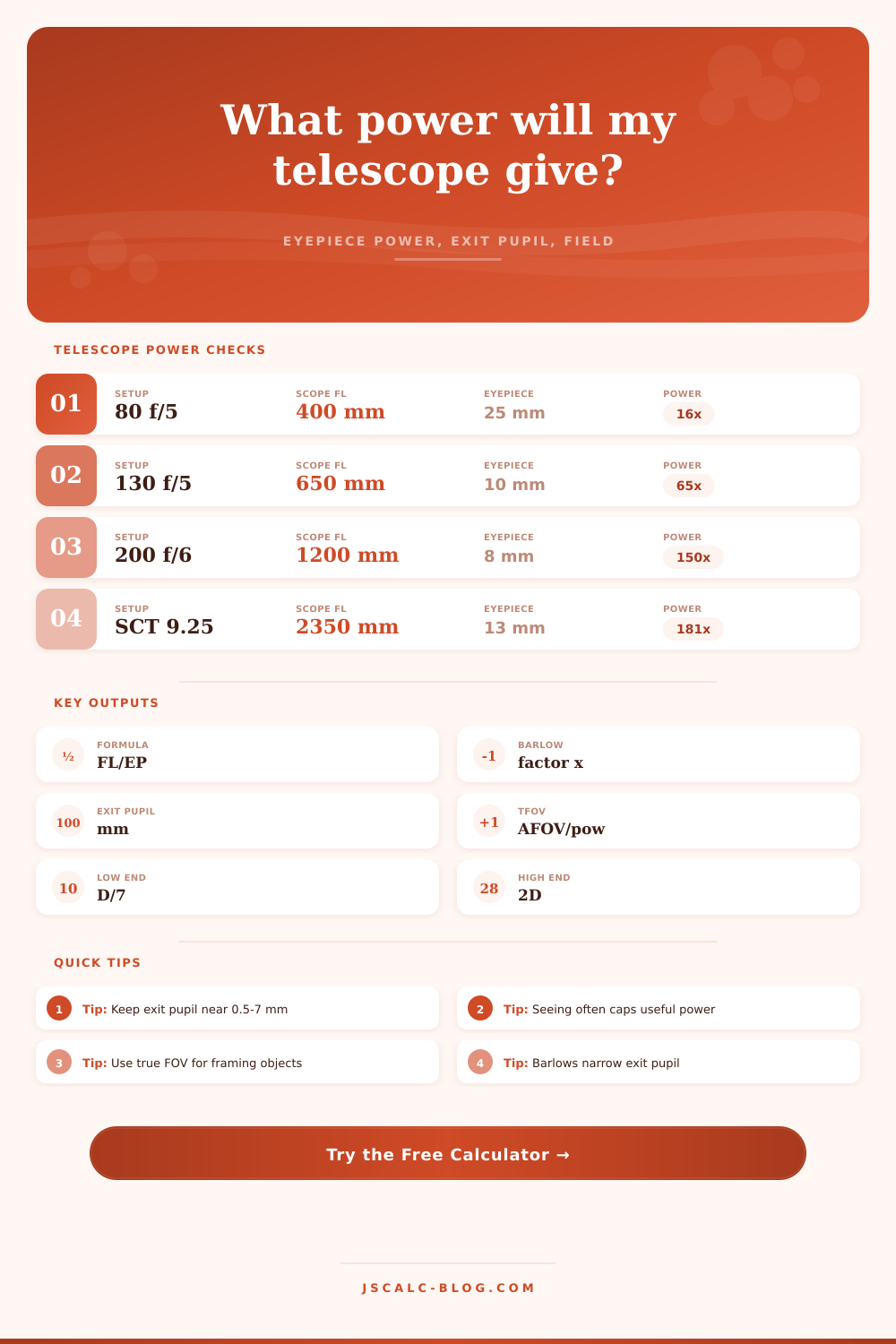
Telescope Magnification Calculator
Calculate eyepiece power with Barlow or reducer factor, exit pupil, useful magnification range, and estimated true field of view.
Magnification = telescope focal length / eyepiece focal length, then multiplied by the Barlow or reducer factor. A 1200 mm telescope with a 10 mm eyepiece gives 120x; adding a 2x Barlow gives 240x.
Exit pupil = aperture / magnification. True field of view is estimated as apparent field / magnification, which is close enough for planning eyepiece choices before field-stop data is available.
| Quantity | Formula | Good Planning Range | Why It Matters |
|---|---|---|---|
| Magnification | Scope FL / eyepiece FL x factor | About 20x to 300x for many scopes | Sets image scale and brightness. |
| Exit pupil | Aperture / magnification | 0.5 mm to 7 mm | Predicts image brightness at the eye. |
| Low useful power | Aperture / 7 | 6x to 115x by aperture | Largest practical bright beam. |
| High useful power | About 2 x aperture mm | Seeing-limited at night | Upper bound before empty power. |
| True FOV estimate | Eyepiece AFOV / magnification | 0.1 deg to 4 deg | Shows how much sky fits in view. |
| Power per inch | Magnification / aperture inches | 5x to 50x per inch | Quick check for useful detail. |
| Telescope | Aperture | Focal Length | Focal Ratio | Useful Range |
|---|---|---|---|---|
| Short-tube refractor | 80 mm | 400 mm | f/5 | 11x-160x |
| ED travel refractor | 72 mm | 432 mm | f/6 | 10x-144x |
| Beginner refractor | 60 mm | 700 mm | f/11.7 | 9x-120x |
| Compact Maksutov | 90 mm | 1250 mm | f/13.9 | 13x-180x |
| Tabletop Newtonian | 130 mm | 650 mm | f/5 | 19x-260x |
| Classic Dobsonian | 200 mm | 1200 mm | f/6 | 29x-400x |
| Schmidt-Cassegrain | 235 mm | 2350 mm | f/10 | 34x-470x |
| Large Dobsonian | 300 mm | 1500 mm | f/5 | 43x-600x |
| Eyepiece | 800 mm Scope | 1200 mm Scope | 2000 mm Scope | Typical Role |
|---|---|---|---|---|
| 32 mm | 25x | 38x | 63x | Finder, widest view |
| 25 mm | 32x | 48x | 80x | Low-power scan |
| 18 mm | 44x | 67x | 111x | Open clusters |
| 13 mm | 62x | 92x | 154x | General detail |
| 10 mm | 80x | 120x | 200x | Moon, planets |
| 8 mm | 100x | 150x | 250x | High power |
| 6 mm | 133x | 200x | 333x | Steady-night detail |
| 4 mm | 200x | 300x | 500x | Rare excellent seeing |
| Exit Pupil | Brightness | Best Targets | Common Feel |
|---|---|---|---|
| 6-7 mm | Very bright | Milky Way fields, large nebulae | Lowest useful power for dark skies. |
| 4-6 mm | Bright | Open clusters, sweeping | Comfortable finder eyepiece range. |
| 2-4 mm | Balanced | Moon, many galaxies, globulars | Often the most used range. |
| 1-2 mm | Dimmer detail | Planets, lunar craters, doubles | Good high-power working range. |
| 0.5-1 mm | Dim | Fine planetary or double-star work | Requires steady air and focus. |
| Under 0.5 mm | Very dim | Special cases only | Often empty power visually. |
Average seeing often makes 150x to 220x more useful than a theoretical maximum. If stars shimmer badly at low power, use a longer eyepiece before adding a Barlow.
For most visual observing, 0.7 mm to 4 mm exit pupil covers detail and brightness well. Large nebulae may need 5 mm or more, while planets often tolerate 0.8 mm to 1.5 mm.
Take the following scenario: You’re standing in your back yard looking through a telescope at some far off galaxy or maybe even Saturn with detail on it. What do you want to do? You naturaly want more magnification; the more, the better, right? That is wrong. That’s where a lot of newbies are trapped.
Don’t think that magnification is a feature of the telescope alone. No, no. It’s a combination of the telescope optics plus what eyepiece you puts into it.
Why More Magnification Is Not Always Better
Once you input your specs into the calculator, it does all the work for you. There’s no guesswork like doing the old divide by 2 thing. Then you’ll know if you have the correct power or if you have a dark image that just won’t focus. It’s all fairly easy math. The formula goes like this: divide the focal length of your telescope by the focal length of your eyepiece. This results in one hundred and twenty times magnification for a telescope with a twelve hundred millimeter focal length and a ten millimeter eyepiece.
Sounds simple enough right? Until you throw in modifiers. Add a two times Barlow lens and double the focal length (two hundred forty) of the effective focal length. But now what good is power without knowing whether it’s useful power or just empty magnification? Here’s where the exit pupil comes into play. This is the beam of light that travels from the eyepiece and into your eye. How big the exit pupil is will dictate how bright something appear.
Seven-millimeters will flood your retinas with light but provide very little magnification. It is perfect if you want to sweep large nebulae but awful when trying to get details on planets. Shrink that exit pupil down to a millimeter and you’ll have more scale, sharper images, but it will be much dimmer. That’s why most observers feel the most well-balanced views falls somewhere between two- and four-millimeters, which the calculator figures out for you.
You must make adjustments to account for atmospheric conditions that no calculator can entirely predict. The air over your back yard is not static. It churns with turbulence and heat. If low power makes stars twinkle violently, then high power will only make them twinkle even more. Optical ability may give you three hundred times magnification; yet the atmosphere may limit you to one hundred fifty. That’s the reality check. The reference table show useful magnification ranges for common setups to help you see those limits. It reminds you that sometimes bigger isn’t better. Sometimes the atmosphere won’t hold the image.
Another practical limitation is field of view. With high magnification, your window on the sky gets small. What filled the window at low power may go out of frame at high. The tool includes a true field estimate to help you see how much of the sky will be contained within circle. And it’s not only about power; it’s also about framing. How much width do you need to find the target before zooming in for detail?
Observers often overlook this point, and end up lost in black space having jumped directly from low to high power without any anchor of a wide-field view.
While beginners often get stuck with the assumption that more power is better, choosing an eyepiece isn’t just about chasing numbers; it’s a matter of making the match between target and tool. High power plus steady air equals planets. Low power plus aperture equal galaxies (to collect those faint photons). The pre-set buttons on the calculator help in simulating these conditions and then allow you to decide what will work best for your specific situation before purchasing equipment.
Try your scope with a certain eyepiece and see what happens if you insert that same Barlow into the mix. That eliminates the fear of the unknown.
In conclusion, good magnification is finding what lets you see the most while still seeing the structure with enough contrast. Optics, stability, light. Let the clearest image be your guide instead of getting hung up on the largest number. Once you understand how the atmosphere, aperture, and focal length work together, it’s no longer a guessing game. It becomes observation. And that matters more than some theoretical max power rating.