Years to Days Converter
Convert years into days with average Gregorian, common, leap, custom, and date-aware calendar modes, including fractional years and rounded outputs.
⚡Quick Presets
📝Conversion Inputs
Years to Days Result
📊Basis Comparison Grid
Average
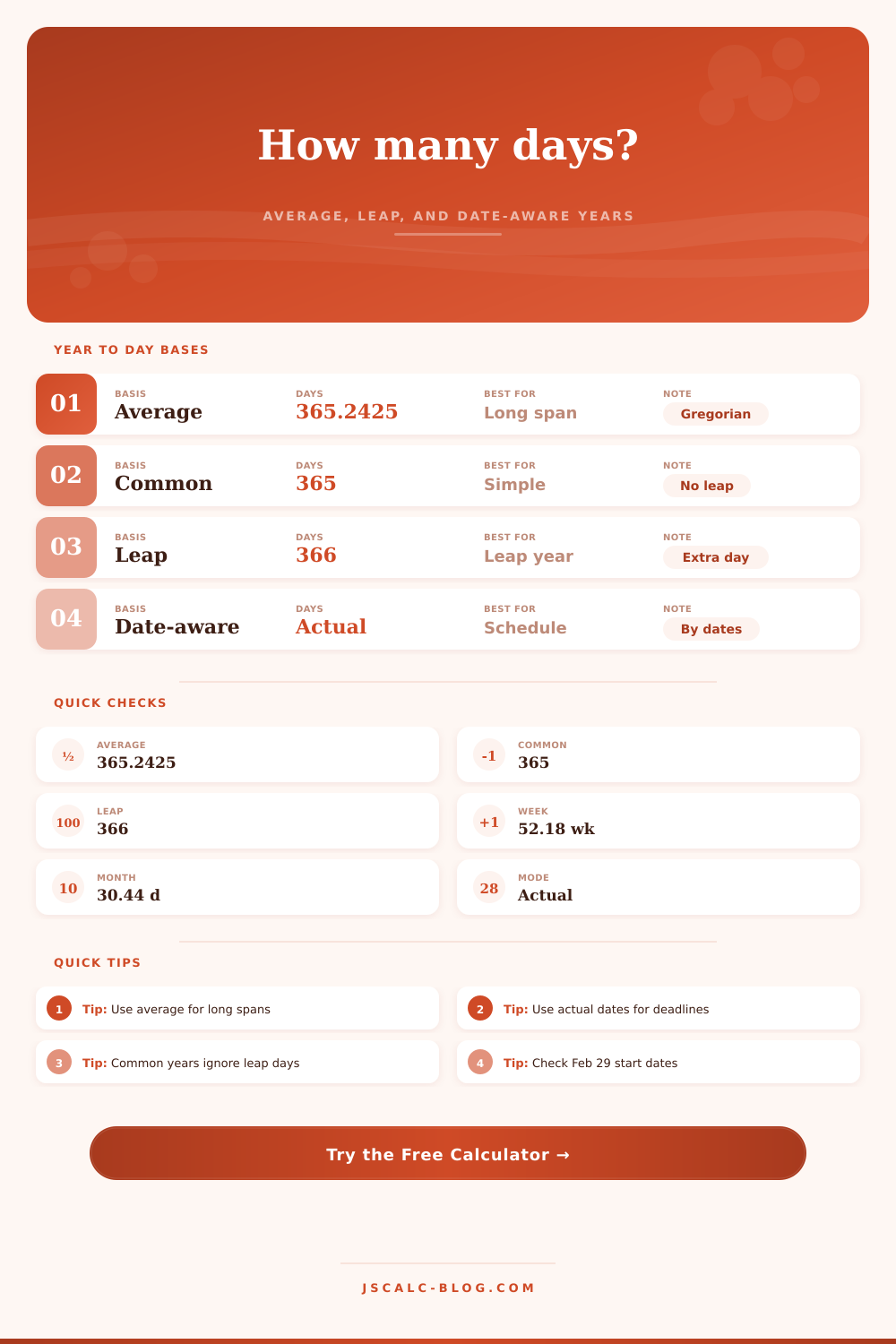
365.24Gregorian mean: 365.2425 days per year.
Common
365.00Standard non-leap year with no extra day.
Leap
366.00Leap-year model with February 29 included.
Actual
365.00Date-aware count from the selected start date.
🧮Year Basis Facts
📘Reference Tables
| Basis | Formula | 1 Year | Best Use | Watch Point |
|---|---|---|---|---|
| Average Gregorian | years × 365.2425 | 365.2425 days | Long-term planning | Can create fractional days |
| Common year | years × 365 | 365 days | Simple estimates | Ignores leap days |
| Leap year | years × 366 | 366 days | Leap-year spans | Overstates ordinary years |
| Date-aware | end date - start date | Actual days | Deadlines and anniversaries | Start date matters |
| Custom | years × custom days | User-set days | Accounting or model calendars | Not a civil calendar |
| Years | Average Days | Common Days | Leap Days | Weeks from Average |
|---|---|---|---|---|
| 0.25 | 91.31 | 91.25 | 91.50 | 13.04 |
| 0.5 | 182.62 | 182.50 | 183.00 | 26.09 |
| 1 | 365.24 | 365.00 | 366.00 | 52.18 |
| 2 | 730.49 | 730.00 | 732.00 | 104.36 |
| 5 | 1826.21 | 1825.00 | 1830.00 | 260.89 |
| 10 | 3652.43 | 3650.00 | 3660.00 | 521.78 |
| Start Date | Calendar Years | End Date | Elapsed Days | Reason |
|---|---|---|---|---|
| 2023-01-01 | 1 | 2024-01-01 | 365 | 2023 is common |
| 2024-01-01 | 1 | 2025-01-01 | 366 | 2024 is leap |
| 2024-02-29 | 1 | 2025-02-28 | 365 | Adjusted anniversary |
| 2026-07-01 | 2 | 2028-07-01 | 731 | Includes Feb 29, 2028 |
| 2027-03-15 | 3 | 2030-03-15 | 1096 | Includes 2028 leap day |
| Output | Formula | Example from 1 Average Year | Useful When |
|---|---|---|---|
| Days | years × basis days | 365.2425 days | Primary conversion |
| Weeks | days / 7 | 52.1775 weeks | Schedule blocks |
| Average months | days / 30.436875 | 12 months | Monthly comparisons |
| Hours | days × 24 | 8765.82 hours | Runtime estimates |
| Minutes | days × 1440 | 525949.2 minutes | Fine-grain duration |
✅Practical Tips
Then it’s February 29th and you’ve started a new job. The handbook says how long you’ll be on probation: precisely one year. Next February 29th rolls around. Except there isnt any such day. The system defaults to the 28th, a minor violation of fairness.
It’s a small calendar oddity that makes converting between years and days rarely simple. In particular, when you say “a year” what do you mean? Define it in your own terms (which may or may not include leap years), then let the tool above does the calculation for you.
How to Choose the Right Year Definition
When we have to estimate or round quickly in our head, most of us goes with 365 days; it’s what we learned back in elementary school. For those case it gets the job done. As soon as you move past a leap year boundary it breaks down. In reality, there are about 365.2425 days in average Gregorian year. That little decimal fraction represent the slight corrections made over centuries. It also accounts for the fact that we need an additional day every fourth year.
When you’re planning on doing something for five years and don’t account for that fraction, it compounds up into close to twelve lost days. That’s practically a whole work month that slipped through your fingers without you even realizing.
With that exact average, plus the typical year, the leap year, and the date aware mode, you can switch back and forth with ease in the calculator. Your choice depend on what you wish to protect.
Is it an exact number of days for a biological incubation period or a concrete cure time? Then you will select the date aware mode. Then you will select the exact average. Do you want to know how many real calendar days there are from your start to finish point? The one you want is the date-aware mode. That’s the one that takes into account the size of each month and the odd length of February. It doesn’t give a hoot about averages, it gives a hoot about the clock.
Compare that to something like long term trend analysis, or financial modeling. In those cases, it’s typically the average year you’d be after. Because of those leap year differences, you tend to smooth the data into a neutral baseline so it is not affected by the specific years you choose. It is a statistical convenience. On a one-year scale, there isn’t much difference between the average year and the common year. Over decades, it become meaningful. Most folks miss that bit. Tiny differences in how you define rates accumulate into big schedule slippage.
And then there’s the custom day feature (for those operating on a simpler internal model or an accounting calendar). For some industries, it makes sense to work on a 360-day year (because it divides cleanly). The month becomes a tidy unit of measurement. Of course, it’s a fiction. Ten equal months dont divide up evenly into the real world. But if your legacy software system or your contract runs on that fiction, enter it that way into the custom input. In these closed loops, consistency beats astronomical accuracy.
It gets even more complicated with fractional years. Half a year… What’s that? Exactly 182.5 days? Or is it based off how many months you’re including? A half-year that spans from January to June have different seasonal influences than one that spans July to December.
Decimals are handled differently by the tool. It allows you to select between using the remaining days within the actual calendar year, or applying an average factor to the whole time period. That changes your end date and it changes when you feel the pressure of the deadline.
The last trap is rounding. You might round up, if it helps you avoid a technical deadline. Or you might round down, if it keeps you under some kind of budget cap. On the calculator, it shows the exact number, and then also shows the rounded number, both together, so that you can compare them and know how close or far you’re being from the actual answer. That require you to know the uncertainty involved in converting.
Clean numbers feel good. A plan is something we can predict. And time isn’t clean. It’s all exceptions and irregularities and messiness. Good converters don’t try to fool you on that fact. They provide you with the tools to adjust for the mess.
If you’re measuring out a subscription window or a lease term, get your day count defined up front so you should of saved yourself from the February surprise. You’ll know when it’s ticking. Be certain you’re counting those ticks rightly.