Lunar Age Calculator
Calculate the Moon's age in the current synodic cycle, phase name, phase angle, illumination, and estimated next new, full, and quarter moon times.
Lunar Age Result
| Phase | Approx age | Phase angle | Illumination | Cycle direction |
|---|---|---|---|---|
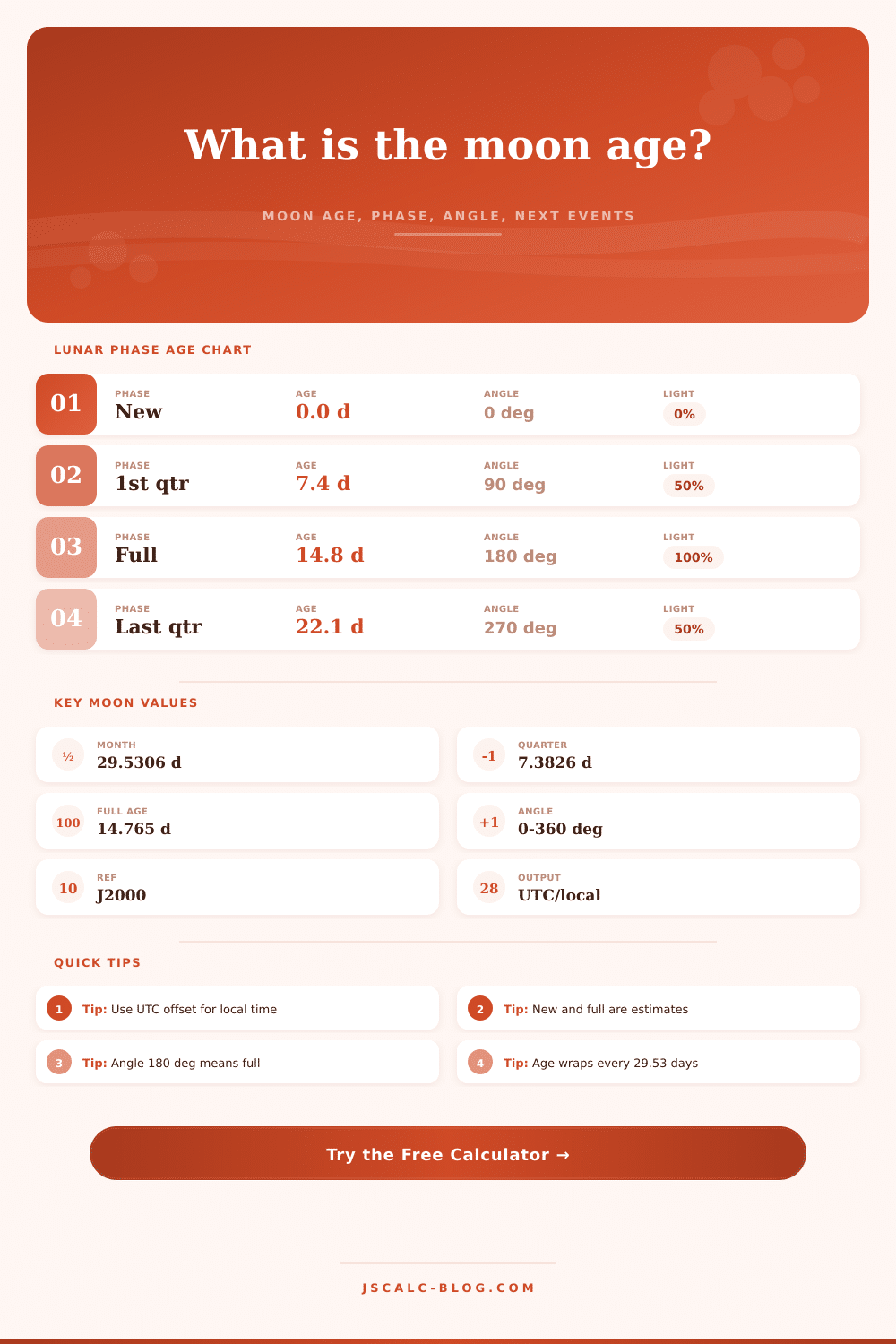
| New Moon | 0.0 days | 0° or 360° | 0% | Start of cycle |
| Waxing Crescent | 1.8 to 5.5 days | 22.5° to 67.5° | Growing | Toward first quarter |
| First Quarter | 7.4 days | 90° | About 50% | Waxing |
| Waxing Gibbous | 9.2 to 12.9 days | 112.5° to 157.5° | Growing high | Toward full moon |
| Full Moon | 14.8 days | 180° | Near 100% | Mid-cycle |
| Waning Gibbous | 16.6 to 20.3 days | 202.5° to 247.5° | Shrinking high | Toward last quarter |
| Last Quarter | 22.1 days | 270° | About 50% | Waning |
| Waning Crescent | 24.0 to 27.7 days | 292.5° to 337.5° | Shrinking low | Toward new moon |
| Event | Target age | Target angle | How estimate is found |
|---|---|---|---|
| Next New Moon | 0 or 29.5306 days | 0° | Add the remaining cycle length to the observation time. |
| Next First Quarter | 7.3826 days | 90° | Add the wrapped difference from current age to one quarter cycle. |
| Next Full Moon | 14.7653 days | 180° | Add the wrapped difference from current age to half cycle. |
| Next Last Quarter | 22.1479 days | 270° | Add the wrapped difference from current age to three quarter cycle. |
| Step | Formula | Purpose | Output |
|---|---|---|---|
| 1 | UTC time = local time - offset | Places the observation on one time scale. | Timestamp |
| 2 | Days = (UTC - reference) / 86400000 | Counts days since a known new moon. | Elapsed days |
| 3 | Age = Days mod 29.530588853 | Wraps elapsed days into one lunar cycle. | Moon age |
| 4 | Angle = Age / 29.530588853 x 360 | Converts age to phase angle. | Degrees |
| 5 | Light = (1 - cos angle) / 2 | Approximates the illuminated fraction. | Percent lit |
| Reference option | UTC timestamp | Best use | Note |
|---|---|---|---|
| J2000 reference | 2000-01-06 18:14 | Default moon age calculations | Stable modern reference |
| 2024 solar eclipse | 2024-04-08 18:21 | Recent eclipse comparison | Near new moon |
| 2023 new moon | 2023-08-16 09:38 | Blue moon month checks | Same lunation series |
| 2017 solar eclipse | 2017-08-21 18:30 | Historical eclipse checks | Near new moon |
| Unix cycle reference | 1969-12-08 21:43 | Software timestamp testing | Cycle before 1970 |
| 2026 new moon | 2026-01-18 19:52 | Near-term calendar checks | Mean-cycle anchor |
Every night, the Moon look different; and it always does so according to a rigid pattern: From one new moon to the next take roughly 29.53 days, known as synodic month. That means it plays into rhythm of the week (and the reason we name the weeks what we do), tides, and even our calendars (whether used by farmers or sailors). When you’re predicting when high tide will be, or scheduling that photo shoot, knowing where you are in cycle helps you out. The calculator above does all the tricky math for you; you don’t have to count days yourself from some point of reference.
The time zone is wrong. The lunar phase occurs everywhere on Earth, but not at exactly the same time, which depend upon Universal Coordinated Time (UTC). For example, it might be 12 midnight right now in New York City, but then it’s 5:00 AM in Greenwich. Those five hours make all the difference when calculating age of the moon; it could make the difference between seeing a full moon rather than a waxing crescent. To sync up with how things work in the universe, you need to accurately specify the UTC offset so that the timestamp match. It is a little thing, but it is important if you want accuracy for navigational or scientific purposes.
How to Use the Moon Calculator
It uses a specific new moon as starting point. Moddern astronomy has standardized on using the year 2000 as its epoch (J2000). By using standard reference, everyone who calculates will be doing so based off the same system. To switch references to another time, you might enter recent solar eclipse or date of Apollo 11 landing. The calculator show what phase the Moon was at that moment. That’s not only good for planning but also for understanding history. You can even switch the reference to specific historical events, like the Apollo 11 landing or a recent solar eclipse, to see the Moon’s state on those days.
The fraction of the Moon’s disk reflecting Sun’s rays to Earth is what we call its illumination. Brightness depend on the angle between the three bodies: the Sun, the Moon and the Earth. If the Moon is at an angle of 180 degrees, it mean that the Earth is positioned between the other two, making it a full moon with nearly 100 percent illumination. A new moon has no illumination; in fact, it’s at an angle of 0 degrees because then the Moon is between Sun and Earth. The calculator take the number of days elapsed and translates that into the angular position which can be translated directly into a specific measure of brightness (as opposed to some vague label). That information assist astrophotographers when they want to determine just how bright the Moon will be for long exposure photography.
The math is easy enough: in theory, moon age is just number of days since new. In practice, it’s complicated. The Moon orbits an elliptical path, which mean it’s moving fast or slow depending on how far out it is from Earth (close = fast; far = slow). Averaging those changes over time give us the mean synodic month. This means the calculator will give you a ballpark guess for general planning. However, it might not be exact to the second for the moment the Moon actualy changes phase, it could of been off by a few hours either way. That’s plenty precise for most people anyway. It will take you through the cycle but you will have to make real-time tweaks based on orbital changes.
Gardeners use lunar calendars, because many think some of the moon’s phases promotes better growth in crops. Science isn’t convinced. But whatever. The tool will tell you what day is before or after new or full moon, meaning you can plan accordingly, as has long been traditional. It’s useful for photographers who shoot at night, too, seeking star photos unimpeded by the moon. If they know when the new moon happen, they can plan their nighttime shooting for when the sky will be darkest.
A chart on the page explains connection between illumination level (and thus age) to name of the phase. Moon Phases If you’re someone who likes to look at the night sky, as a photographer, amateur astronomer, or just out of curiosity; knowing how it works and what’s going on makes the whole thing better. Knowing how the Moon works is meaningful because it has affected our lives for thousands of years and connecting to that natural rhythm matter. Here, the tools take that motion and help you turn it into something practical: actionable information about where the moon is in her cycle right now. Exactly. Where in sky is she? What is her next step in her journey around us? You know. And that helps you see the world more clear.