Moon Phase Calculator
Find lunar age, phase angle, illuminated fraction, phase name, and the next full or new moon timing from any calendar date.
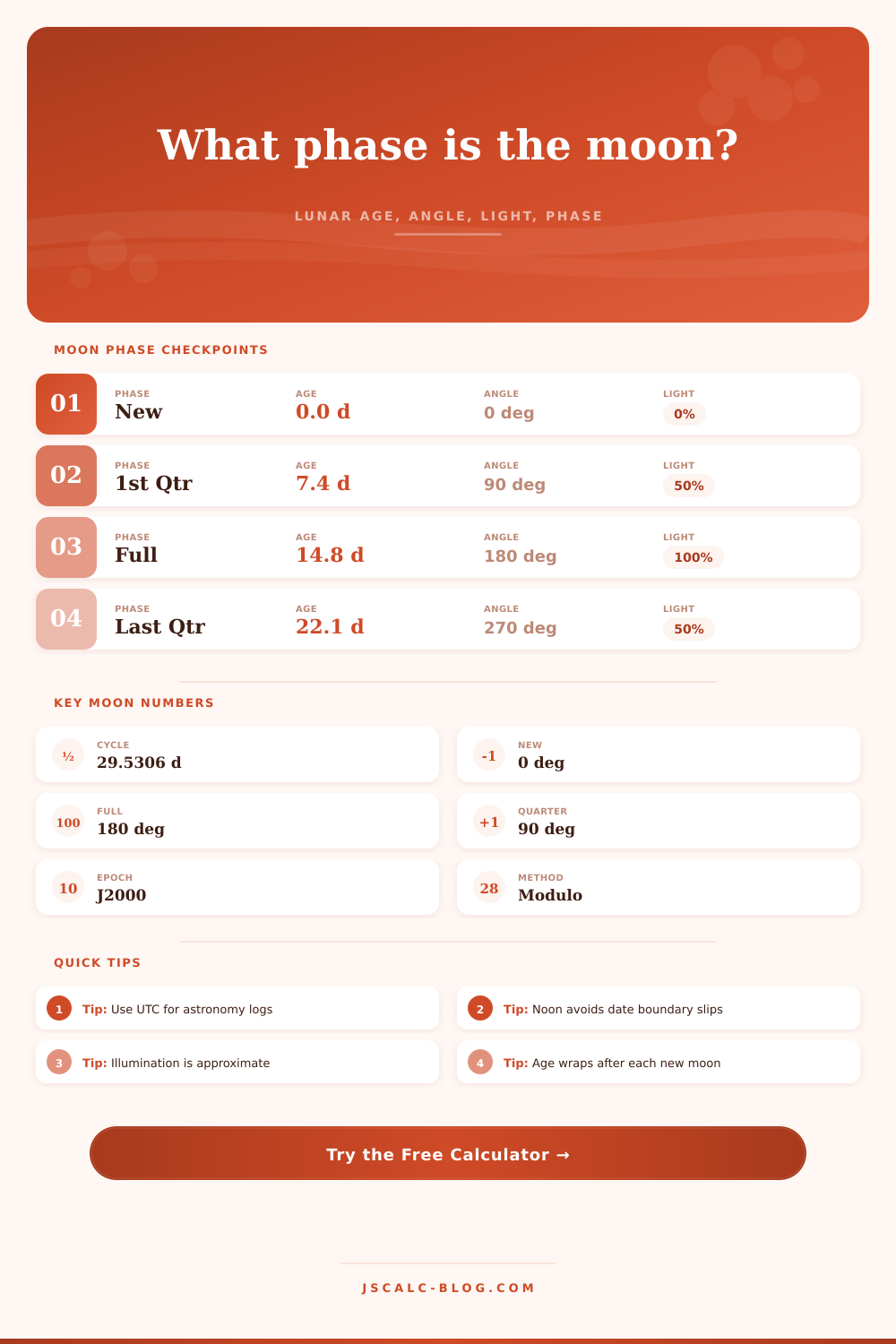
Synodic month: 29.530588853 days, the mean interval from one new moon to the next.
Lunar age: days since known new moon modulo 29.530588853. The modulo step wraps every completed lunation back to age 0.
Phase angle: 360 × lunar age / 29.530588853. New moon is near 0°, full moon is near 180°.
Illumination approximation: (1 - cos(phase angle)) / 2. The result is multiplied by 100 for percent illumination.
| Phase | Age range | Angle range | Illumination trend |
|---|---|---|---|
| New Moon | 0.0 to 1.8 d or 27.7 to 29.5 d | 0° near wrap | Dark or very thin |
| Waxing Crescent | 1.8 to 5.5 d | 22.5° to 67.5° | Increasing below half |
| First Quarter | 5.5 to 9.2 d | 67.5° to 112.5° | Near 50 percent |
| Waxing Gibbous | 9.2 to 12.9 d | 112.5° to 157.5° | Increasing above half |
| Full Moon | 12.9 to 16.6 d | 157.5° to 202.5° | Brightest part of cycle |
| Waning Gibbous | 16.6 to 20.3 d | 202.5° to 247.5° | Decreasing above half |
| Last Quarter | 20.3 to 24.0 d | 247.5° to 292.5° | Near 50 percent |
| Waning Crescent | 24.0 to 27.7 d | 292.5° to 337.5° | Decreasing below half |
| Event date | Preset purpose | Expected phase | Useful check |
|---|---|---|---|
| 2024-04-08 18:21 UTC | Total solar eclipse day | New Moon | Age close to 0 days |
| 2023-08-31 01:35 UTC | Super Blue Moon | Full Moon | Age near 14.8 days |
| 1969-07-20 20:17 UTC | Apollo 11 landing | Waxing Crescent | Young visible moon |
| 2022-12-11 17:40 UTC | Artemis I splashdown | Waning Gibbous | Past full moon |
| 2024-01-25 17:54 UTC | January full moon | Full Moon | Angle near 180° |
| 2022-09-10 09:59 UTC | Harvest Moon | Full Moon | High illumination |
| Anchor | Julian day | Best use | Notes |
|---|---|---|---|
| J2000 new moon | 2451550.25972 | General calculator baseline | Stable long-range reference |
| 2024 January new moon | 2460319.77083 | Recent-year comparison | Good for 2024 checks |
| 2024 April eclipse new moon | 2460408.19167 | Eclipse-day testing | Validates age near zero |
| 2024 July new moon | 2460496.40417 | Mid-year calendar work | Reduces accumulated drift nearby |
| 2024 October new moon | 2460584.62917 | Autumn sky planning | Useful around eclipses |
| 2024 December new moon | 2460673.35417 | Year-end estimates | Close to 2025 dates |
Every night, the moon change shape. It changes from a bright disk to a dark void, and back again. For thousands of years, it’s been this rhythm that has helped guide sailors, farmers, and storytellers.
In moddern times, things move fast, most people don’t spend time looking up at the night sky to see what day it is anymore. Instead you pull out your phone and check. But this separation can make it easy to forget just how complex lunar mechanics actualy are.
How to Calculate the Moon Phase
The cycle isn’t as simple as a circle. It’s a precise dance between the sun, the moon, and the Earth. To understand that dance you need more than to guess if the moon appears new or full. You need to know precisely where the satellite is sitting in its orbit compared to light source.
If it were as simple as picking a date, you’d think: “Oh, okay, then I know when it was.” Usually, yes. But sometimes precision makes a difference.
If you’re interested in why this month’s moon isn’t exactly like last month’s, if you plan to photograph it or schedule an observation with a telescope, or if you want to get realy technical about its location in the sky, the calculator up top do the math for you. It simplifies all the complicated stuff about orbital geometry into one clear answer.
First, it knows your date and time (and because we live on Earth, it accounts for your time zone). Then it computes the lunar age, which is how many days have passed since the last new moon. Everything else follow from that lone number. From that single number, the rest of information flows.
We have the phase angle, the moon’s current spot in a 360-degree circle. And we also have the illumination percentage; how large a fraction of the face is lit? They’re related numbers, but they each speak differently. History. Geometry. Light.
This lets you pick known anchor dates for the new moon. Those are fixed points in the timeline; and they keep any little mistakes from getting worse each time around. They also help choose the right anchor date to get the correct answer: The moon’s cycle isn’t precisely 29.5 days. That decimal make a big difference.
Pick your anchor date starting from the wrong new moon and every calculation that follows gets further away from reality. You don’t have to remember those dates. Just use the tool, and it picks them. So you can concentrate on what happens next instead of whether you got something wrong going into it.
The names of the phases are also mistaken for what they look like. People often confuse phase names with what they actualy look like. A waxing gibbous moon is not quite full. It’s increasing in size to full moon, but there is still a sliver missing from its face. A waning crescent isn’t just a thin slice of moon. That’s a moon that has come past full and is decreasing in size.
Knowing the phases allows for better planning. Photographers will tell you that the first quarter are ideal. Those dramatic shadows show off texture on the lunar landscape. And stargazers will tell you they love their dark-sky nights when the moon is new. Knowing exactly what phase the moon is lets you set your expectations to match. No more guessing about how the night skies should look.
There is one more wrinkle: time zones. Local time doesn’t mean anything to the moon. It move on Universal Time. So when you’re looking at the moon around midnight local time, it could well be past its next phase for somebody in London. Or it could still be in the previous one for somebody in Tokyo.
That’s why the calculator asks for your UTC offset. It makes an adjustment to account for that and ensures the phase you see is actualy what you should see from where you are. That’s right: it will correspond to the moon in your sky, not the moon over Greenwich. (That’s a necessary tweak; otherwise phases around the transition points between phases can confuse.)
Tracing the moon’s path back through history is an old practice, but that doesn’t mean tracking it isn’t relevant today. For anyone who gardens by traditional lunar calendars, or who just wants to appreciate the nighttime skies, it helps to have good information. You can turn a casual peek into something more: an informed look. You can put some order on the beauty of it all.
To know not just that there’s a moon up there, but what the heck its phase is; and once you grasp that calculation, the moon stops being merely a gleam. Instead it becomes your reliable night-time companion, one that you know you’ll spot, and can plan around. Know when to expect what. Know when it’s not looking as you’d anticipated, and know exactly why you should of checked.