Nth Weekday of the Month Calculator
Find the first, second, third, fourth, fifth, or last selected weekday in any month, then validate whether that requested occurrence actually exists.
Nth Weekday Result
Selected Rule
Valid in July 2026.
Last Mode
Last Tuesday in the same month.
Next Month
Same nth weekday rule in next month.
Observed Shift
Difference between requested and observed dates.
| Occurrence | Date | Weekday | Business Flag | Observed Date |
|---|
| Weekday | Count This Month | First Date | Fifth Exists? | Last Date |
|---|
| Month | Requested Rule | Result | Status | Observed |
|---|
| Rule | Calculation | Validation | Best For |
|---|---|---|---|
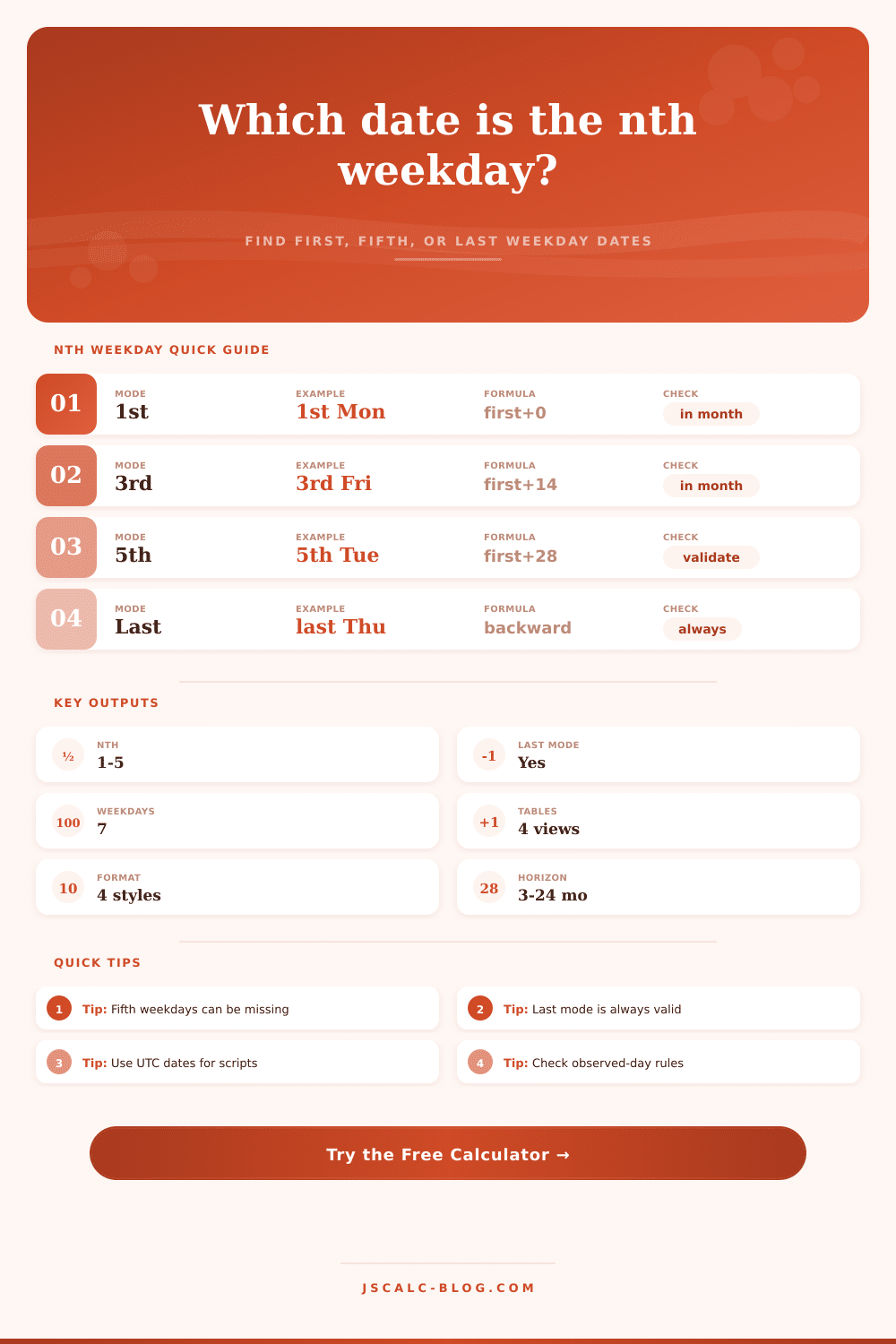
| Nth weekday | first match + (n - 1) x 7 days | Date must remain in the same month | Meetings, payroll, releases |
| Fifth weekday | first match + 28 days | Valid only when the candidate day is within month length | Exception checks and audits |
| Last weekday | last day of month - backward offset | Always has one matching date | Month close and rotations |
| Observed date | move to next, prior, or nearest business day | Uses selected weekend and holiday options | Operational schedules |
| Rolling months | repeat the same rule month by month | Each month validates independently | Recurring calendar planning |
If you have an event that recurs every month (“Monthly Team Sync”) then your calendar probably has a big ol’ gray box in there and you don’t even know what Tuesday it’s going to land on. Why? Because months aren’t all equal chunks of time. Some have 31 days, others have 28, some even has 30. The fact that they’re uneven makes it difficult to try to pin a recurring event to any single day of the week.
I think most folks expect if a day of the week falls on the first week of the month, it’ll be on the fifth as well. But here’s the thing: people gets that part wrong. The calendar doesn’t care about how you schedule things. When you plug your month and year into the calculator above, it does all the work for you, no need to guess about week counts or do math by hand.
Why Your Monthly Calendar is Confusing
That’s because a fifth weekday doesn’t happen very often. It only happens if the first occurrence of the weekday (e.g., the first Monday) falls on or before the third day of the month. Otherwise, it rolls over in the following month (the first Tuesday falling on the fourth means there are only four Tuesdays this month). Attempting to jam one in anyway will result in missed deadlines and/or other scheduling problem. The date-validation feature ensure you don’t embarrass yourself before it’s too late.
The key to improving your planning is understanding relative dates vs. Fixed dates. A fixed date (the fifteenth) always occurs on the same square of the calendar. However, its position in the week change. A relative date (the second Wednesday) always happens on a Wednesday, but it moves around the squares of the calendar. Both have their trade offs.
Fixed dates is easy to recall. But they are less convenient to align with your weekly rhythms. Relative dates honor the weekly rhythm, but then they slide around within the month. With this tool, you can view both sides at once.
You get to pick the weekday you want to happen. Then the calculator will shows you exactly when it’ll occur. It also shows which day in same month was the last instance of that weekday. This can be helpful if you have a role with a dual responsibility, e.g., managers may review finances on the last Friday, but meet about operations on the second Tuesday. Seeing these two together give you an idea of how long the gap is between those two commitments.
The rules above get even more complicated by holiday adjustments. You might need to attend a mandatory meeting on a public holiday, in which case the adjustment will be either forward (to the following business day) or back (the preceding business day). Each organization have its own set of rules. For example, certain financial markets shut down earlier on the eve of a holiday. So depending off the organization(s), an adjustment based on “next business day” is going to make more sense than less.
The tool enables you to specify these observed-date rules so that the date you calculate actualy matches what’s happening in the world, as opposed to just what’s written on the calendar. It is a small detail. This is important if you’re working across teams with different sets of holidays to observe.
The view from one month is like looking through a pinhole: it hides many of the pattern visible when we look ahead a few months on the rolling horizon. For example, if you have a monthly meeting on the third Thursday, do you notice that these events tend to come later in the month during the spring then they do during the fall? That’s because of the “drift” of the days of the week relative to the days of the month. Once you understand that drift, you can expect shorter (or longer) lead time and turn-around requirements.
The table below shows how that rule looks in a six- or 12-month view. The same rule applies different than depending on where in the year you are looking.
The trick to mastering the nth weekday isn’t making the calendar behave; it’s understanding that the calendar is in charge. It has rules, and it will obey them. If you want to live by those rules, you should of known what day your rule points at, precisely. That way you won’t worry so much about being ambiguous.
You’ll know when you’re done guessing and can begin to calculate. Then, your calendar is no longer confusing; instead, it’s a roadmap for your time.