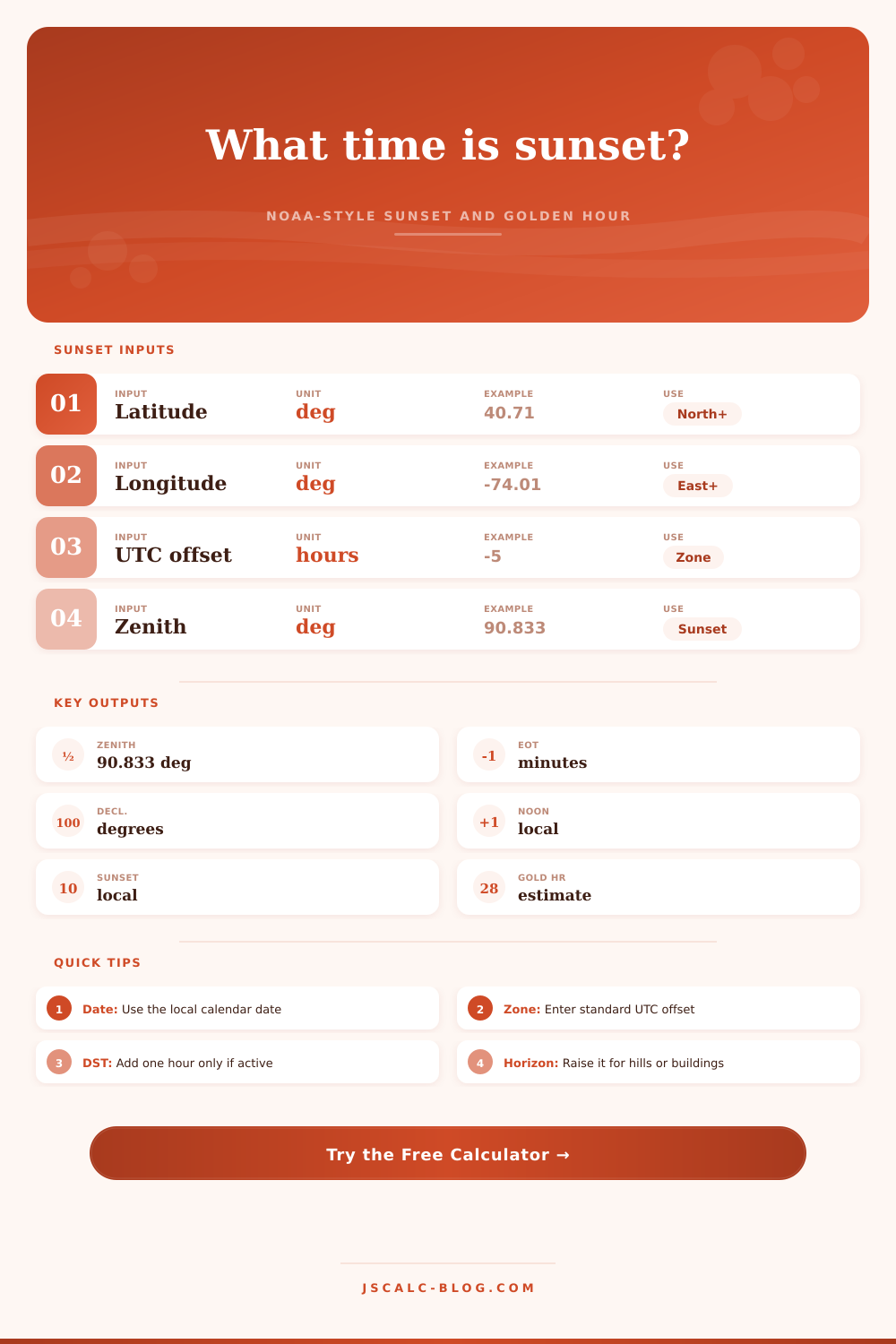
Sunset Time Calculator
Estimate sunset, solar noon, daylight length, and evening golden hour with NOAA-style solar declination, equation of time, zenith, and hour-angle math for JSCalc-Blog.com.
Formula Breakdown
| Step | Expression | What It Produces | Used For |
|---|---|---|---|
| Fractional year | γ = 2π / 365 × (N - 1) | Season position in radians | Declination and EOT |
| Solar declination | δ polynomial in sin/cos γ | Sun angle north or south of equator | Latitude daylight effect |
| Equation of time | EOT = 229.18 × harmonic series | Minutes between clock noon and solar pattern | Solar noon correction |
| Hour angle | cos H = cos Z / (cos φ cos δ) - tan φ tan δ | Angular distance from noon to sunset | Sunset and daylight |
| Sunset time | sunset = solar noon + H / 15 | Local clock sunset estimate | Main result |
| Preset | Latitude | Longitude | Standard UTC Offset | Typical Use |
|---|---|---|---|---|
| New York | 40.7128° | -74.0060° | -5 | Eastern U.S. city planning |
| Los Angeles | 34.0522° | -118.2437° | -8 | Pacific coast summer light |
| Chicago | 41.8781° | -87.6298° | -6 | Central time city sunset |
| Miami | 25.7617° | -80.1918° | -5 | Low-latitude winter sunset |
| Seattle | 47.6062° | -122.3321° | -8 | Northern U.S. long evening |
| Anchorage | 61.2181° | -149.9003° | -9 | High-latitude summer light |
| Honolulu | 21.3099° | -157.8581° | -10 | Tropical island horizon |
| London | 51.5072° | -0.1276° | 0 | Temperate midsummer sunset |
| Sydney | -33.8688° | 151.2093° | 10 | Southern Hemisphere summer |
Solar Noon
Sun crosses the local meridian. Clock time shifts with longitude, time zone, and equation of time.
Golden Hour
Evening estimate from sun altitude 6° down to apparent sunset, useful for warm low-angle light.
Sunset
Standard apparent sunset uses zenith 90.833°, allowing for refraction and the solar disk radius.
Civil Twilight
Begins after sunset and ends near sun altitude -6°, often enough light for outdoor movement.
| Event | Sun Altitude | Zenith | Typical Evening Use |
|---|---|---|---|
| Golden hour start | +6° | 84° | Warm directional light begins |
| Standard sunset | -0.833° | 90.833° | Upper edge of sun disappears |
| Civil twilight end | -6° | 96° | Streetlights and navigation light |
| Nautical twilight end | -12° | 102° | Horizon fades for navigation |
| Astronomical twilight end | -18° | 108° | Dark-sky observing starts |
| Latitude | March Equinox | June Solstice | September Equinox | December Solstice |
|---|---|---|---|---|
| 0° | 12h 07m | 12h 07m | 12h 07m | 12h 07m |
| 20° N | 12h 09m | 13h 21m | 12h 08m | 10h 55m |
| 40° N | 12h 11m | 15h 01m | 12h 09m | 9h 20m |
| 60° N | 12h 15m | 18h 52m | 12h 12m | 5h 52m |
| 40° S | 12h 11m | 9h 20m | 12h 09m | 15h 01m |
What happens if you know that the golden hour isn’t as long as you’d hoped? Panic sets in. You’re standing on the roof (or out over the vista), the camera’s up, and the sky has changed from blue to violet. There’s only one question left. It isn’t when will the sun set, but when will the light be too dim to use for your purposes?
This calculator gives a best guess for when it’ll happen locally based off date, coordinates, time zone, horizon distance and a choice of NOAA-style solar formulas. It include additional output to help plan for golden hour and solar noon. It also shows how much daylight remains. In other words, it converts astronomical unknowns into something you can put on a calendar.
How to Use the Sun Light Calculator
That’s the trick: the math that powers the clock seems so straightforward, but then you start plugging in variables and realize there are some. Not all days has exactly 12 hours of sunlight; sometimes it takes longer to go down than rise, and vice versa. And then there’s the fact that our planet isn’t a perfect sphere or even an ideal circle when viewed from above. Its axis is tilted and its path around the sun are oval. So the sun doesn’t necessarily hit its “high point” at exactly twelve o’clock; it’s often a little later or a little earlier.
That’s where the equation of time comes into play. It corrects the difference between what we call apparent solar time and mean solar time. Without it, your schedule could vary by as much as fifteen minutes depending on the time of year. Most people miss this one. They think the sun follows a strict timetable, but in reality it’s just sort of wandering here and there. When you plug in your location the calculator catches the drift and the rest of the math get handled for you.
The amount of daylight you recieve depends heavily on latitude. That’s what makes winters in Alaska so dark (barely enough for reading a newspaper) and summers so long (endless). The chart on that page clearly shows that daylight lengthens to almost nineteen hours in June at higher latitudes, but shortens to less than six in December. If you’re going to travel, understanding daylight length lets you plan accordingly: bringing the appropriate equipment or timing your activities. You don’t want to reach the top of a mountain ridge, only to realize that you have only twenty minutes of light remaining, when you should of checked the seasonal shift! The calculator provides exact window so you don’t have to guess your time frame.
Geographic location isn’t everything: Your local surroundings also play a role. By default, the standard sunset calculation uses a flat horizon. But nobody lives on a flat plain. If there’s a skyline in front of you, as in many cities, or if you’re in a valley with hills rising to the west, the sun will appear to go down sooner different than officially stated. You can enter the number of degrees the horizon rises. This is typically described in degrees and could represent something like a row of tall buildings blocking the sun before it reaches the theoretical geometric horizon. It could be just a small ridge. Adjusting this up by a few degrees shifts the outcome so that it matches when your eyes actualy saw the sun disappear. That’s a useful adjustment to avoid waiting around in darkness for a sun that has since hid itself behind a roofline.
This output can be especially helpful for filmmakers and photographers looking for the famed “golden hour.” This is where the directionality and warmth come in handy. For filmmakers, it is the perfect time to shoot. The sun is low enough in the sky to cast flattering shadows but still high enough to provide enough light to see. For photographers, this is a flattering light that won’t last long. It starts with the sun at six degrees above the horizon. With that said, you’ll know exactly when the light hits that sweet spot. So, you can run out there and get into place before the window shuts. Ten minutes too late could mean the difference between getting a moody, cinematic shot and something that looks flat and overcast.
Then there’s daylight saving time. And then there are time zones. To use this calculator, you have to enter your time zone as its standard UTC offset. But since daylight saving might not be in effect (or it could be), you also has to account for that. Only do so when daylight saving is actualy being used. This way the resulting time will match what’s on your wall. Solar time is not the same thing as civil time, but by entering your UTC offset and daylight saving adjustment, the calculator crosses that bridge for you.
Enter your location’s fixed information and the current date’s changing information and you get back something you can count on. It’s more of an expectation than exact science, planning by the sun. But knowing when the sun shifts allow you to position yourself accordingly. Knowing when the light changes allows you to be in the right place at the right time.
If you’re building a home, shooting a movie, simply hoping to wrap up that after-work run before nightfall: the sun doesn’t care if you’re looking or not. It goes down regardless. And while it won’t slow its pace for you, you can still get there on time, just as long as you know how to set your watch.