Sunrise Time Calculator
Estimate local sunrise from latitude, longitude, date, time zone, zenith angle, declination, and equation of time using NOAA-style solar geometry.
| Zenith setting | Angle | What it marks | Common use |
|---|---|---|---|
| Official sunrise | 90.833° | Upper limb plus refraction | Weather, almanacs, planning |
| Geometric sunrise | 90.000° | Sun center on ideal horizon | Pure geometry comparisons |
| Civil twilight | 96.000° | Sun center 6° below horizon | Usable outdoor light |
| Nautical twilight | 102.000° | Sun center 12° below horizon | Marine horizon visibility |
| Astronomical twilight | 108.000° | Sun center 18° below horizon | Dark-sky observations |
| Variable | NOAA-style expression | Unit | Role in sunrise |
|---|---|---|---|
| Fractional year | gamma = 2*pi/365*(N-1) | radians | Seasonal position in the year |
| Declination | Fourier series in gamma | degrees | Solar latitude used in cosH |
| Equation of time | 229.18 times Fourier series | minutes | Shifts solar noon from clock noon |
| Solar noon | 720 - 4*longitude - EOT + zone*60 | minutes | Center point between sunrise and sunset |
| Hour angle | acos(cosH) | degrees | Converted to hours by H / 15 |
| Location pattern | Latitude effect | Season effect | Sunrise behavior |
|---|---|---|---|
| Equator | Small day-length swings | EOT dominates timing | Near 6 AM solar time |
| Mid-latitude summer | Large positive hour angle | Long daylight | Earlier sunrise |
| Mid-latitude winter | Smaller hour angle | Short daylight | Later sunrise |
| High latitude summer | cosH may be below -1 | Continuous daylight possible | No discrete sunrise |
| High latitude winter | cosH may be above 1 | Continuous night possible | No sunrise that day |
| Stage | Formula | Calculator detail | Result meaning |
|---|---|---|---|
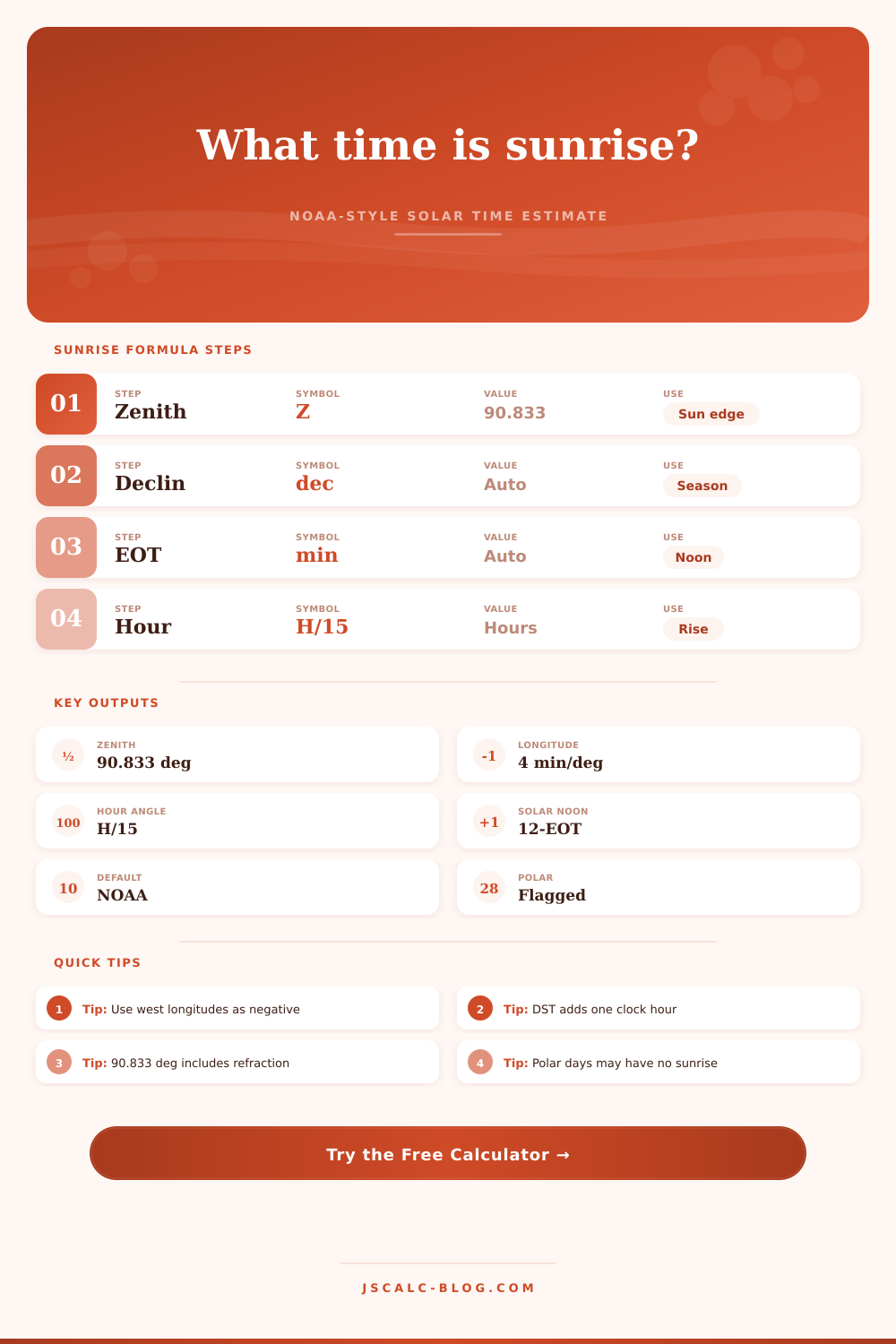
| Zenith | Z = 90.833° | Default value unless a twilight or custom angle is selected | Defines the apparent horizon crossing |
| Hour angle input | cosH = cosZ/(cosLat*cosDec) - tanLat*tanDec | Angles are converted to radians for trigonometry | Must fall from -1 to +1 |
| Hour angle | H = acos(cosH) | Degrees from local solar noon to sunrise or sunset | H/15 gives time hours |
| Solar noon | 720 - 4*lon - EOT + zone*60 | Longitude west is negative, east positive | Clock minute for local solar noon |
| Sunrise | sunrise = solar noon - 4*H | Equivalent to solar noon - H/15 hours | Local clock time before optional DST shift |
To find out precisely at what time sun will rise (or set), there’s an online calculator that takes the day of the year, your latitude and longitude, then spits out a specific time in your local zone. It does all the complicated math for you, but knowing how it works make you more confident in its answer. That confidence come in handy if the answer doesn’t make sense.
Solar declination (the sun’s latitude in the sky) is at the center of calculation. Because the earth revolves around the sun, this number vary over time, ranging from 23.5 degrees north in June to 23.5 degrees south in December. That’s what causes our longer winter shadows compared more than summer ones. For those who wish to use a precise ephemeris value rather than default one, you may change the setting; however, most people don’t need to adjust it since automated ones work well enough for scheduling photo session and hikes.
How the Sunrise Calculator Works
A second factor, one less understood, is equation of time, which accounts for the Earth’s elliptical orbit and tilted axis. That means solar noon doesn’t always coincide with 12:00 PM; indeed, throughout the year, the difference (sometimes called “clock vs. True solar time”) can be up to about fifteen minutes, either way. In mid-February, solar noon may come at 11:56 AM, or in early November, 12:14 PM. To accommodate that offset the calculator simply subtracts or adds that adjustment from actual sunrise moment, making sure that the displayed time correspond to clock time, not theoretical solar time.
Because the sun doesn’t rise at the same moment everywhere (even inside a city), you’ll need to plug in your own latitude/longitude coordinates. One degree of longitude changes solar time by about four minutes. Four minute makes all the difference when shooting dawn: it’s the distance from fully illuminated horizon to that beautiful purple sky.
Based off those coordinates, the tool will find where you are in relation to the sun’s path. What does that mean? That’s the zenith angle setting. It tells the calculator how to make its measurement. By default, it’s set to 90.833 degrees. This is official measurement of sunrise, which consider the apparent size of the sun and effect of atmospheric refraction. If you adjust it to 90 degrees, it will tell you the geometric center (which happen a minute or two after official sunrise). At 96 degrees, you’ll get civil twilight setting that many photographers use. This is as soon as it’s light enough to read without artificial lighting. To switch back and forth from official sunrise to different level of twilight, just use reference table on the page to toggle between them depending on your needs.
There’s another wrinkle to the math when dealing with polar regions: Some days there is no sunrise (the cosine of the hour angle would be less than -1) and some days there is no sunset (the cosine of the hour angle would be greater than +1). That’s where the calculator warn against doing the calculation because it will result in an invalid answer. At mid-latitudes, you’ll see the sun rise earlier or later; in places such as Anchorage or Tromsø, however, it could sit above the horizon for weeks during summer months or hide itself for weeks during the winter months.
If you’re curious about this, great, but there are other practical application. For instance: Event planners will want to know when outdoor events can be held without the light failing (also known as dusk). Gardeners will want to know their frost-free date (assuming they live in a place with a cold winter!). And athletes might want to know when to take their morning run so they’ll be out there at peak-visibility time.
Keep in mind: This is a geometric calculation. A big feature of the landscape, like a row of tall building, or perhaps a mountain ridge, can push the actual visible sunrise up to 10 minutes later or longer. It’s the local horizon that counts; the calculator gives you the astronomical starting point, and then the real answer comes into focus.
It’s a geometric estimate, but in your heart of hearts you know how it feels: knowing when to rise with the sun ties you to the rhythm of our planet. Beat the traffic? Chase the golden hour? Whatever the reason, having an accurate idea about rising time lets you make plans comfortabley. The sun doesn’t wait for anyone, but with this calculator, you’ll be able to greet it at its set time. You should of used this sooner.