Day Length Calculator
Estimate daylight duration, sunrise, sunset, solar noon, twilight span, and polar day or night using latitude, date, zenith angle, elevation, and local clock offset.
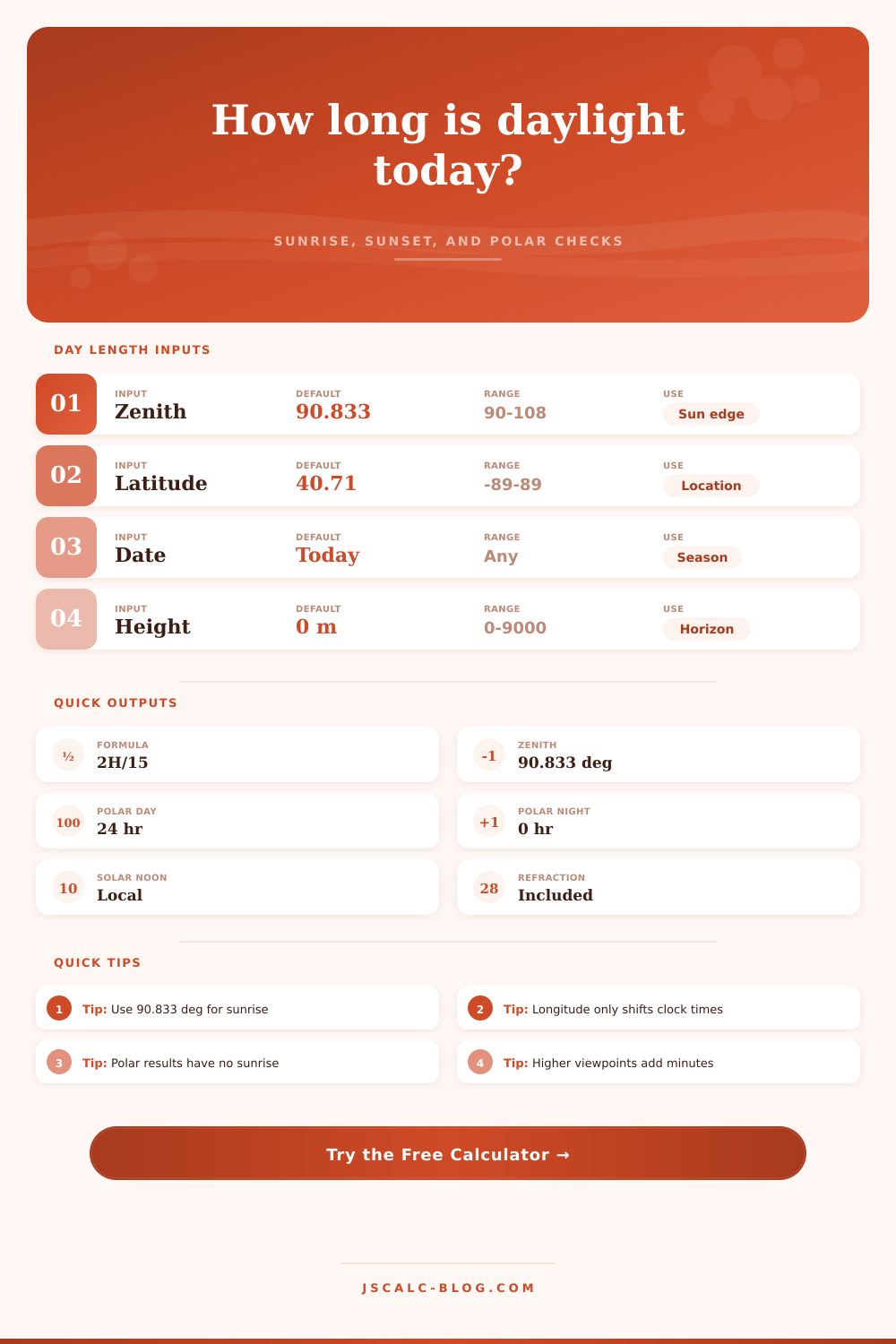
The calculator estimates solar declination for the selected day, converts latitude, declination, and zenith to radians, then evaluates the hour angle. The required day length formula is day length hours = 2*H/15, where H = acos((cosZ/(cosLat*cosDec))-tanLat*tanDec) in degrees. If the expression inside acos is below -1, the sun remains above the selected horizon all day; if it is above 1, the sun never reaches that horizon.
| Mode | Zenith Angle | Sun Position | Typical Use |
|---|---|---|---|
| Geometric sunrise | 90.000° | Sun center on ideal horizon | Pure geometry without refraction |
| Official sunrise | 90.833° | Upper limb visible with refraction | Standard daylight length |
| Civil twilight | 96.000° | Sun center 6° below horizon | Outdoor visibility transition |
| Nautical twilight | 102.000° | Sun center 12° below horizon | Marine horizon visibility |
| Astronomical twilight | 108.000° | Sun center 18° below horizon | Dark-sky astronomy planning |
| Latitude | March Equinox | June Solstice | December Solstice |
|---|---|---|---|
| 0° Equator | About 12h 07m | About 12h 07m | About 12h 07m |
| 30° North | About 12h 07m | About 14h 05m | About 10h 09m |
| 45° North | About 12h 09m | About 15h 26m | About 8h 51m |
| 60° North | About 12h 13m | About 18h 31m | About 5h 52m |
| 66.6° North | About 12h 16m | Near 24h | Near 0h |
| 75° North | About 12h 25m | 24h polar day | 0h polar night |
| Location | Latitude | Season Example | Expected Pattern |
|---|---|---|---|
| New York City | 40.7128° N | June solstice | Long summer day, sunrise early |
| London | 51.5074° N | December solstice | Short winter day, low solar noon |
| Tromso | 69.6492° N | June and December | Polar day or polar night |
| Quito | 0.1807° S | Equinox | Nearly balanced day and night |
| Sydney | 33.8688° S | December solstice | Southern Hemisphere long day |
| Reykjavik | 64.1466° N | June solstice | Very long day, brief night |
| Term | Symbol | Units | Role In Result |
|---|---|---|---|
| Solar zenith | Z | Degrees | Defines the horizon or twilight threshold |
| Latitude | Lat | Degrees | Sets seasonal daylight amplitude |
| Solar declination | Dec | Degrees | Tracks Earth tilt through the year |
| Hour angle | H | Degrees | Half the daylight arc of the sun |
| Equation of time | EOT | Minutes | Shifts clock solar noon from 12:00 |
Visit Tromso in mid-winter, and you’ll notice that there isn’t any sun. For weeks at a time it hovers just beneath horizon, bathing the place in constant twilight. Six months later, there’s a midnight sun over same town. That’s the geometry of things, not weather.
This calculator of day lengths can tell you how many hours of daylight you’ll get anywhere on earth. It makes complicated spherical trigonometry easy by just using multiplication. To make sense of its numbers, you have to grasp Earths tilt. Day and night is divided equally, most people believe. Technically that’s true at the equator. As you approach poles, it starts to get lopsided. How much so? That’s where calculator comes in (above).
How to Calculate Daylight Hours
All you have to do is input the date and your latitude. No need to worry about sun’s angle each day. Solar declination mean the sun’s position, expressed as an angle from equator. That swings back and forth through the year, from +twenty-three point five degrees up to the North Pole to -twenty-three point five down into the South Pole. When the tilt is matched by your own hemisphere, the sun trace out a longer arc across the sky. This results in long summer days.
For a scientist, or even more so a photographer, precision are key. The tool includes multiple settings called zenith modes, which refer to an angle off a perfect vertical (a straight line up from where you stand) above. If you’re looking at standard sunrise and sunset, this will be a peak of ninety point eight three three degrees, taking into account atmospheric refraction. That’s because the atmosphere refracts the light, bending it along the curve of the planet. And it appears to make sun higher than it actualy is. It also takes into account the disk size of the sun.
To find out when the sky has gotten dark enough for astrophotography, you need to set your watch to the astronomical twilight setting, which means that the sun must be eighteen degrees below horizon. In high latitudes, that can mean almost two hours’ difference between the civil and astronomical twilights, enough to change the nature of the ambient light entirely.
There’s another element that play a surprising role: your local horizon. If you’re standing atop a mountain, you’ll have a longer view over curvature of the Earth. That horizon dip results in the sun rising earlier (and setting later). To account for this, enter your altitude above sea level in meters into the calculator. It might be a tiny adjustment, but when planning down to the minute for a shoot, every second count.
If you’re in a steep valley, the sun will be obscured until it clear the nearest ridge. There’s no way for any calculator to know what’s around your location. You need to figure out the amount of time required for the sun to crest that next ridge.
There’s another wrinkle, time zones. Your real solar time is determined by your longitude. Standard time offsets are political boundaries. Twelve o’clock rarely match solar noon. That’s when the sun is overhead. In many places, it’s off by an hour or even more. How much it vary depends on how far east or west you are.
This calculator divides the total day into daylight time and then also separates out what the clock times will be. Date plus latitude determine the duration. Time zone offset and longitude changes the clock times. This is where most folks get it wrong. They think sunrise occur later in the summer. Actually, in a lot of locations, it begins moving earlier in late June. During this period, sunset keeps delaying. But it’s all spelled out clearly in the table of reference on the page.
Here, we see that as you move north, your daylight diminishes. At high latitudes, the sun hardly rise above horizon. This creates hours of a weak, scattered light. Near the equator, the sun rise steeply. So there are abrupt transitions from night to day.
And that brings us back to the hour angle, which is the angular distance the sun moves from noon until sunset. Double that angle and divide by fifteen and voila: hours of daylight. It is elegant in its simplicity.
It’s hard to appreciate what you don’t have, especially daylight. Whether you’re a photographer or a gardener, the dynamics remains identical. You should of checked the weather too. You are looking for that magic golden hour. Checking to see if there’s enough light.
The sun arcs. The Earth tilts. Light bends through atmosphere. These are exact numbers from the calculator. Understanding the geometry provides context. Your time doesn’t mean anything to the sun. It follows the rules of the sky.