Twilight Duration Calculator
Estimate civil, nautical, and astronomical twilight from solar hour-angle crossings at official zenith thresholds.
The calculator first estimates solar declination from the date, then finds each solar hour angle with cos H = (cos Z - sin phi sin delta) / (cos phi cos delta).
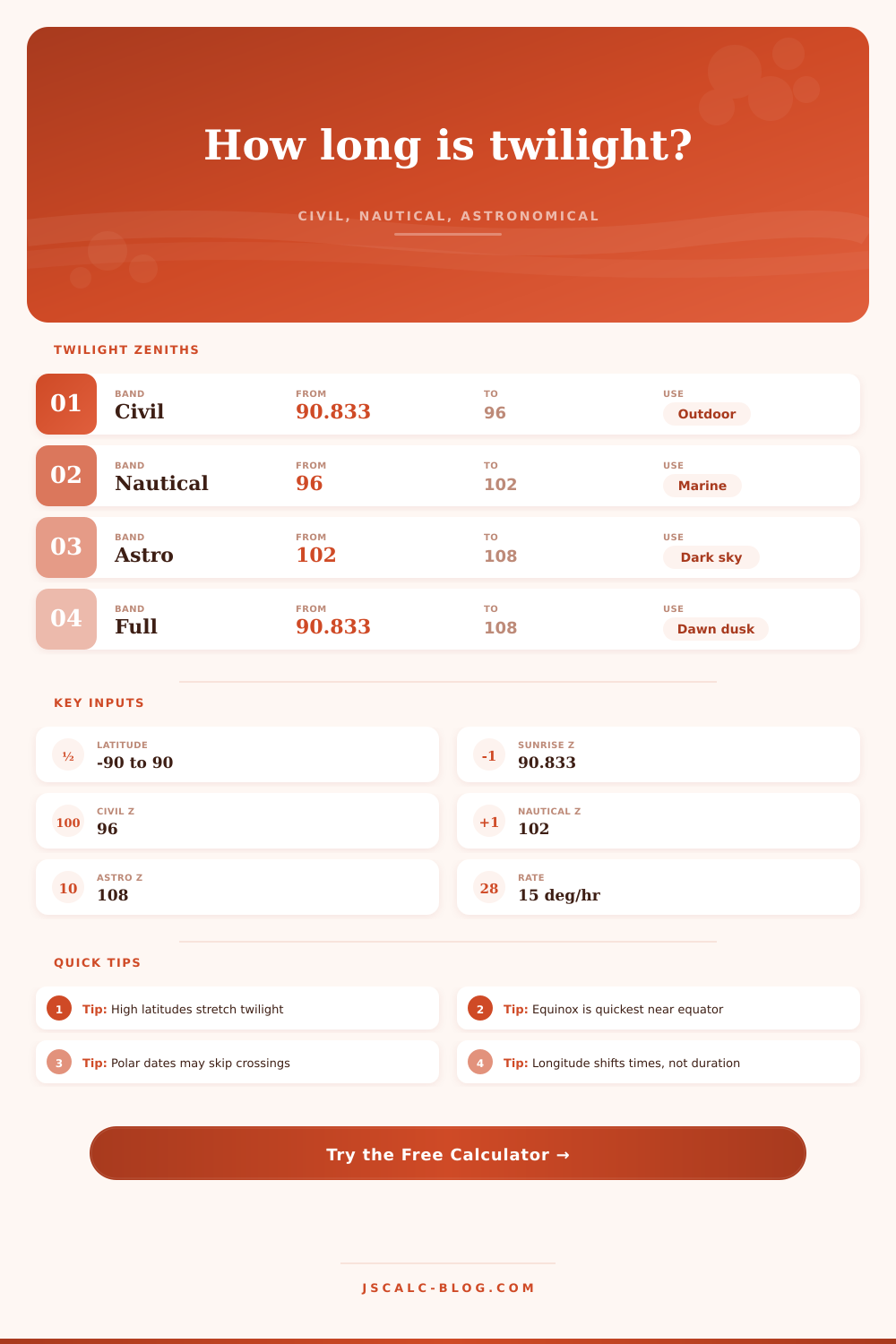
Civil, nautical, and astronomical twilight durations use the difference between adjacent hour angles: minutes = (Hdeep - Hshallow) / 15 * 60, with H measured in degrees. Full dawn or dusk uses H108 - H90.833.
If a threshold is always above or always below the Sun for that latitude and date, the calculator labels the polar condition instead of forcing a false duration.
| Twilight band | Zenith range | Solar altitude range | Typical use |
|---|---|---|---|
| Civil | 90.833° to 96° | -0.833° to -6° | Outdoor visibility and street lighting |
| Nautical | 96° to 102° | -6° to -12° | Horizon still visible for marine navigation |
| Astronomical | 102° to 108° | -12° to -18° | Transition into fully dark astronomical sky |
| Full astronomical dawn or dusk | 90.833° to 108° | -0.833° to -18° | Complete twilight stack before sunrise or after sunset |
| Location scenario | Latitude | Date | Expected pattern |
|---|---|---|---|
| Equator near equinox | 0° | March or September equinox | Short, balanced dawn and dusk |
| Mid-latitude summer | 40° to 55° | June in north, December in south | Longer evening twilight |
| High-latitude summer | 60° to 66° | Near local summer solstice | Astronomical darkness may vanish |
| Inside polar circles | Above 66.56° | Near solstices | Sunrise or sunset thresholds may disappear |
| Polar case | Hour-angle result | Meaning | Calculator handling |
|---|---|---|---|
| Midnight Sun | Threshold always above | The Sun never drops below a selected altitude | Band marked as no evening or morning crossing |
| Polar night | Sunrise zenith never crossed | The Sun remains below the official sunrise line | Twilight light windows shown when deeper thresholds cross |
| White nights | 108° not crossed | Astronomical darkness does not occur | Astronomical band is labeled unavailable |
| Normal day | All threshold values valid | Each zenith has a morning and evening crossing | Duration is hour-angle difference divided by 15 |
| Symbol | Value or source | Used for | Notes |
|---|---|---|---|
| phi | Latitude | Observer position | North positive, south negative |
| delta | Solar declination | Seasonal Sun angle | Estimated from day of year |
| Z | 90.833°, 96°, 102°, 108° | Twilight threshold | Zenith angle from vertical |
| H | arccos expression | Solar hour angle | 15° equals one hour of Earth rotation |
The twilight isn’t always a set period. It varies with tilt of the earth and your latitude. Dawn also isn’t a one-point event in most people’s minds. It is gradual. Shadows is removed from sky gradually. Depending on when and where you are this elongates at times.
A calculator will do math for you. Given a date and your coordinates, it determine exact minutes. Then it divides the sky into three bands, with first band determined by where sun is in relation to horizon.
Why Twilight Varies by Location
The brightest band is civil twilight. This conclude when the sun dips six degrees beneath horizon. Now you can see well enough to read street signs outdoors. Often, streetlamps kick in.
Next is nautical twilight, which continues down to twelve degrees. Sailors can still make out the horizon, though details becomes blurry. Last comes astronomical twilight, which lasts as sun descends to eighteen degrees. By then, the sky are dark enough that Milky Way appears.
A large part of it is latitude. Twilight isn’t long around the equator. The sun sink straight into the atmosphere. Daylight fades to night within an hour or so.
As we get closer to the poles, however, things change dramaticly. The sun sinks low on the horizon. Instead of diving downward through bands of twilight, it cut across them. At mid-latitudes (such as London or New York) in summer, evening twilight may last up to two hours. Even when the sun have set, the sky doesn’t feel like night yet.
At extreme latitudes, however, math is different than before. Within the polar circles, the sun might never set below six-degree mark in midsummer. Weeks go by without any astronomical darkness at all. When it doesn’t cross those thresholds, the tool know about that. It gets it right and doesn’t insist on a phony number.
If you’re scheduling your sleep or want to do some astrophotography, this can matters. If the calculation reveal zero minutes of astronomical twilight, then the calculation succeeded. The sky simply didn’t get dark enough because sun remained too high above the horizon. Knowing the thresholds makes it easy for you to plan accordingly.
In December, a December runner in Tromsø has complicated light windows: the sun hover just below the horizon. That’s enough to get around unaided by headlamp. It is not enough to perceive as daylight. Nautical versus civil light make all the difference. Sometimes that means being able to see a shape rather than a face.
This isn’t information that require formulas to be remembered for use. All it requires is some respect for sun’s angle. When you put in your date and place, you’re asking the Earth how steeply it sits. Shorter twilight mean steeper angle. Longer twilight means shallower angle.
Look at the figures in the output columns, and they tells you what direction light travels. They tell you something about atmosphere overhead. That’s what you’re witnessing: The planet turning on its side.
And yes, the light isn’t jammed. It’s moving along a shorter route … but it’s doing so at more gentle angle. By knowing just how much of that route it travels, waiting becomes something you could of measure. So too can you plan out your evening stroll (or morning cuppa joe), confident the light will behave naturaly.