Days Until Full Moon Calculator
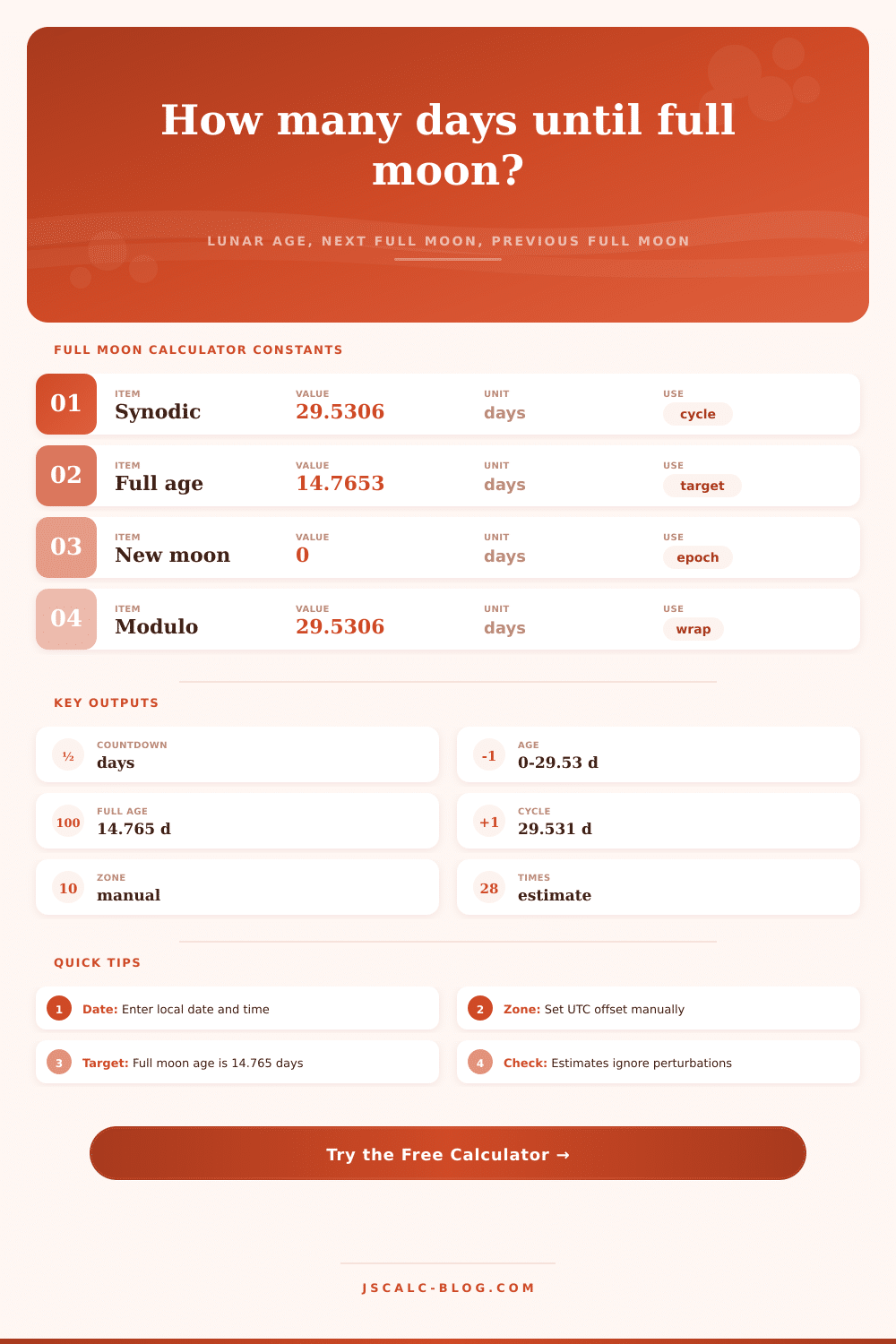
Estimate the lunar age for any date and time, then count forward to the next full moon and backward to the previous full moon using the synodic-month modulo formula.
🌕Full Moon Presets
⚙Calculator Inputs
🔢Lunar Constants And Current Snapshot
🗓Nearby Nights Comparison Grid
📐Formula Breakdown
🌙Lunar Phase Age Reference
| Phase | Approx Age Range | Countdown Pattern | Illumination Trend | Viewing Note |
|---|---|---|---|---|
| New Moon | 0.0 to 1.8 days | About 13 to 15 days until full | Very low | Moon near the Sun in the sky |
| Waxing Crescent | 1.8 to 5.5 days | About 9 to 13 days until full | Increasing | Visible after sunset |
| First Quarter | 5.5 to 9.2 days | About 6 to 9 days until full | Near half and rising | Evening half-moon view |
| Waxing Gibbous | 9.2 to 12.9 days | About 2 to 6 days until full | Brightening quickly | Good pre-full planning window |
| Full Moon | 12.9 to 16.6 days | At or just past target | Highest | Rises near sunset |
| Waning Gibbous | 16.6 to 20.3 days | About 24 to 28 days until full | Decreasing | Bright late evening and morning |
| Third Quarter | 20.3 to 24.0 days | About 20 to 24 days until full | Near half and falling | Best after midnight |
| Waning Crescent | 24.0 to 29.5 days | About 15 to 20 days until full | Low and decreasing | Pre-dawn crescent |
📋Full Moon Name Presets
| Preset | Input Date | Input Time | Default Offset | Why It Is Included |
|---|---|---|---|---|
| Wolf Moon 2026 | 2026-01-03 | 12:00 | UTC-5 | Early January full moon planning example |
| Snow Moon 2026 | 2026-02-01 | 23:00 | UTC-5 | Winter month countdown check |
| Worm Moon 2026 | 2026-03-03 | 12:00 | UTC-5 | Late winter to spring transition |
| Pink Moon 2026 | 2026-04-01 | 21:00 | UTC-4 | Spring evening observation example |
| Flower Moon 2026 | 2026-05-01 | 20:00 | UTC-4 | Near full moon date with short countdown |
| Strawberry Moon 2026 | 2026-06-29 | 22:00 | UTC-4 | Summer full moon planning example |
| Buck Moon 2026 | 2026-07-29 | 20:00 | UTC-4 | Mid-summer bright moon example |
| Harvest Moon 2026 | 2026-09-26 | 21:00 | UTC-4 | Autumn full moon reference |
| Cold Moon 2026 | 2026-12-23 | 21:00 | UTC-5 | Late-year countdown example |
⏱Countdown Interpretation Table
| Days Until Full | Typical Phase | Brightness Read | Planning Meaning | Common Use |
|---|---|---|---|---|
| 0 to 1 day | Full moon window | Very bright | Target night is here or very close | Moonrise timing, night photos |
| 1 to 3 days | Late waxing gibbous | Bright | Nearly full with small timing shift | Outdoor evening plans |
| 3 to 7 days | Waxing gibbous | Building fast | Good advance notice for full moon week | Trip planning, tide awareness |
| 7 to 11 days | First quarter to gibbous | Moderate | Full moon is next week | Calendar reminders |
| 11 to 16 days | Crescent or new | Low to rising | Roughly half a lunar cycle away | Dark-sky checks |
| 16 to 29.5 days | Waning half of cycle | Falling then rebuilding | The last full moon just passed | Next-cycle planning |
🧭Time Zone And Accuracy Notes
| Setting | What It Changes | What It Does Not Change | Best Practice | Example |
|---|---|---|---|---|
| UTC offset | Input conversion and displayed date | The Moon phase itself | Use the offset active on that date | UTC-4 during EDT |
| Entered time basis | Whether offset is applied to input | The modulo formula | Use local mode for normal clock entries | 8:00 PM local |
| Hemisphere | Waxing or waning viewing note | Countdown or lunar age | Choose where the Moon is observed | South reverses the lit-side cue |
| Mean cycle | Simple repeatable estimate | True ephemeris variations | Treat exact times as approximate | Actual full moon can differ |
| Precision | Displayed decimals only | Underlying calculation constants | Use 2 decimals for planning | 0.25 days is 6 hours |
💡Full Moon Calculator Tips
Maybe you’re trying to figure out when the next full moon arrives, perhaps you’re preparing to do some night photography, maybe you want to know when you can get together with friends around a campfire in your back yard, or maybe you just want to know: what’s up with the moon tonight?
When does the next full moon occur? How is that going to impact amount of light in the sky? Light impacts everything from how well people sleeps to how wildlife is observed.
How to Plan for the Next Full Moon
Enter your date into the calculator and it takes care of all the math for you. You won’t have to guess about conversions and coefficients anymore. You just need to know why those things matter.
So what is the heart of lunar tracking? The synodic month are the amount of time it takes for the moon to come back around to the same position relative to the sun. And it’s roughly twenty-nine and a half days, on average. It is not exactly twenty-eight days like most people think.
That little bit accumulates over time. If you go by an approximate mental calendar, your predictions won’t hold together. The tool relies on a careful average so that your guesses stays anchored to reality.
It gives you the current age of the moon in terms of days past the last new moon. Then it figures out how far away we are from the middle point. This is when the moon is completely illuminated from our perspective here on Earth.
There’s another thing that trips people up: the time zone offset. At any given moment on the planet, the moon is exactly the same age everywhere. However, because of differences in time zones, you may see a different date on your clock. It could be 8:00 PM in New York but it’s a new day in Tokyo.
Enter an offset from UTC and you’ll have the results synced with your calendar. That can be important when you’re syncing with a friend across the globe, or maybe a big event happening around the world. You don’t want to end up at the beach for a full moon party only to realize the moon is three days away by your clock.
It is also worth noting that where on earth you’re standing makes a difference. No matter where you live, the moon will always rise in the East and set in the West. However, the illuminated side will flip.
When it’s waxing (getting brighter), the right half will illuminate first if you’re in the Northern Hemisphere; it’s the left half in the Southern Hemisphere. That doesn’t affect when the full moon happens; just how it appears leading up to that date.
The tool takes that visual clue into account so you can see which half should be lit up. It’s a tiny thing, but it helps confirm you’re viewing correct phase.
The moon doesn’t go instantly from zero to ninety percent and then to a hundred; it illuminates gradually. In fact, often there’s plenty of light in those pre-full-moon days to get things done. Maybe the exact right time isn’t even necessary when you’re hiking, or inspecting garden?
To help determine that, the page includes a table showing when the moon is getting brighter, so you can see whether the waxing gibbous moon is bright enough for whatever task you have in mind. Is it worth another day’s delay to wait until very top of the curve?
And then there’s the question of accuracy. The mean cycle formula used by the calculator is a good one: an accurate average. It doesn’t account for the fact that the moon orbits on an ellipse, pulled in various directions by the gravity of the planets.
That can make the real full moon arrive anywhere between a day or two before or after what the mean prediction says it should of be. That’s fine for photo shoots or other vacation plans; more than enough for the purpose. If you’re doing scientific observation, though, you’d require a high-precision table of positions.
Most of us are looking only to see whether we’ll have moonlight tonight.
The built-in presets are also a nice time-saver. There’s a preset for every past and future full moon. This includes things like the Harvest Moon or Wolf Moon, which date back to European and Native American farming traditions. They’re markers of the year based off which animal was out and about, or what plant might be flowering.
Those presets put the math into cultural context. We have been following the moon for thousands of years. And it wasn’t because we had a calculator, we had eyes and memory.
In the end, though, we have this: A clock any one of us can look at and know. No batteries required. No software update needed. It is just moving.
The moddern lens is our calculator. It allows us to learn how to better read that age-old clock. Knowing the timeline puts you back in control. Control whether you’re running from the light or running towards it. Control whether you guess or plan.
And when that glowing disc comes up, you’ll know right where it’s at along that journey around us. It is worth the few seconds it takes to do the math for that moment of connection.