Lunar Cycle Calculator
Calculate moon age, synodic-cycle progress, estimated illumination, waxing or waning direction, and the next new, quarter, full, and last-quarter phase dates.
| Upcoming phase | Target age | Date and time | Days from input | Estimated light |
|---|---|---|---|---|
| First quarter | 7.3826 days | Calculate to update | 0.00 | 50% |
Convert the observation date to Julian day, subtract the selected reference new moon JD, then take the positive remainder modulo 29.530588853 days.
Approximate the lit fraction with (1 - cos(2π x age / 29.530588853)) / 2, then display the result as a percent.
Cycle progress is age / 29.530588853 x 100. Values near 0% are new moon; values near 50% are full moon.
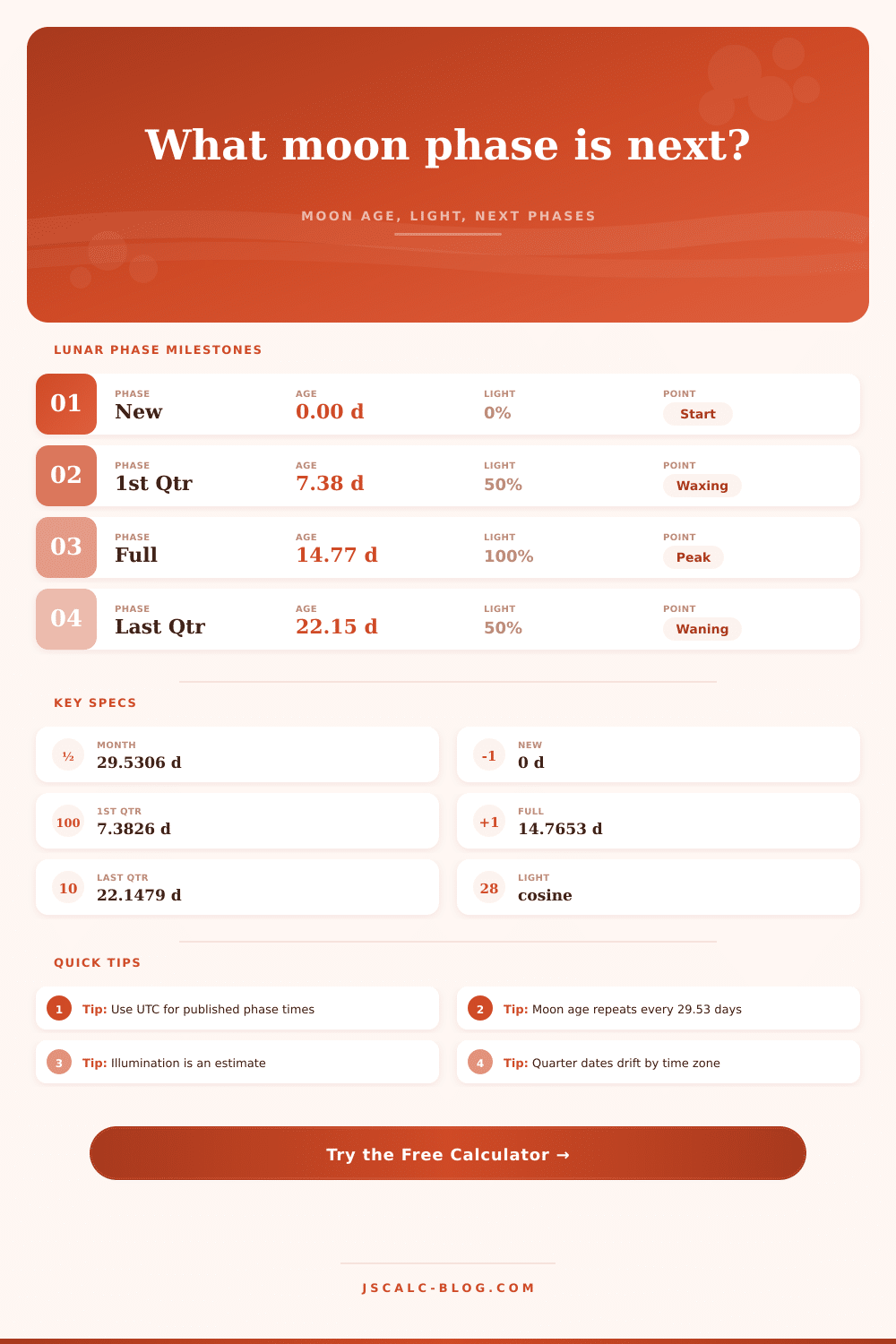
For each milestone age 0, 7.3826, 14.7653, and 22.1479 days, add the forward difference from the current age to the observation time.
| Milestone | Age in cycle | Cycle progress | Illumination estimate | Direction |
|---|---|---|---|---|
| New moon | 0.0000 days | 0% | 0% | Start of waxing half |
| First quarter | 7.3826 days | 25% | 50% | Waxing toward full |
| Full moon | 14.7653 days | 50% | 100% | Transition to waning |
| Last quarter | 22.1479 days | 75% | 50% | Waning toward new |
| Next new moon | 29.5306 days | 100% | 0% | Cycle repeats |
| Moon age range | Common phase name | Approximate light | Cycle direction | Planning note |
|---|---|---|---|---|
| 0 to 1.85 days | New moon window | 0% to 4% | Waxing begins | Darkest nights near the middle of this range. |
| 1.85 to 7.38 days | Waxing crescent | 4% to 50% | Light increases | Evening crescent grows after sunset. |
| 7.38 to 12.92 days | Waxing gibbous | 50% to 92% | Light increases | Moon remains useful for evening observing. |
| 12.92 to 16.61 days | Full moon window | 92% to 100% | Peak light | Bright nights and strong moonlight. |
| 16.61 to 22.15 days | Waning gibbous | 92% to 50% | Light decreases | Moon shifts later into the night. |
| 22.15 to 27.68 days | Waning crescent | 50% to 4% | Light decreases | Best seen before sunrise. |
| 27.68 to 29.53 days | Old crescent | 4% to 0% | New moon approaches | Short pre-dawn visibility window. |
| Quantity | Value used | Formula role | Where it appears |
|---|---|---|---|
| Mean synodic month | 29.530588853 days | Modulo divisor | Age and progress |
| New moon milestone | 0 days | Phase target | Next phase list |
| First quarter milestone | 7.3826 days | Phase target | Next phase list |
| Full moon milestone | 14.7653 days | Phase target | Next phase list |
| Last quarter milestone | 22.1479 days | Phase target | Next phase list |
| J2000 reference epoch | JD 2451550.25972 | Reference new moon | Default age baseline |
The moon doesn’t follow a rigid schedule. It waxes and wanes, and then drifts some more across a timeline you intuitively understand yet struggle to nail down on a calendar.
Enter the Lunar Cycle Calculator at JSCalc-Blog.com, which bring the realities of celestial mechanics down to clear numbers: Enter the moon’s age, how illuminated it’s estimated to be, and when in the future to expect next major phase. And no, we’re not talking about when full moon falls on any given day. We’re talking about getting in step with the rhythm of the light.
How the Lunar Cycle Calculator Works
So what’s the magic ingredient? What make this tool tick? It’s the synodic month: The time the moon takes to get back to a given phase on average, which comes out to about 29.53 days. (That’s the technical term, by the way: synodic month.) This is the number that anchors the calculator.
If you know approximate new moon in your area (more on that below), you can plug your day of observation into the calculator and it subtracts that from the reference new moon. There it is! This are the current age. That’s the math engine humming under the hood, though, and you don’t have to do the subtraction; the calculator does it for you. You only need to choose where to start.
You can choose from well-known times such as the 2024 eclipse or the 1969 lunar landing. Or you can pick your own if that’s what sort of data you’re dealing with, say, historical, or based off some astronomical reference frame.
Why is this important? Because this establish the starting point of your cycle. In the case of something like the moon, where we care about which phase it’s in at any given moment, you need an exact starting point. (That means knowing which day was “day one” and letting the calendar system figure out how many days ago it is.)
The Julian day conversions are left up to the tool; no need for you to be wrestling with calendars spanning centuries.
The biggest point of confusion for folks is time zones. The moon runs on the world’s clock, not yours. Entering a time that isn’t adjusted for your offset from UTC will give results that may differ by hours. Not so bad you say? An hour at a quarter phase makes the difference between spotting a clearly defined gibbous or a slender crescent.
To account for this, the calculator ask for your time zone offset as soon as you open it. From there it crunches the numbers in UTC. Your results reflect what you’ll find in telescope planning data as well as almanacs.
It is a little thing, yes. It is a matter of importance if you’re looking for accurate results.
And what about lighting? It use a cosine function to estimate this. That’s a fancy way to say it approximates the geometry. And it’s good for planning. If you want to do some astrophotography you’ll know how dark the sky will be. If you want to go for a night hike you’ll know if you’re going to get lit up or not.
It provides the percentage of the moon’s face that is illuminated. But it also provides the current stage of the cycle. At 50 percent you’re at the top of the hill. It is the full moon. On zero percent you’re back at new moon when the face is dark and it starts all over again.
This is laid out simply as a table of references on the page. The anchor points are full, last quarter, first quarter, and new. Those is the anchor points of the month.
Since moon phases follow a cycle, how long should a photo be exposed? It depends on the moon’s age. Want to garden with the moon’s pull (some people do)? Want to know when an old manuscript was written? Want to plan your day around the upcoming event?
Here are the dates for the next phase and a few forward from there. It offers practical utility, neatly packaged inside tidy design. It’s like a clock for the moon that runs a little slow or a little fast depending on where you are. The calculator sets your watch by the sky. It takes the guess out of the glow.
You plug in the day and the hemisphere (to show up correctly) and there is the snapshot of the celestial moment. This brings a little bit of order to the chaos of the night sky.
If you know where to look then the moon won’t hide its schedule from you; though it’ll still hold onto some of its secrets. That’s what making light into data can do for you. You should of started by asking a question about the sky and end up holding a clear answer in your hand.