Moon Illumination Percentage Calculator
Find the Moon's lit disk percentage, lunar age, phase angle, phase label, and waxing or waning direction using the JSCalc-Blog.com lunar illumination formula.
🌙 Real Moon Presets
📅 Moon Data Inputs
Moon Illumination Result
🔭 Phase Comparison Grid
📊 Lunar Cycle Specs
📘 Moon Phase Age Table
| Phase Label | Approx Age Range | Angle Range | Illumination Pattern | Direction |
|---|---|---|---|---|
| New Moon | 0.00 to 1.85 d or 27.68 to 29.53 d | Near 0° or 360° | Near 0% | Transition |
| Waxing Crescent | 1.85 to 5.54 d | 23° to 68° | Growing from thin crescent | Waxing |
| First Quarter | 5.54 to 9.23 d | 68° to 113° | Near 50% | Waxing |
| Waxing Gibbous | 9.23 to 12.92 d | 113° to 158° | More than half and growing | Waxing |
| Full Moon | 12.92 to 16.61 d | 158° to 203° | Near maximum light | Peak |
| Waning Gibbous | 16.61 to 20.30 d | 203° to 248° | More than half and shrinking | Waning |
| Last Quarter | 20.30 to 23.99 d | 248° to 293° | Near 50% | Waning |
| Waning Crescent | 23.99 to 27.68 d | 293° to 338° | Thin crescent before new | Waning |
🧮 Formula Breakdown Table
This JSCalc-Blog.com calculator uses the requested illumination formula directly. Date mode only estimates lunar age first; the illumination math is the same in both modes.
| Step | Expression | What It Means | Typical Output |
|---|---|---|---|
| Normalize age | age mod synodicMonth | Places the Moon inside the current 0 to 29.53059 day cycle. | 0 to 29.53 d |
| Phase angle | phaseAngle = 2*pi*age/synodicMonth | Converts lunar age into a radian angle around the phase cycle. | 0 to 2π |
| Illumination | illumination = (1 - cos(phaseAngle))/2 * 100 | Maps the angle to the visible fraction of the lunar disk. | 0% to 100% |
| Waxing or waning | age < synodicMonth / 2 | First half grows brighter, second half grows dimmer. | Waxing/Waning |
| Phase label | Age bands by eighths | Assigns new, crescent, quarter, gibbous, or full label. | 8 labels |
| Next marker | Distance to 0, 7.38, 14.77, 22.15, 29.53 | Shows the closest upcoming major phase marker. | Days remaining |
📌 Common Illumination Lookup
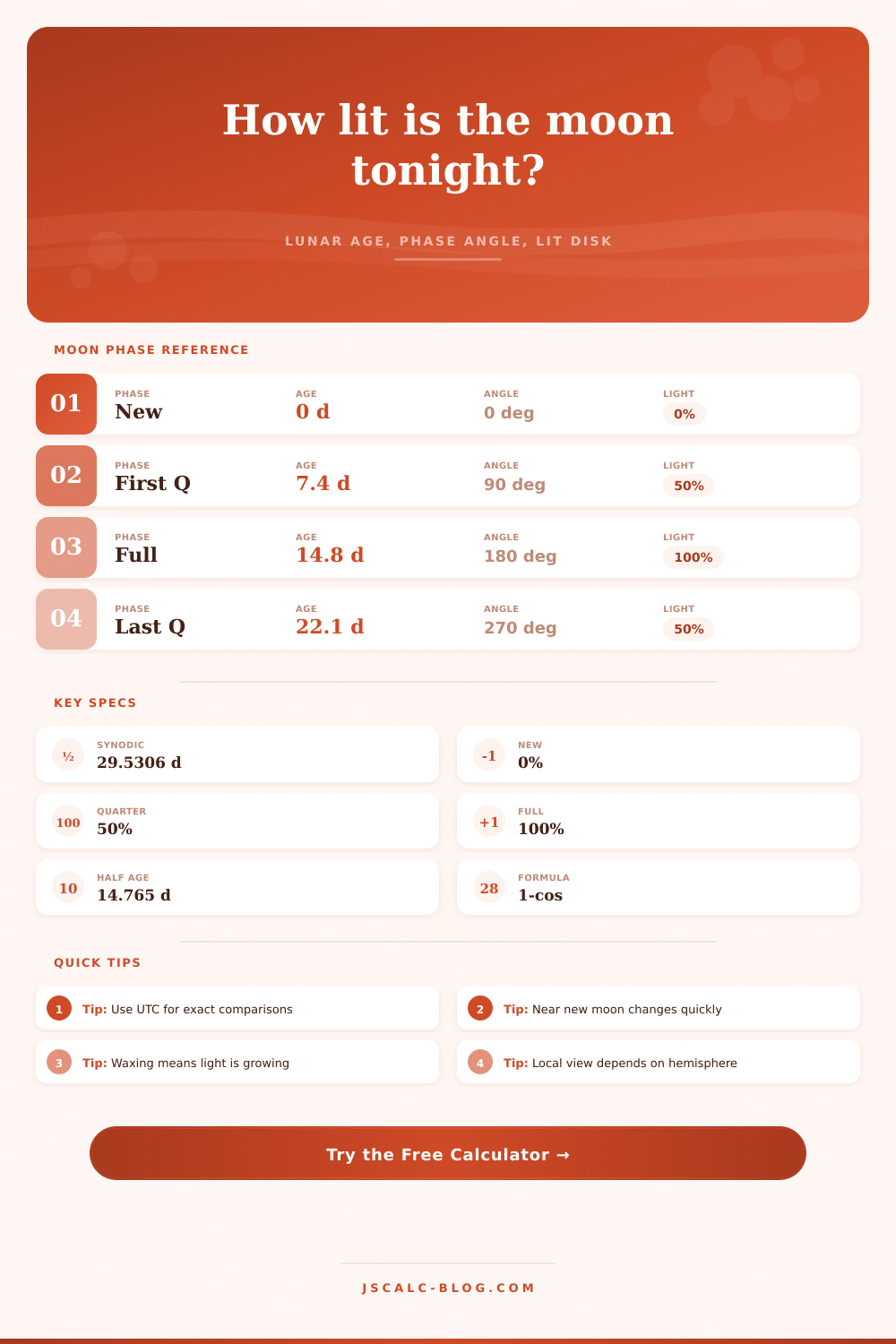
| Lunar Age | Phase Angle | Illumination | Phase Reading | Sky Use |
|---|---|---|---|---|
| 0.0 d | 0° | 0% | New Moon | Darkest moon phase |
| 3.7 d | 45° | 14.6% | Waxing Crescent | Early evening crescent |
| 7.4 d | 90° | 50.0% | First Quarter | Half-lit evening Moon |
| 11.1 d | 135° | 85.4% | Waxing Gibbous | Bright evening Moon |
| 14.8 d | 180° | 100.0% | Full Moon | Bright all night |
| 18.5 d | 225° | 85.4% | Waning Gibbous | Late evening to morning |
| 22.1 d | 270° | 50.0% | Last Quarter | Morning half-lit Moon |
| 25.8 d | 315° | 14.6% | Waning Crescent | Pre-dawn crescent |
🌐 Hemisphere Display Notes
| Location Setting | Waxing Appearance | Waning Appearance | Illumination Math |
|---|---|---|---|
| Northern Hemisphere | Right side brightens | Left side remains bright | Same percentage |
| Southern Hemisphere | Left side brightens | Right side remains bright | Same percentage |
| Near Equator | Moon can look tilted | Moon can look tilted | Same percentage |
| Photograph Review | Camera rotation can flip view | Camera rotation can flip view | Use age and angle |
💡 Calculation Tips
There is something satisfying about watching the moon go through its changes. It’s a slow process which means that on any one night you’re unlikely to even be aware of it happening. On one evening the moon is brightly lit; on another it seems unchanged from last time out. Then maybe it takes a week before you register some change in the light. You might notice the shift in the curve of the disk or the retreat of the shadow. Most of us guess our way through these phases of the moon. We know a new moon is dark and we know a full moon is bright. Everything else is just noise until someone gives you a method for measuring it.
But how exactly does it work? Here’s the thing: Moonlight isn’t magical; it’s mathematical. The moon doesn’t produce its own light. Rather, it bounces off sunlight. How much we see on any given night depends purely on relationship between the sun and the moon and Earth. That is, it’s a question of phase angle, the angle formed by three bodies in space. If the moon is directly between the earth and sun then this angle is zero. We’re looking at dark side, hence a new moon. And if the Earth is between the moon and sun then the angle equals one hundred eighty degrees. We look at whole lit up face, so it’s a full moon. All other moons are simply a question of location and perspective.
How to Measure the Moon’s Phases
To do so, you feed it either a calendar date or known lunar age. If you select a date, the system converts that instant into a Julian Day number. Astronomers use this sort of continuous numbering of days as a way around quirks in the calendar. Then it calculates time between that moment and some reference new moon. And here’s where it gets important: the synodic month; the time between one new moon and the next, averages roughly twenty-nine point five days. Twenty-nine days? No; thirty? Nope. Not exactly. The drift is taken out using an exact average value that keeps the cycle in line with itself over time. Using a rough number adds up. Your predicted full moon will be a day off after a few months.
What you get back is percentage of the lit part of the disk. That’s the fraction of visible face that is lit. Do not confuse this with how much you’ll actualy see. If the moon is a narrow crescent and only one percent of its face is lit, that may well be mathematicaly true; but practically speaking it’s probably impossible to see anything because it’s deep in haze or low down, lost in the twilight glare.
Another thing the tool will tell you is whether the moon is waxing or waning. Waxing: The light is increasing. Waning: The light is decreasing. That’s an absolute point in time, no matter what phase happens to be. It’s either growing lighter or getting dimmer. The phase, say “gibbous” or “first quarter”, is simply a name for where the moon is on that timeline at any given moment. The math is the same.
But depending on where you live those numbers will look different than expected. A rising moon becomes brighter on its right side in the Northern Hemisphere, while a rising moon becomes brighter to its left side in the Southern Hemisphere. This is why calculator lets you choose which hemisphere you’re in. This isn’t a variation on amount of light; rather, it’s a variation on where the shadow line lies. If you are near the equator at certain times of year and at certain times of night, the moon may seem upright or tipped over. No matter where you are standing, the amount of light doesn’t vary. What varies is your angle of view, but not the physics.
For example, both photographers and observers with telescopes tends to get hung up on the precise moment of a phase transition. In fact, because the moon moves so quickly near the new moon phase, a difference of only a couple of hours can change how thin a crescent looks; at full moon, it move slower. So an error of a day or two won’t be so evident there. The chart on the page spells it all out: the age range of each phase name. Remember: they’re estimates! Reality doesn’t respect hard edges. Crescent-to-quarter transitions is gradual, not separate.
For the most part, all you have to remember is this: When you’re looking at the night sky, you’re seeing a view from an ever-changing angle. Everything else falls out of the cosine formula. Use the tool to get your answer. How much of disk gets hit? How many days until the next big marker? What’s the percentage, and make it tangible. Now use that number to plan. Know when the light is going to be soft for landscapes or harsh for astrophotography. Use it to keep the beat of the month, no guesswork required.
The moon doesn’t change its rules. It just plays by the geometric rules of where it orbits. After a while, when you see the pattern, it stops being mysterious. It becomes predictable. And then you begin to pick up on the change not because you’re looking any harder, but because now you know exactly what to look for.