Lunar Distance Calculator
Estimate the Moon's geocentric distance from true anomaly, then compare perigee, apogee, light travel time, and apparent angular diameter.
Lunar Distance Result
| Orbit point | True anomaly | Distance from formula | Light time | Angular diameter |
|---|---|---|---|---|
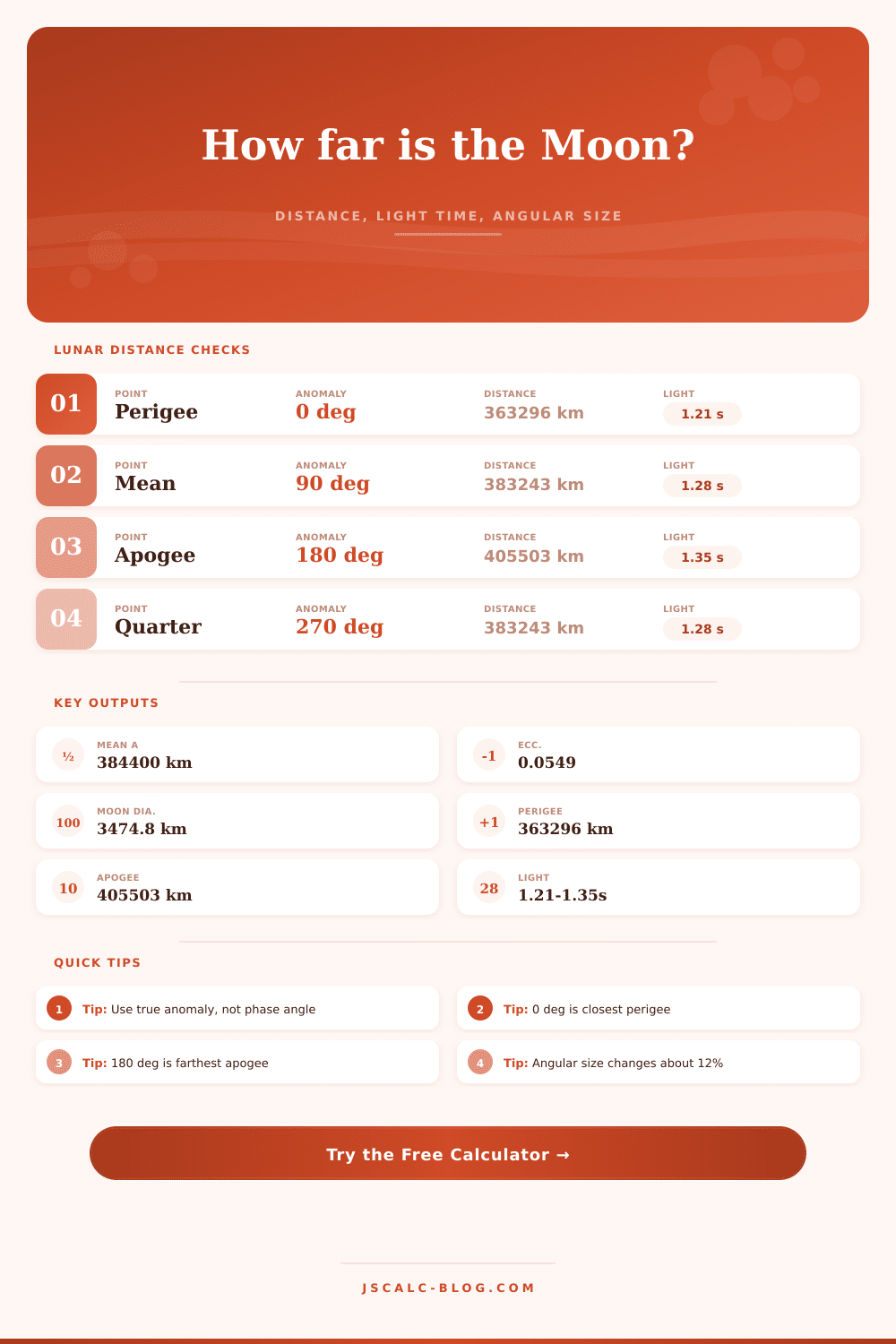
| Perigee | 0° | 363,296 km | 1.212 s | 32.88 arcmin |
| Quadrature-like distance | 90° or 270° | 383,241 km | 1.278 s | 31.17 arcmin |
| Semi-major axis reference | Model value | 384,400 km | 1.282 s | 31.08 arcmin |
| Apogee | 180° | 405,504 km | 1.353 s | 29.46 arcmin |
Values use a = 384400 km, e = 0.0549, Moon diameter = 3474.8 km, and light speed = 299792.458 km/s.
a is the semi-major axis. This calculator defaults to a ≈ 384400 km, the standard mean Earth-Moon distance used for a compact elliptical approximation.
e is orbital eccentricity. The default e ≈ 0.0549 makes perigee equal to a(1 - e) and apogee equal to a(1 + e).
true anomaly is measured from perigee around the ellipse. It is not the same as visual lunar phase, because phase depends on the Sun-Moon-Earth angle.
light time divides distance by 299792.458 km/s. Angular diameter uses 2 × atan(Moon diameter / (2 × distance)) converted to degrees and arcminutes.
| True anomaly | Orbit position | Distance | Difference from mean | Moon apparent size |
|---|---|---|---|---|
| 0° | Perigee | 363,296 km | -21,104 km | Large, 32.88 arcmin |
| 45° | Outbound | 368,920 km | -15,480 km | Large, 32.38 arcmin |
| 90° | Side of ellipse | 383,241 km | -1,159 km | Near mean, 31.17 arcmin |
| 135° | Approaching apogee | 398,720 km | +14,320 km | Smaller, 29.96 arcmin |
| 180° | Apogee | 405,504 km | +21,104 km | Smallest, 29.46 arcmin |
| 225° | Inbound | 398,720 km | +14,320 km | Smaller, 29.96 arcmin |
| 270° | Side of ellipse | 383,241 km | -1,159 km | Near mean, 31.17 arcmin |
| 315° | Approaching perigee | 368,920 km | -15,480 km | Large, 32.38 arcmin |
| Preset | Anomaly | Model | Why use it |
|---|---|---|---|
| Perigee closest point | 0° | Mean lunar orbit | Shows the minimum distance and largest apparent lunar disk for the default ellipse. |
| Near first quarter | 90° | Mean lunar orbit | Useful midpoint check where the formula denominator is 1 and distance is a(1 - e²). |
| Apogee farthest point | 180° | Mean lunar orbit | Shows the maximum distance and smallest apparent lunar disk for the default ellipse. |
| High eccentricity check | 180° | Custom e = 0.0700 | Demonstrates how changing eccentricity widens the perigee-apogee distance spread. |
| Reference point | Kilometers | Miles | Earth radii | Light time |
|---|---|---|---|---|
| Default perigee | 363,296 km | 225,742 mi | 56.96 | 1.212 s |
| Mean semi-major axis | 384,400 km | 238,855 mi | 60.27 | 1.282 s |
| Default apogee | 405,504 km | 251,969 mi | 63.58 | 1.353 s |
| Perigee to apogee span | 42,207 km | 26,226 mi | 6.62 | 0.141 s |
Use true anomaly carefully: lunar phase labels are convenient presets here, but the formula needs orbital angle from perigee. Actual dates require ephemeris data, because perigee does not stay locked to a phase.
Expect approximation error: the real Moon is perturbed by the Sun and other effects. This ellipse is best for quick comparisons of distance, light time, and apparent size.
Sometimes the moon seems bigger then other times. Yes, it does! But you aren’t crazy; sometimes the moon is closer to us (and so appears big), and other times it’s farther away (so it doesn’t look as big).
And that make a difference in how much time it takes for its light to reach your eye. Get used to the beat of it, and you’ll be better at looking up.
Why the Moon Looks Different Sizes
If you consider the orbital position of the moon, it’s simply a matter of math. Stop trying to use the moon’s phase as an input; that depends on the sun’s position relative to the Earth-moon line. Instead, think of the moon’s position in space. Instead, think of the moon’s position in space.
To do that, you’ll want to know true anomaly. True anomaly is angle measured from the point in the orbit where the object is closest. It’s the one part of this process many beginner stumble over. They attempt to enter the moon’s phase (new, full, etc.) into the calculator. That won’t work. The phase results from position of the sun relative to the Earth-moon line. Distance is based off where the moon is in its oval track. It is easier to understand how to get a meaningful value if you remember that these two things are different.
For instance: eccentricity and semi-major axis. Eccentricity is the value that defines what makes the orbit an ellipse rather than a circle. Semi-major axis is average distance from earth’s center. Around 0.055. Not much oval at all. A little bit stretched out. And that small amount of stretching make a real-world impact on closeness.
Not much oval at all. A little bit stretched out. And that small amount of stretching makes a real-world impact on closeness. When it’s close (called perigee) it’s about 363,000 km from us. When it’s far (called apogee) it’ll go out to around 405,000 km. That’s over 40,000 km apart. You could stick an entire Earth there with plenty of space left over.
You can play with those variables in the tool to see how a more eccentric orbit stretches that out. For now let’s keep the average values; they are a good starting point to keep things realistic. How far away? That makes all the difference.
One result is its angular diameter, which is immediately noticeable when the moon is closest to Earth: it looks bigger. By contrast, at its farthest point, it’s about 14 percent smaller. You might not realize how big (or little) the moon look without seeing photographs side-by-side, taken days apart. But it does make a difference, one used by photographers who chase supermoons for their best shots.
The calculator computes the distance, then uses the known physical diameter of the moon to estimate its apparent size. That’s simple trigonometry. You can see the arcminutes go from nearly 33 down to just under 30; that puts the change into perspective.
And then there’s travel time. It is a value we don’t mention much in everyday life, but one that puts things into context. Light from the Moon reaches us within roughly 1.21 seconds (at closest approach) to 1.35 seconds (farthest away). So anytime you’re viewing the Moon, you’re looking at it over a second ago. And while waving at the moon wouldn’t help. Since it would immediately wave back; you’d still have to wait because it’s still a fraction over a second later when it replies. That’s almost two-and-a-half seconds. That’s nothing by human standards. But it is a real thing out in space.
In the tool, I include a reference table showing those numbers at important points in orbit. All that stuff ties together: size, distance, and time.
“This is how the sky works: This is what it’s made of. And the more you play with this thing, the less mystified you are by it at night. The less like some static decoration that hangs in the sky the moon become for you. It becomes more like a moving thing that travels across a measurable and understandable space. The mystery of the moon is given structure by those numbers. Next time you look up, it’ll be different. Close.