Eclipse Magnitude Calculator
Calculate eclipse magnitude from apparent angular radii and center separation, then compare it with the disk-overlap obscuration estimate for solar and lunar eclipse geometry.
| Equal-Radius Magnitude | Center Separation | Area Obscuration | Visual Read |
|---|---|---|---|
| 0.05 | 1.90 x target radius | 1.9% | Tiny grazing bite |
| 0.25 | 1.50 x target radius | 14.4% | Small partial eclipse |
| 0.50 | 1.00 x target radius | 39.1% | Half-diameter coverage |
| 0.75 | 0.50 x target radius | 68.5% | Deep partial eclipse |
| 1.00 | 0.00 x target radius | 100% | Full equal-disk overlap |
| Mode | Target Radius | Occluding Radius | Magnitude Means | Obscuration Means |
|---|---|---|---|---|
| Solar total | Sun apparent radius | Moon apparent radius | Fraction of Sun diameter covered along the center line | Fraction of the Sun disk hidden by the Moon |
| Solar annular | Sun apparent radius | Smaller Moon apparent radius | High diameter coverage, but below totality | Sun disk minus central ring opening |
| Solar partial | Sun apparent radius | Moon apparent radius | Diameter bite depth across the Sun | Actual disk-area loss, usually lower than magnitude |
| Lunar umbral | Moon apparent radius | Earth umbral radius | How deeply the Moon enters the umbra by diameter | Moon disk inside the dark umbral shadow |
| Lunar penumbral | Moon apparent radius | Earth penumbral radius | Geometric entry into the penumbra | Soft brightness loss, often visually subtle |
| Object or Shadow | Typical Radius | Useful Range | Use In Calculator | Notes |
|---|---|---|---|---|
| Sun disk | 15.7 to 16.3 arcmin | Varies with Earth-Sun distance | Solar target radius | Use apparent radius for the event date |
| Moon disk | 14.7 to 16.7 arcmin | Varies with lunar distance | Solar occluder or lunar target | Large Moon favors total solar eclipses |
| Earth umbra at Moon | About 40 to 46 arcmin | Depends on solar-lunar geometry | Lunar occluding radius | Often much larger than the Moon |
| Earth penumbra at Moon | About 70 to 80 arcmin | Soft shadow edge | Lunar occluding radius | Light loss needs a low intensity factor |
| One degree | 60 arcmin | 3600 arcsec | Unit conversion | Solar and lunar diameters are near half a degree |
| Preset | Mode | R_target | R_occluding | Separation | Expected Read |
|---|---|---|---|---|---|
| Total Solar Centerline | Solar | 16.0 arcmin | 16.2 arcmin | 0.5 arcmin | Total or near-total coverage |
| Annular Solar Path | Solar | 16.2 arcmin | 15.5 arcmin | 0.3 arcmin | Annular, high magnitude |
| Half-Magnitude Solar | Solar | 16.0 arcmin | 16.0 arcmin | 16.0 arcmin | About 39% area obscured |
| Grazing Solar Limb | Solar | 16.1 arcmin | 15.8 arcmin | 30.5 arcmin | Small partial bite |
| Solar Near Miss | Solar | 16.0 arcmin | 15.9 arcmin | 33.0 arcmin | No disk overlap |
| Total Lunar Umbra | Lunar | 15.6 arcmin | 42.0 arcmin | 20.0 arcmin | Moon fully inside umbra |
| Deep Lunar Totality | Lunar | 15.2 arcmin | 44.0 arcmin | 8.0 arcmin | Very deep umbral eclipse |
| Partial Lunar Bite | Lunar | 15.4 arcmin | 41.0 arcmin | 48.0 arcmin | Partial umbral coverage |
| Penumbral Lunar Pass | Lunar | 15.3 arcmin | 74.0 arcmin | 80.0 arcmin | Soft penumbral shading |
Publicity surrounds eclipses, but even veteran eclipse watchers may get confused by their numbers. Maybe there’s a prediction stating that it’ll have a magnitude of 0.98: The Sun will look like it has nearly gone away! When you get up on location you find yourself staring into a dazzling ring of fire instead. Why the disconnect? Because size doesn’t correspond exacty with what we call obscuration.
One describes linear diameter; the other refers to actual surface area. We tend to use these words interchangeably when in fact they represent different things, how much of the disk’s edge is obscured versus how much light are actually blocked. Knowing this alters your preparation for the event. So when you enter your apparent radii and center separation into the calculator above, it does math for you. No more conversion or coefficient guesswork.
Understanding Eclipse Numbers
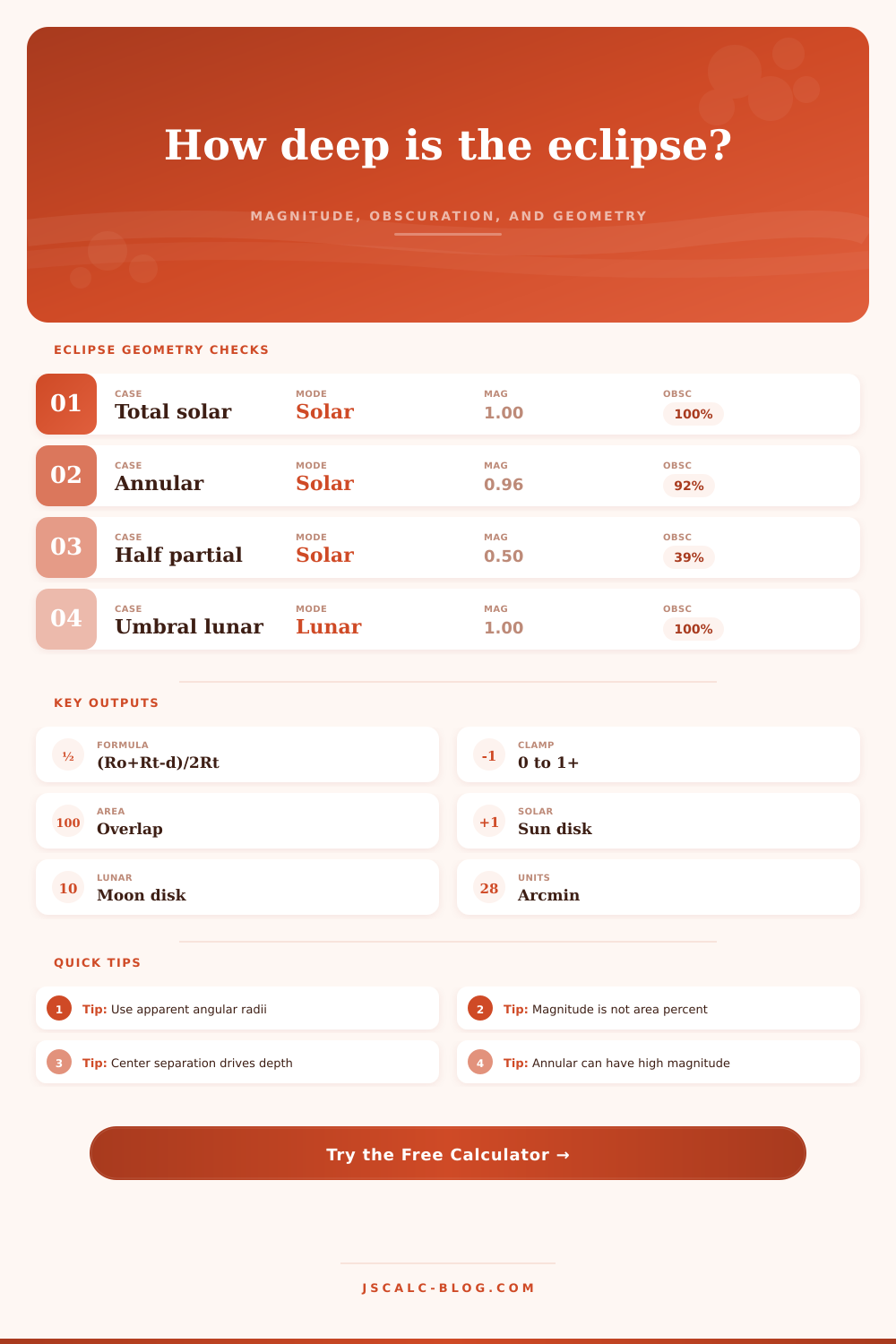
It reduces orbital mechanics down to geometry of that particular moment in time’s sky. Enter your inputs (the angular size of both bodies; the apparent distance between their centers) and the tool will spit out percent obscured and the obscuring body’s diameter fraction. Simple relationship, but it’s the non-linear nature of circular overlap that throws so many observer for a loop. They think a magnitude of 0.50 means half the sun is covered. Nope. Usually only ~39% of solar disk is hidden by a half-diameter magnitude. So, you must know exactly what you are measuring.
That brings us to another reason annular eclipses are impressive despite never achieving totality: the ring shape occurs within this geometric reality. You can have a magnitude as large as 0.96 if the moon looks smaller than the sun (because it’s near apogee). That sound total? But what if the obscuration is only 92%, or even less? That would of mean you’d miss out on 8% of the show, which would be the rare fire ring that distinguishes annular events from others.
When the earth’s shadow enters the picture, the tool switches into “lunar” mode vs. The tool switches from “lunar” mode to “solar” mode because the dynamics change. Why does an eclipse of the moon behave different than? The moon is no match for the width of the earth’s shadow. A lunar magnitude can be larger than 1.00, which means the moon is completely inside the shadow. On the other hand, for totality, solar magnitude tops out at 1.00.
The variable that governs depth of the event is center separation. This is distance between the celestial bodies as they travel across the sky. It changes over time. It change every second. The page has a reference table that lays this out. That table demonstrates how drastically small differences in separation can change visual experience.
A magnitude of 0.05 could be a very slight grazing eclipse. It is just a tiny bite on the limb of the sun. A size pushing well beyond 0.75 could mean an eclipse so deep it obscures almost 70% of the sun’s surface. Those are all thresholds for both safety and photography. Even something less than a total eclipse at 0.60 may look tempting since it isn’t total. But the remaining light can still do permanent damage to your eyes.
You can also fiddle with intensity factors using the tool, which really comes into play with lunar eclipses. Because they’re so subtle, penumbral eclipses are famusly difficult to spot. Instead of cleanly cutting out the moon, the outer fringe of the earth’s shadow simply dims it more and more over time. You can dial this down or up on the calculator for a sense of how much it’ll matter visually. It recognizes that it’s not a black-and-white situation where something gets brighter or darker; there’s a range.
It makes you realize that objects has physical dimensions. As the earth orbits the sun from its closest point to its farthest point, its distance from the sun changes, meaning the sun’s apparent radius change. So instead of treating it as one number for all events, you should find the apparent radius for the day in question and plug that into your calculations if you want to predict accuratly. The difference between an annular and a total eclipse, at the edges of path, can mean a difference of only a few arcminutes in the separation. That’s what makes local forecast better than a general prediction for the region.
With the calculator, you can play with this. Adjusting the input separation, you can watch the magnitude react. Turn the ideas of orbital math into something real. See how much darker the sky will become. Find out if the diamond ring effect will be noticeable.
In the end, it’s all about scale. Knowing the amount will help you plan the logistics of your observation. With a small amount of obscuration, you’re going to require patience and some good solar filters. With large obscuration, perhaps you have time to get out the timing devices and cameras to prepare for totality. These geometric details often make difference between an unforgettable experience and a disappointment.
It’s a grand dance in the heavens; you look up and see something cosmic. But the mathematics involved here is exacting and merciless. When the numbers aligns, you will see exactly what you intended to see at the right time. The eclipse doesn’t care whether you expected it or not. That part can align with reality.