Solar Eclipse Duration Calculator
Estimate totality or annularity duration from effective shadow path diameter, relative ground speed, angular diameter overlap, and contact timing.
☀️Real Eclipse Presets
📐Eclipse Geometry Inputs
Estimated Eclipse Duration
🔢Formula Breakdown
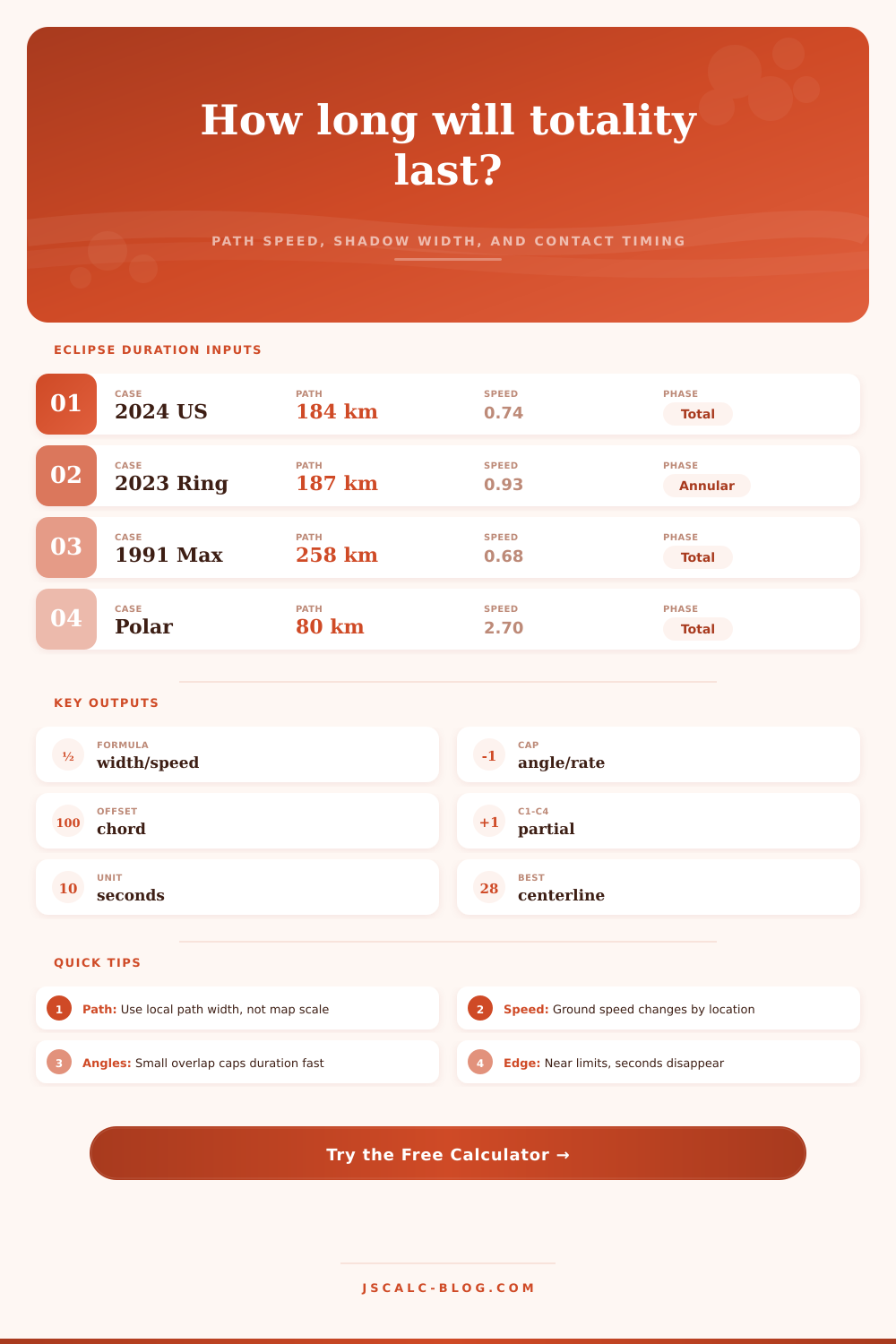
Totality/annularity duration ≈ effective shadow path diameter / relative shadow speed
- Centerline chord = path diameter; off-center chord = 2 × square root(radius² – offset²).
- Geometric time = corrected chord / shadow speed, where the correction accounts for limb and local path uncertainty.
- Angular diameter overlap cap = absolute Moon-Sun diameter difference in arcseconds / angular contact rate.
- Final central phase estimate = the smaller of the geometric time and angular cap, because thin overlaps cannot last longer than the apparent disks allow.
- C1-C4 contact estimate = (Moon angular diameter + Sun angular diameter) in arcseconds / angular contact rate, with ingress and egress split around the central phase.
🧭Duration Geometry Grid
📊Path Speed Presets
| Preset | Speed | Common Situation | Duration Effect |
|---|---|---|---|
| Very slow equatorial | 0.47 km/s | Near maximum-duration geometry | Long central phase |
| Slow maximum track | 0.62 km/s | Broad tropical or subtropical path | Longer than average |
| 2024-style U.S. | 0.74 km/s | Central North American totality | Several minutes possible |
| Typical annular | 0.93 km/s | Antumbral path through mid latitudes | Moderate ring duration |
| Mid-latitude fast | 1.18 km/s | Steeper path angle or narrower track | Shorter duration |
| High latitude | 1.60 km/s | Shadow skims a high-latitude region | Brief central phase |
| Polar grazing | 2.70 km/s | Low Sun, oblique shadow motion | Seconds to a minute |
| Horizon extreme | 5.00 km/s | Sunrise or sunset edge cases | Very brief centrality |
🌚Angular Diameter Comparison Grid
| Geometry | Sun Diameter | Moon Diameter | Overlap Difference | Likely Center Phase |
|---|---|---|---|---|
| Deep total | 31.7 arcmin | 33.5 arcmin | 108 arcsec | Long cap |
| Typical total | 32.0 arcmin | 33.1 arcmin | 66 arcsec | Moderate cap |
| Near hybrid | 32.0 arcmin | 32.1 arcmin | 6 arcsec | Very short cap |
| Thin annular | 32.2 arcmin | 31.9 arcmin | 18 arcsec | Short ring |
| Strong annular | 32.6 arcmin | 30.7 arcmin | 114 arcsec | Long ring cap |
| No central phase | 32.2 arcmin | 32.2 arcmin | 0 arcsec | Limit case |
⏱️Contact Duration Estimates
| Contact Pair | Meaning | Approximation Used | What Changes It |
|---|---|---|---|
| C1 to C2 | Partial ingress before center phase | (C1-C4 minus central) / 2 | Angular rate and disk sizes |
| C2 to C3 | Totality or annularity | Minimum of chord time and overlap cap | Path width, offset, disk excess |
| C3 to C4 | Partial egress after center phase | (C1-C4 minus central) / 2 | Same as ingress |
| C1 to C4 | Whole partial eclipse window | (Sun + Moon diameters) / angular rate | Apparent speed across sky |
🔍Scenario Comparison Table
| Scenario | Path Diameter | Speed | Offset | Practical Reading |
|---|---|---|---|---|
| Centerline total | 180 km | 0.74 km/s | 0 km | Geometry can allow minutes |
| Halfway to edge | 180 km | 0.74 km/s | 45 km | Chord is still wide |
| Near path limit | 180 km | 0.74 km/s | 85 km | Duration falls sharply |
| Narrow hybrid | 28 km | 1.18 km/s | 0 km | Angular cap often dominates |
| Fast polar | 80 km | 2.70 km/s | 0 km | Short even on centerline |
| Broad annular | 190 km | 0.93 km/s | 0 km | Ring may last several minutes |
💡Practical Timing Tips
That’s the particular sort of dashed hope that eclipses bring: you drive to your appointed spot and discover it wasn’t enough; the sky turned black for just a split-second. Online, the images showed minutes of totality. On the ground, the shape informed you otherwise: you stood on the edge of the path rather than its center, and the math spoke truth.
Here, the calculator does all the hard work, peeling back the hype to reveal how long the Sun would go dark, based off the exact position of both you and the heavens involved in this cosmic dance of planetary motion. That makes abstractions tangible, counting down to a moment that you might actualy get to experience.
How to Know How Long the Eclipse Lasts
Speed’s the tricky variable that tends to trip people up. The Moon’s shadow doesn’t simply sweep in one direction at one steady pace across the planet’s face: it rushes along equator, then slows down toward higher latitudes (or speeds up, if its angle of approach allows). In places where the shadow arrive at sunrise, or near the poles, it can streak toward the ground at almost 5 kilometers per second. That leaves little room for even a generous stretch of totality, seconds of darkness at best. The tool lets you choose from presets based off your latitude and time of day, which is much better then guesswork. It also makes you realize that just as Moon’s distance determines duration, your location does too.
And then there’s offset. Because of lodging and travel limits, most people will end up being off-center. They want to be on the centerline where they get maximum time, but they can’t. In terms of eclipse geometry, moving off-center reduce the chord length of the shadow we’ll see. To account for this, calculator figures out the effective width of the shadow at our location, and here’s how: it uses the Pythagorean theorem. (It’s a little math detail, but it goes from three minutes to ninety seconds.) That’s the difference between a full camera exposure and a missed shot.
Secondly, there’s the apparent size of the Moon relative to the Sun. That’s what distinguishes an annular eclipse from a total one. If the Moon is a little too small in diameter, it creates ring of fire. How long does that ring last? Well, that depends on just how much overlap there was. The calculator use the apparent diameters to compute an angular cap. The central phase can never persist any longer than the time it would take the Moon to pass completely across the Sun’s disk even though the width of the shadow path might be large. It’s the angular limitation which often catches off guard those who anticipate a prolonged totality but instead experience a fleeting annularity. The tool flags it so no one wastes time hoping for something they will not see.
You get a single max duration across the whole thing, which everyone else gives you anyway. That is only good if you’re at one particular point on the ground. And if you put in your offset and your path width, it gets you a personal estimate of how long it might take. It even takes into account the fact that the Moon’s edge isn’t flat; there are mountains and valleys that bites into the disk of the Sun and shave seconds from its otherwise theoretical maximum. It is a fine-tuned tweak to match the messy business of looking at stuff up in the sky through our lousy atmosphere.
And at the end of the day, that’s what it all comes down to: managing your expectations when chasing an eclipse. That number isn’t just a number; it explains what that number means. And it closes the gap from the grand scale of orbital mechanics to personal experience of being out in the middle of a field waiting for light to change. When you do look up, you’ll know exactly how long you’ve got to watch the diamond ring flare up or the corona bloom into view. The shadows will pass quickly, but if you enter the right things, you won’t be caught off-guard. You should of been prepared for when the sky goes dark.