Lunar Eclipse Duration Calculator
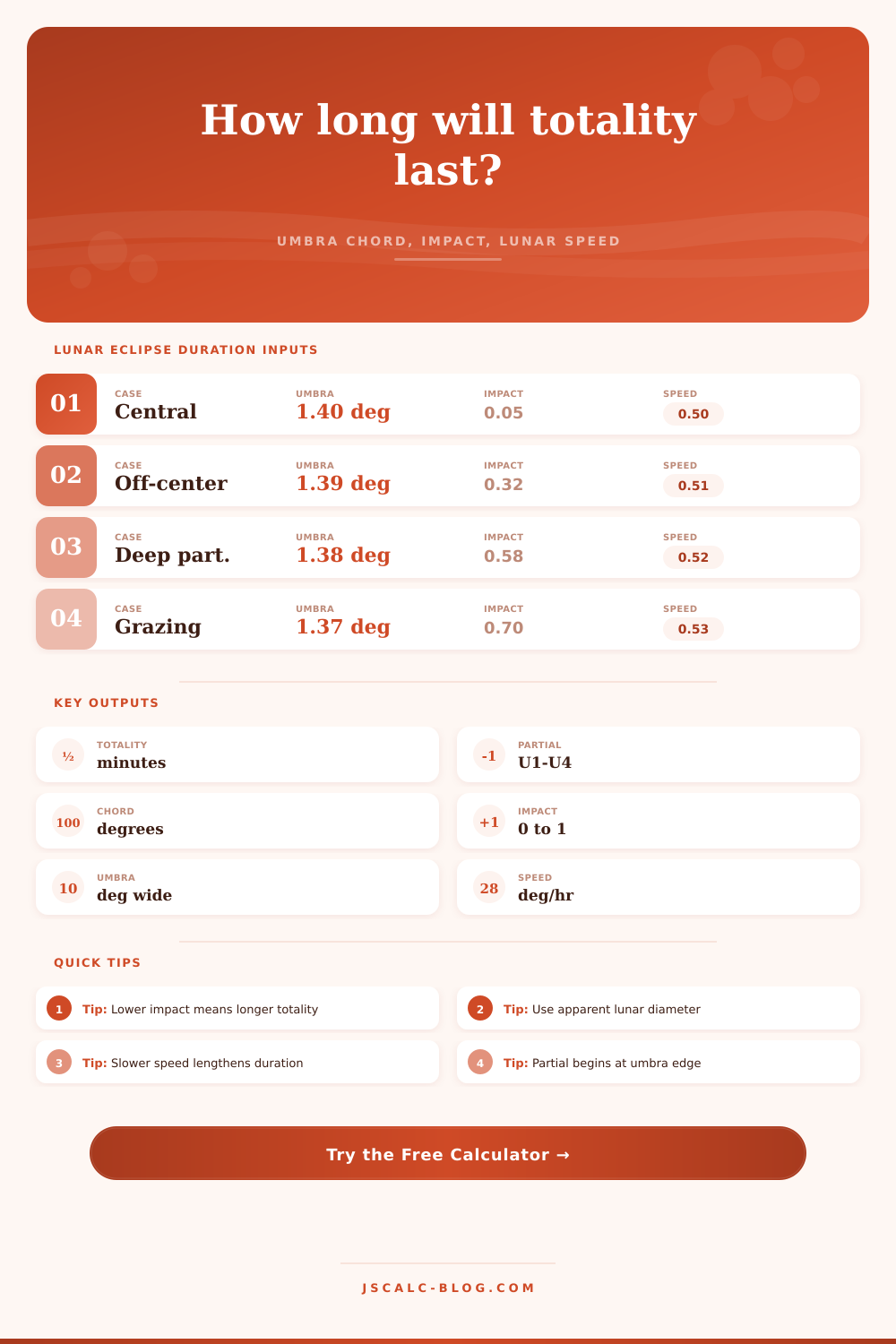
Estimate totality, partial umbral duration, chord length, umbral magnitude, and impact geometry from Earth umbra size and relative lunar speed.
Calculated Eclipse Duration
| Geometry | Impact Range | Totality Chord | Partial Window | Expected Duration Pattern |
|---|---|---|---|---|
| Central total | 0.00–0.15 | Longest | Very long | Often 90+ minutes of totality |
| Deep total | 0.15–0.35 | Long | Long | Totality remains broad and stable |
| Average total | 0.35–0.50 | Moderate | Moderate-long | Totality shortens quickly with impact |
| Short total | 0.50–0.62 | Short | Moderate | Totality may last only minutes |
| Deep partial | 0.62–0.70 | None | Moderate | Large lunar bite, no full immersion |
| Grazing partial | 0.70–0.90 | None | Short | Small umbral contact window |
Impact limits shift slightly with umbra and lunar apparent size. The calculator applies the entered diameters, not a fixed category cutoff.
| Input | Typical Range | Longer Duration When | Shorter Duration When |
|---|---|---|---|
| Earth umbra angular diameter | 1.36–1.43° | Umbra is wider | Umbra is narrower |
| Lunar angular diameter | 0.49–0.56° | Moon is smaller | Moon is larger |
| Impact parameter | 0.00–0.90 | Path is central | Path is grazing |
| Relative angular speed | 0.48–0.55°/hr | Speed is lower | Speed is higher |
| Timing allowance | -5% to +5% | Positive correction | Negative correction |
| Rounding | 0.5–10 min | Does not change physics | Coarser display only |
| Preset | Type | Umbra (°) | Impact | Speed (°/hr) |
|---|---|---|---|---|
| 2000 Jul Long Total | Central total | 1.421 | 0.060 | 0.489 |
| 2007 Aug Deep Total | Deep total | 1.410 | 0.210 | 0.501 |
| 2018 Jan Total | Deep total | 1.382 | 0.280 | 0.516 |
| 2019 Jan Total | Central total | 1.403 | 0.180 | 0.506 |
| 2021 May Short Total | Short total | 1.371 | 0.600 | 0.532 |
| 2022 May Total | Deep total | 1.401 | 0.250 | 0.508 |
| 2022 Nov Total | Deep total | 1.389 | 0.260 | 0.512 |
| 2023 Oct Partial | Partial | 1.394 | 0.760 | 0.520 |
| 2024 Sep Shallow Partial | Grazing partial | 1.392 | 0.835 | 0.526 |
| 2025 Mar Total | Total | 1.397 | 0.330 | 0.510 |
| Quantity | Formula | Uses Radius | Contact Meaning |
|---|---|---|---|
| Totality chord | 2 sqrt(Rt² - d²) | (U - M) / 2 | Moon fully inside umbra |
| Umbral chord | 2 sqrt(Rp² - d²) | (U + M) / 2 | Any umbral contact |
| Total duration | Chord / speed | Totality chord | U2 to U3 |
| Partial duration | Chord / speed | Umbral chord | U1 to U4 |
| Impact distance | Impact × U / 2 | Umbra radius | Closest center separation |
| Umbral magnitude | (Rp - d) / M | Radius sum | Moon-diameter immersion |
The big moment arrives, it’s a full moon, you look up and ask yourself: How long will this eclipse be? You set alarms for the contacts, plot your vacations around the peak, pray the clouds won’t come through.
It is a brief shadow and a deep immersion. It is not magic. Not realy. This is geometry and speed and celestial luck. When you understands how it works, what was once a passive experience becomes a predictable one. No more guesswork; now you know.
How to Calculate Eclipse Duration
Three physical facts drive the calculation.
One: the width of Earth’s shadow. Our planet traverses an elliptical orbit around the sun, so the umbra is not constant width. Depending off how close or far away we are from the sun, the umbra widens and narrows. As it widens, the moon have more space within which to go about its business when completely inside.
Second is the moon’s apparent size. The moon appear bigger at perigee and smaller at apogee. A narrower lunar disk will fits snugly into the shadow cone. That enlarges the totality window.
Third is the path of the moon through that shadow. This is where the impact parameter comes into play. When the moon pass right down the middle, it will cross the longest possible chord. When it grazes one edge, it make a quick trip.
Once you input your parameters, the calculator does all the work for you, so you do not need to picture fancy intersecting circles.
Observers tend to get hung up on whether the eclipse will be total or partial. Partial). That two-word description masks the truth. Sometimes, a brief total eclipse will pass quickly while a deeper partial eclipse lingers as it spends more time in the shadow of Earth’s umbra, or just barely grazes the inner rim. For photographers wanting to know when to change exposures, that matters. If even one sliver of light remains on the lunar rim, you’re no longer in totality but the partial phase instead.
The tool cleanly separates those stages for you. It tells you the span of U1 to U4 for complete umbral contact and then U2 to U3 for genuine totality. That knowledge means not missing out on the changing colors at the transition points.
Most folks miss something else: Speed matters a lot. At roughly half a degree per hour, the Moon transit across the shadow of Earth. That may sound like a crawl, but over an hour’s time, it covers quite a bit of angular distance. The more quickly the Moon move across the shadow, the shorter its stay in darkness. And how fast the Moon travels compared to the shadow depends on where its orbital plane lies compared to the ecliptic plane. No two eclipses is alike. Because of this, the calculator lets you modify the speed profile.
Want to chase after precision? Tweak the allowance for refined ephemeris data. For most enthusiasts, the defaults will be fine; we’re looking for a good guess here, not perfect astronomical accuracy, after all. What we want is a solid estimate that will enable us to plan our viewable window.
For perspective, look at history. In 2000, there was a total event during July that lasted more than an hour and a half as the Moon stayed deep in darkness. During May 2021, there was a short total eclipse where the Moon only brushed the very center, so it did not stay dark for long. And these presets let you see how slight adjustments in the impact parameter affect duration. Change it by a couple of tenths and you go from total eclipse to partial. That is why the fine details matter when you plan precisely what you want. No guesswork here.
When you sit down to watch an eclipse, what you’re doing is watching a clockwork mechanism. Here comes the shadow. There goes the Moon turning red. And off it runs.
When you see that, you know the clock. Because you know its speed. Its chord length. You know when to look away. Look up. You’ll have the data to read the sky if you ask the right questions.
Next time the Moon slips into Earth’s shadow, you won’t just be seeing a spectacle. You’ll be reading it. You should of checked the math first.