Umbra Size Calculator
Calculate finite-source shadow cone length, umbra diameter at a target distance, antumbra diameter beyond the cone tip, and target coverage for eclipse geometry.
| Preset | Light source | Occulting body | Target | Typical geometry |
|---|---|---|---|---|
| Moon on Earth | Sun | Moon, 3,474.8 km | Earth, 384,400 km | Total umbra can reach Earth |
| Annular Moon | Sun | Moon, 3,474.8 km | Earth, 405,500 km | Target beyond cone tip |
| Earth on Moon | Sun | Earth, 12,742 km | Moon, 384,400 km | Large lunar-eclipse umbra |
| Io on Jupiter | Sun | Io, 3,643 km | Jupiter, 421,700 km | Umbra reaches cloud tops |
| Europa on Jupiter | Sun | Europa, 3,121.6 km | Jupiter, 671,100 km | Umbra reaches Jupiter |
| Ganymede on Jupiter | Sun | Ganymede, 5,268.2 km | Jupiter, 1,070,400 km | Broad Jovian umbra |
| Titan on Saturn | Sun | Titan, 5,149.5 km | Saturn, 1,221,870 km | Umbra can reach Saturn |
| Phobos on Mars | Sun | Phobos, 22.2 km | Mars, 9,376 km | Antumbra at Mars |
| Venus Transit | Sun | Venus, 12,104 km | Earth, 41,400,000 km | Antumbra, tiny solar disc spot |
Distances vary through elliptical orbits; presets use rounded representative center-to-center distances for calculator comparison.
| Symbol | Meaning | Required condition | Calculator handling |
|---|---|---|---|
| D_light | Physical diameter of the light source | Greater than zero | Usually the Sun diameter |
| D_occulting | Physical diameter of the blocking object | Greater than zero | Moon, planet, or satellite |
| distanceToLight | Occulter-to-light distance | Greater than zero | Center-to-center distance |
| L | Umbra cone length | D_light greater than D_occulting | Finite cone with possible antumbra |
| x | Target distance behind the occulter | Zero or positive | Compared directly with L |
| D_shadow | Shadow diameter at x | Uses similar triangles | Umbra before L, antumbra after L |
| Coverage | Shadow-to-target disc area ratio | Needs target diameter | Limited to 100% for display |
| Target distance case | Distance | Shadow diameter | Region | Coverage area |
|---|---|---|---|---|
| Calculate to fill this table. | ||||
Sensitivity keeps light diameter, occulter diameter, light distance, and target size fixed while moving the target closer or farther behind the occulter.
| Region | Target position | Diameter equation | Observed effect |
|---|---|---|---|
| Full umbra | x less than L | D_occulting * (1 - x / L) | Light source fully blocked from central line |
| Cone tip | x equals L | 0 | Umbra narrows to a point |
| Antumbra | x greater than L | D_occulting * (x / L - 1) | Occulter appears smaller than the light source |
| Cylindrical limit | D_light equals D_occulting | D_occulting | No finite cone in this simplified model |
| Diverging umbra | D_light less than D_occulting | D_occulting + slope * x | Full shadow widens with distance |
Orbital mechanics determine size of umbra, and that, in turn, tells us how large a shadow will be. That means you can use the umbra size calculator to calculate where a solar eclipse will be either an annular event (just a ring) or a total event (darkness). It’s frequently a matter of a couple thousand kilometers. Either you get a ring of fire…or you don’t.
It’s a race: a geometric race between curvature of the planet and reach of shadow. That’s because it use the idea that similar triangles have proportional sides. A big triangle is formed by Sun, Moon, and a point on Earth. The Sun is big but distant. The Moon is small but near.
How to Calculate Eclipse Shadows
There’s also a shadow cone projected from the Moon away from the Sun. The length of that cone depend on ratio between the Moon’s diameter and the Sun’s diameter, which change depending on how much farther or closer each one is. If the Moon are nearer to Earth, then its cone gets longer; if further away, then shorter. It’s what accounts for whether certain eclipses is annular or total.
The size (diameter) of the blocking body. This is the size (diameter) of the light source. These two objects is separated by a distance. The tool will tell you length of cone. That’s how far away end of shadow is from the occulter. That means any target beyond that point will be in antumbra.
This is the portion of the shadow where the blocking object are smaller than light source. It look like a ring of fire. And if the target is closer then the tip, then it’s inside the umbra: Total shadow. And the tool will let you know if your geometry support annularity or totality.
The size of the shadow itself get a lot of attention. Some might think the shadow has the same width as Moon all over. It doesn’t. As it travels farther out from the source, the umbra grow narrower. By the end, tip of the shadow is basically just a single point.
Because Earth is bigger than the Moon, the Earth’s shadow will be wider when casting onto the Moon (hence a lunar eclipse). That means moon is in the dark longer then the earth is during a total solar eclipse. You can see that with coverage fraction output. That is comparing shadow’s width at some given distance to diameter of object being covered. How much of target is covered?
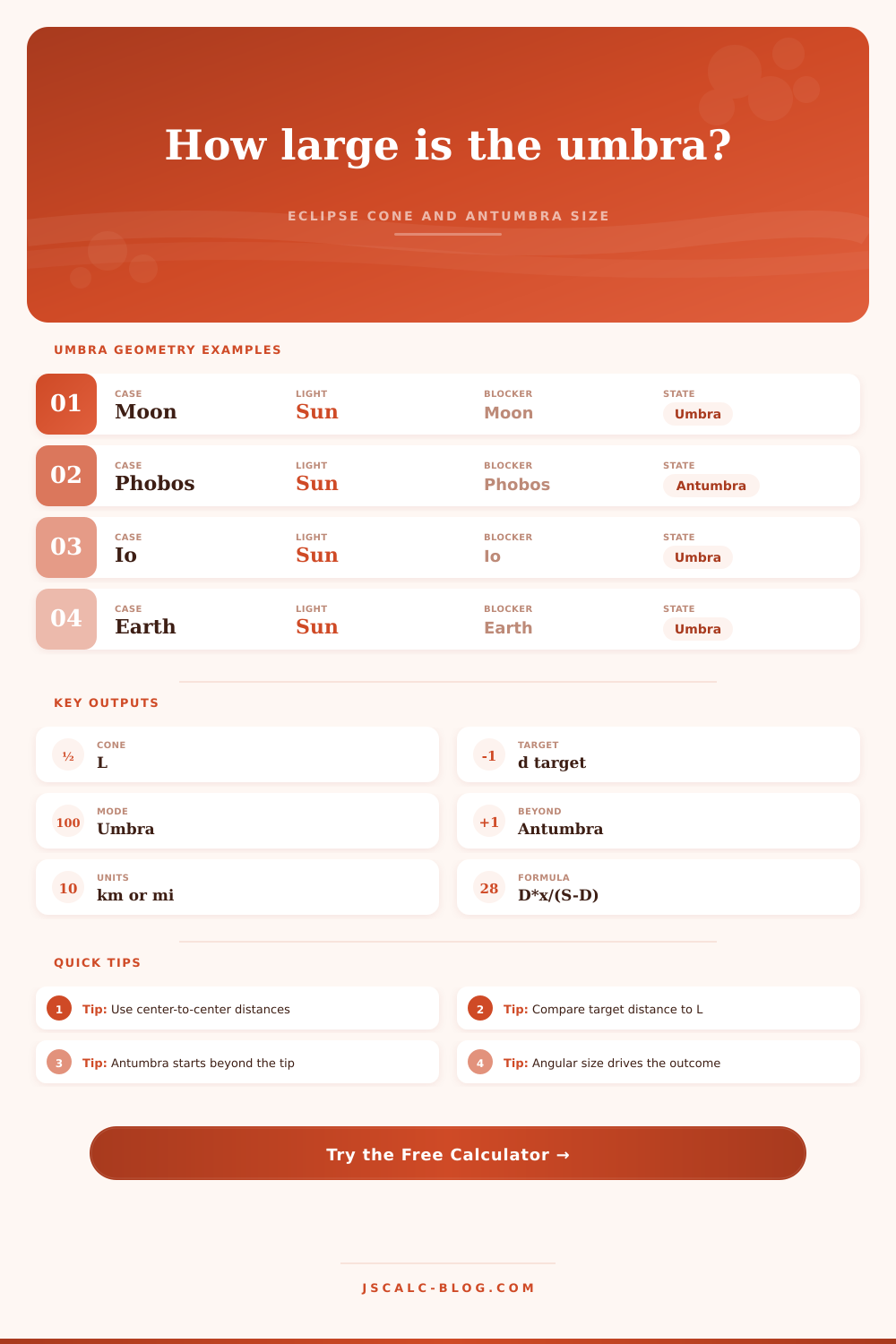
These ratios are illustrated in preset buttons. Mars’s small moon Phobos is too small to produce complete shadow on the Martian landscape. The moon’s shadow cone does not reach all the way down to surface. From view of Mars, observers witness an annular eclipse. (More precisely, this is a transit since the shadow doesn’t touch them at all.)
Jupiter’s large moon Io produce a wide shadow that easily touches tops of gas giant’s clouds. What makes these illustrations important is lesson that it isn’t always so much about size as it is proportion. If a moon is near its primary body, even a small moon can throw a lengthy shadow. Conversely, a moon that orbits far out may be physically larger but fall short.
Exact means exact. It’s not enough for people to say, “I measured X distance from this point and Y distance from that.” That won’t work because you’re measuring from surfaces rather than from center to center. The calculator use the standard definition of astronomical terms. You should of be equally careful with what you enter into it.
A small error in your input will cause calculator to shift position of shadow’s tip. In turn, that may make the difference between an annular eclipse situation and a total eclipse situation. Distance and alignment determine what part of space is umbra. And it’s a dynamic region defined by alignment and distance.
Knowing how long cone is provides a predictive advantage. You won’t have to guess where that dark spot will be. Now you know. The math lead to shadow following. Predictability increase when you know the triangle.