Angular Diameter Calculator
Calculate apparent size with the exact arctangent formula, then compare degrees, arcminutes, arcseconds, and the small-angle approximation.
Angular diameter result
The calculator converts diameter and distance to kilometers, computes the exact angular diameter in radians, then converts it to degrees, arcminutes, and arcseconds.
For small objects far away, the quick estimate is θ ≈ diameter / distance radians. The approximation is usually excellent when the angle is well below 1°.
Use center-to-center distance for planets and mean geocentric distance for the Moon unless you are matching a specific observing date.
| Object | Typical diameter | Typical distance | Angular diameter | Best unit |
|---|---|---|---|---|
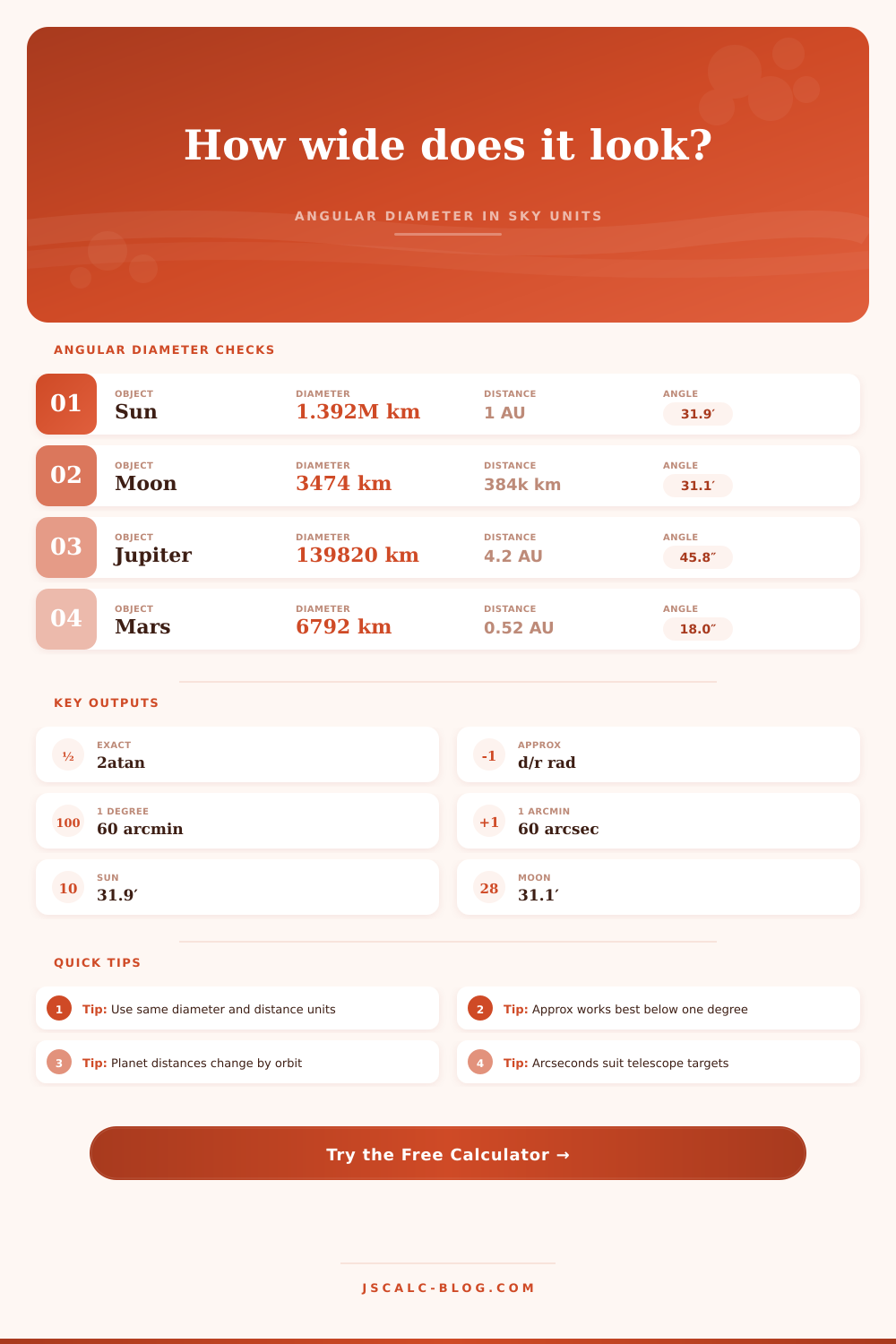
| Sun | 1,392,000 km | 1.000 AU | about 31.9′ | arcminutes |
| Moon | 3,474 km | 384,400 km | about 31.1′ | arcminutes |
| Mercury | 4,879 km | 0.60 AU | about 11.2″ | arcseconds |
| Venus | 12,104 km | 0.28 AU | about 59.6″ | arcseconds |
| Mars | 6,792 km | 0.52 AU | about 18.0″ | arcseconds |
| Jupiter | 139,820 km | 4.20 AU | about 45.8″ | arcseconds |
| Saturn globe | 116,460 km | 8.50 AU | about 18.9″ | arcseconds |
| Neptune | 49,244 km | 28.90 AU | about 2.35″ | arcseconds |
| Unit | Kilometer value | Use it for | Calculator field |
|---|---|---|---|
| 1 meter | 0.001 km | Near-field lab geometry | diameter or distance |
| 1 Earth diameter | 12,742 km | Planet size comparisons | diameter |
| 1 Moon diameter | 3,474.8 km | Lunar-size bodies | diameter |
| 1 Solar diameter | 1,392,000 km | Stars and the Sun | diameter |
| 1 astronomical unit | 149,597,870.7 km | Solar System distances | diameter or distance |
| 1 light-year | 9.4607 trillion km | Nearby stars | distance |
| 1 parsec | 30.8568 trillion km | Astronomical catalogs | distance |
| 1 lunar distance | 384,400 km | Moon or near-Earth objects | distance |
| Diameter / distance | Exact angle | Small-angle estimate | Approx error |
|---|---|---|---|
| 0.00001 | 2.063″ | 2.063″ | near zero |
| 0.001 | 3.438′ | 3.438′ | near zero |
| 0.01 | 34.377′ | 34.377′ | 0.001% |
| 0.05 | 2.864° | 2.865° | 0.021% |
| 0.10 | 5.725° | 5.730° | 0.083% |
| 0.50 | 28.072° | 28.648° | 2.052% |
| Angle range | Best display | Familiar comparison | Typical target |
|---|---|---|---|
| More than 1° | degrees | several lunar widths | constellation span |
| 0.1° to 1° | arcminutes | Moon or Sun scale | large disk |
| 1′ to 6′ | arcminutes | small naked-eye patch | wide deep-sky object |
| 1″ to 60″ | arcseconds | planetary disk | planet viewing |
| Below 1″ | milliarcseconds | stellar angular size | interferometry |
| Near zero | ratio first | unresolved point | distant star |
We live with a coincidence: The Moon and the Sun are about the same apparent size in our sky. They are not actualy the same size. One is a huge ball of glowing gas 150 million kilometers away, while the other is a chunky world only 384,000 kilometers from us.
Because of this, a total eclipse is a sight to behold. When you view it, you don’t care so much about the actual sizes as their angular diameters. Angular diameter equals what you see. Look straight up and you’ll agree; they appears nearly identical in size.
How to Calculate Angular Diameter
The calculator above do the calculation for you. Physical size is converted into degrees, or even smaller units like arcminutes and arcseconds, to describe how something appear. Everyone knows that the further something is from you, it appears smaller.
But what exactly are we measuring? We’re measuring angular diameter: the angle the object make at your eye. And what determines it? Two things determine it: the object’s true diameter and its distance from you. Once those two values is known, the geometry is set in stone. There’s no guessing.
That is where the tool comes into play. It uses the proper arctangent formula. Specifically, this: $\theta = 2 \times \arctan(\text{diameter} / (2 \times \text{distance}))$. It is precise. It is accurate.
This works whether you’re talking about a galaxy billions of light-years away or a coin you hold an inch before your face. Here’s an easier workaround, which is a common approximation used by astronomers to do just that. They call it the small-angle approximation. Basically, they divide the object’s diameter by its distance away and say that’s the angle. That’s far quicker to compute mentally.
And really does work well when the angle is very small. For the vast majority of things you want to see through a telescope, this approximation are accurate within the margin of error. As things grow larger (or approach nearer), the approximation falls apart. Want to know how wide a nearby building appears from across the street? The approximation will wander off.
You’ll be able to tell from the calculator because it tells you the difference between the true answer and the quickie one. Use it to judge whether or not you can get away with rough guess.
But that’s where people mess up with units. Before you plug anything in, you must convert all values to same base. That’s what the calculator does for you. It normalizes kilometers, meters, moon/earth diameters, and astronomical units. So instead of trying to remember conversion factors, it lets you do some math.
And it lets you compare apples to oranges. Want to get the sun’s diameter in solar units? No problem. Want to input its distance in astronomical units? Done. It adjusts it so you only have to worry about entering something that makes sense. If you mix millimeters for diameter and light years for distance, then don’t expect sensible output.
What does all that mean in terms of things you can see? A constellation could be something like ten degrees across. It is a large structure. The Moon and the Sun are each roughly thirty arcminutes across. Planetary observation is in arcseconds. You might observe Jupiter and find that it appear about forty-six arcseconds across at opposition.
That’s tiny. To get any sense of detail from it, you need stable air and good viewing conditions. That table on the page makes it clear where everything fits onto that angle scale. The interpretation involve choosing the proper unit for the outcome.
A number such as 0.005 degrees can be difficult to envision. It’s far better to convert that to 18 arcseconds… Something an astronomer will find handy. That tells you exactly how much sky the planet take up, and it enables you to choose what size eyepiece you’d like to use.
Remember: high magnifications shrinks the field of view. You don’t want the planet cropped so that it only fills some small amount in the eyepiece’s view.
There’s orbital mechanics. Planets aren’t stationary, so they’re not always the same distance from us. When it’s at opposition, Mars will appear huge; when it’s at conjunction, tiny. The change is dramatic.
Your snapshot-in-time calculation isn’t something permanent about the planet. You want its distance on a particular day, like the day you will make your observation next month.
The tool has presets to get you started. They provide mean, or typical, values. To do real work, perhaps you need to pull out specific ephemeris data.
There’s also the issue of deep sky objects. A nebula frequently have no defined edge; it’s often diffuse. It has an angular size that might subjectively differ among observers. You’ll find in catalogs that sometimes they list the extent of the filaments you can see, but other times they just list the bright center. That’s not like a crisp planetary disk.
And what about stars? The naked eye nearly always sees them as points of light. The only ones with an angular diameter big enough to measure with a standard telescope are giants like Betelgeuse. But even for these giants, you require use of interferometry.
That’s the beauty of it: It works everywhere. It works on a star in the Andromeda galaxy as much as on a grain of sand in your palm. The geometry is the same, but the scale is different. It is a different perspective.
But once you get that relationship between angle, distance and size, the sky no longer appears two-dimensional, like a dome. Instead, it’s an organized space. You begin to see the distances from object to object. You understand how near Jupiter seems when it’s at opposition. How far off the Moon truly is.
It alters your looking upward. The numbers become a map. This map is based off the elegant, simple relationship between distance and what is there. One tiny triumph of this geometry is how the Moon and Sun happen to match in the sky.