Angular Separation Calculator
Calculate the great-circle spacing between two right ascension and declination coordinates, then compare it with common binocular, finder, eyepiece, camera, and naked-eye fields.
cos(θ) = sin(dec1) * sin(dec2) + cos(dec1) * cos(dec2) * cos(ΔRA)
The calculator converts RA to degrees, changes all angular inputs to radians, applies the spherical cosine formula, clamps the cosine value between -1 and +1, then uses arccos to recover θ.
For close targets the same result is also shown as arcminutes and arcseconds: degrees × 60 = arcminutes, and degrees × 3600 = arcseconds.
The FOV ratio is separation divided by selected field diameter. A value below 100% means both coordinates fit across that circular field diameter.
| Pair | RA 1 / Dec 1 | RA 2 / Dec 2 | Approx separation |
|---|---|---|---|
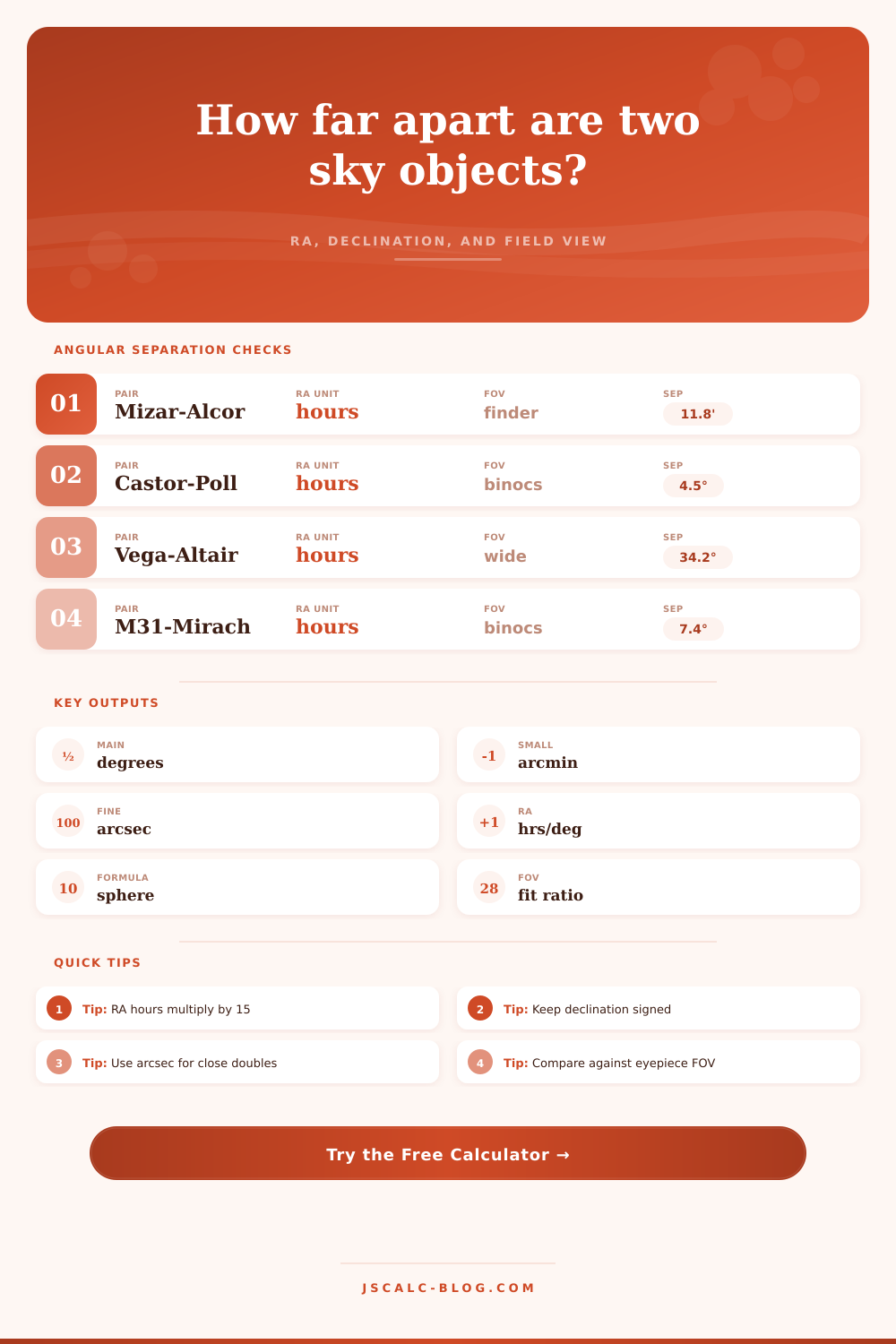
| Mizar and Alcor | 13.39875h, +54.92536° | 13.42042h, +54.98778° | 0.20° / 11.8' |
| Castor and Pollux | 7.57667h, +31.88828° | 7.75528h, +28.02619° | 4.5° |
| Betelgeuse and Rigel | 5.91953h, +7.40706° | 5.24230h, -8.20164° | 18.6° |
| Sirius and Procyon | 6.75248h, -16.71612° | 7.65503h, +5.22499° | 25.7° |
| Vega and Altair | 18.61565h, +38.78369° | 19.84639h, +8.86832° | 34.2° |
| M31 and Mirach | 0.71231h, +41.26917° | 1.16217h, +35.62056° | 7.4° |
| Viewing field | Typical diameter | Best use | Separation reading |
|---|---|---|---|
| Unaided eye sweep | About 60° | Constellations and star hops | Large sky spacing |
| 7x50 binocular | About 7° | Wide star fields | Neighboring bright stars |
| Finder scope | About 5° | Telescope pointing | Most hopping steps |
| APS-C 50 mm lens | About 2.8° | Camera framing | Cluster and nebula fields |
| Low-power eyepiece | About 1° | Whole-Moon scale | Close pair planning |
| High-power eyepiece | About 0.25° | Double-star inspection | Small angular pairs |
| Angular value | Degrees | Arcminutes | Arcseconds |
|---|---|---|---|
| One arcsecond | 0.0002778° | 0.016667' | 1" |
| One arcminute | 0.016667° | 1' | 60" |
| Moon diameter | About 0.5° | About 30' | About 1800" |
| One degree | 1° | 60' | 3600" |
| One RA hour | 15° | 900' | 54000" |
| Full circle | 360° | 21600' | 1296000" |
There is a spot in the sky with some light on it. It is a fuzzy smudge. What’s that? Oh yeah, you want to look at that. But wait, your finder scope is running away from it. You know it’s there, but darn if you can’t keep it in sight.
That’s what knowing your angular separation does for you, it helps you understand how far apart one thing is from another. It shows how much sky space separate the objects on the celestial sphere. Knowing where something is isn’t enough. Knowing how far apart things are make all the difference between seeing a blur or seeing clearly.
Why Angular Separation Helps You Find Stars
Above is a calculator to do the math for you: turn coordinates (declination and right ascension) into one distance. That’s the sort of spherical trigonometry that makes straight subtraction impossible when your sky is not flat. Just plug in the coordinates, select a field of view, and the calculator will return the answer as degrees, arcminutes and arcseconds. That way it will tell you whether to hop over a larger interval or if your target pair will fit within your binoculars’ field of view.
For example, right ascension is measured in hours, minutes, and seconds. It sounds like time, but it is actualy a measure of angle. It is fifteen degrees of arc per hour. Many observers find themselves tripped up because they attempt to do simple arithmetic with RA values expressed in hours by trying to subtract one from the other. That’s wrong. First you must convert that hour number into an angle. Only then can you do any geometry and know that resulting math respects the roundness of the sphere instead of squashing it out onto a flat grid. This conversion is handled for you behind the scenes when you provide RA either in decimal degrees or decimal hours. Either way, your input are converted into the form required, and all the math is performed while keeping track that we are on a sphere, not just a plane.
The good news is declination acts like terrestrial latitude, and that makes things easy. It ranges from plus ninety at the north pole to minus ninety at the south. And the sign of declination is very important: Because a star at minus ten degrees and one at plus ten degrees aren’t zero but twenty degrees apart. Enter negative for the south and you’ll be just fine; the calculator want signed values for correct behavior on this point.
Look at how much the separation is compared to the field of view of your equipment. For instance, you have a set of binoculars with a seven-degree field of view. Two stars separated by two degrees will just fit, and sit comfortabley side by side. Those same two stars if they’re separated by 12 degrees won’t ever be seen together in the round viewfinder.
The reference table on the page has some common ones: Alcor and Mizar and so forth, and helps you visualize the scale before you look through the eyepiece. This ratio will help determine which telescope to use. For example, if I want to see the entire cluster of stars known as the Pleiades, then I’d need a wide-angled eyepiece; if I only wanted to see one of those star, then a high power lens would do it. If the separation covers most of your field (high percentage), that’s telling you that you’re about at the limit of what you can see with your scope. That’s important when planning out your star-hopping trips or imaging sessions.
Our focused field of view is much narrower than our total sweep. However, we’re also able to take in an area of sky up to around sixty degrees at any given time. Our brains pick out the big differences. We perceive patterns between objects separated by great distances (e.g., the Summer Triangle). However, we are less good at judging separation of smaller ones unless aided. By knowing the angular distance, you know what to expect. You no longer have to hope or guess; now you know exactly where to look.
To compensate for that sphere in the formula behind the scenes, there is sines and cosines. They don’t let you go anywhere mathematically close to the poles or you might screw things up. You don’t have to derive it, but understanding that it’s out there will help explain how it feels different than a flat-earth distance map. It’s precise because it knows about the shape of the universe we’re looking at.
In the end, though, all the space between those stars you’re looking at, all that space up there in the sky, it’s emptiness. And because this emptiness can be measured, it turns what might seem like chaos into a chart you could navigate. The distance between one star and the next has been calculated, not guessed. You know how far you have to trace the arc to get from here to there. You do the math. You point. And in the dark, there it is: Your target.