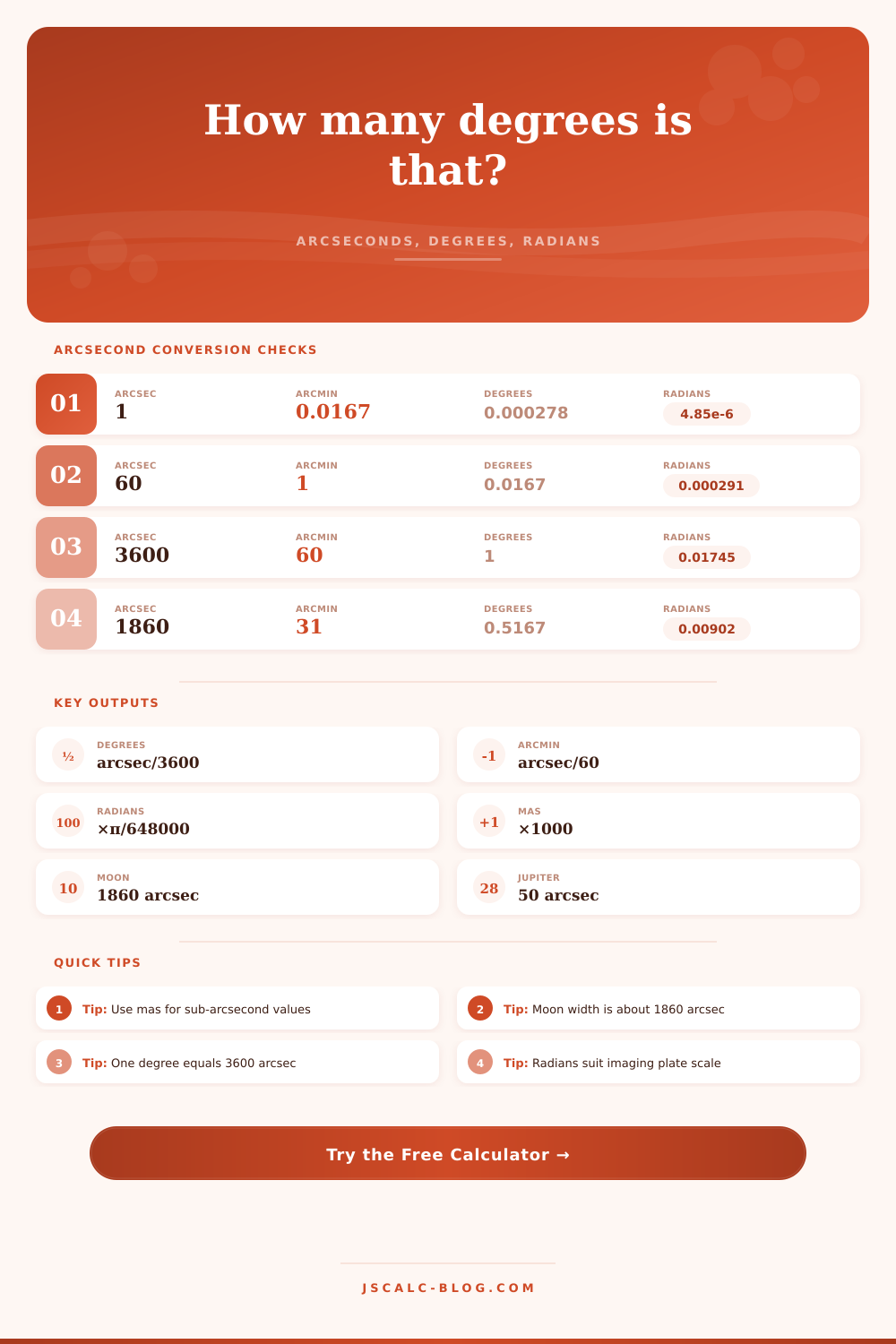
Arcseconds to Degrees Converter
Convert fine sky angles into degrees, arcminutes, radians, milliarcseconds, and practical field-of-view comparisons for astronomy notes and imaging plans.
| Arcseconds | Arcminutes | Degrees | Radians | Typical Use |
|---|---|---|---|---|
| 0.031 | 0.0005167 | 0.00000861 | 1.503e-7 | JWST NIRCam short-wave pixel scale |
| 0.05 | 0.000833 | 0.0000139 | 2.424e-7 | Hubble ACS/WFC approximate pixel scale |
| 1 | 0.016667 | 0.0002778 | 4.848e-6 | One parsec annual parallax |
| 60 | 1 | 0.016667 | 0.000291 | One arcminute or coarse naked-eye resolution |
| 3600 | 60 | 1 | 0.017453 | One full degree of sky |
| Example | Arcseconds | Degrees | What It Represents | Best Output Unit |
|---|---|---|---|---|
| 1 pc parallax | 1 | 0.0002778 | Annual parallax defining one parsec | Arcseconds |
| Proxima Centauri parallax | 0.7685 | 0.0002135 | Nearby-star parallax near 768.5 mas | Milliarcseconds |
| Sirius B separation | 11.3 | 0.003139 | Approximate apparent separation near wide parts of its orbit | Arcseconds |
| Jupiter apparent disk | 50 | 0.013889 | Large opposition apparent diameter | Arcseconds |
| Mizar-Alcor separation | 708 | 0.196667 | About 11.8 arcminutes across the sky | Arcminutes |
| Average Moon diameter | 1860 | 0.516667 | About 31 arcminutes, varies with distance | Degrees |
| Reference Field | Arcseconds | Degrees | Useful For | 50 Arcsec Covers |
|---|---|---|---|---|
| JWST NIRCam SW pixel | 0.031 | 0.00000861 | Space telescope imaging scale | 1612.90 pixels |
| Hubble ACS/WFC pixel | 0.05 | 0.0000139 | High-resolution image sampling | 1000.00 pixels |
| Naked-eye resolution | 60 | 0.016667 | Human visual resolving scale | 83.33% |
| Average Moon diameter | 1860 | 0.516667 | Lunar field comparison | 2.69% |
| Low-power telescope field | 7200 | 2 | Wide eyepiece planning | 0.69% |
| 10x50 binocular field | 21600 | 6 | Wide sky sweeping | 0.23% |
| 6x30 finder field | 25200 | 7 | Star hopping | 0.20% |
| Conversion | Formula | Constant | When To Use |
|---|---|---|---|
| Arcsec to degrees | arcsec / 3600 | 3600 | Sky maps, field sizes, coordinate offsets |
| Arcsec to arcmin | arcsec / 60 | 60 | Moon, Sun, binocular, and finder fields |
| Arcsec to radians | arcsec x pi / 648000 | 648000 / pi | Optics, trig, and plate-scale equations |
| Arcsec to mas | arcsec x 1000 | 1000 | Parallax, proper motion, and astrometry |
Pointing a telescope up into the night sky, not being able to find what you’re after, that’s angular scale. Until it frustrates you out of a night of observing, its nothing but an abstract idea. We think in degrees because that is how we map the world. But much of universe talks in fractions of a second. An arcsecond is one sixtieth of an arcminute, which is one sixtieth of a degree. A degree of sky equals 3600 arcseconds.
It is a very small slice of sky, hardly noticeable with naked eye. But enough to make the difference between seeing a planet and just looking at empty space. But the math are done for you by calculator. It’ll take all those tiny units and turn them into whatever degree, radian, or milliarcsecond unit you desire. What’s more important isn’t doing the calculation but knowing why you’re doing it.
Why Angular Scale Matters in Stargazing
You might read in one of the tables about how big Jupiter look, perhaps it says it’s about 50 arcseconds. Well, that doesn’t sound like much but in fact, for a telescope, thats pretty darned big. Put Jupiter in your high-power eyepiece view and it will occupy a large part of field of view. Convert that to degrees and now we have 0.0139. Doesn’t seem like much, right? Wrong! The conversion only shifts the point off reference: from the object to the sky.
Where most observers gets tripped up is in choosing correct unit. When you’re talking about the proper motion of stars, or even parallax, you’re typically talking about milliarcseconds. It is one thousandth of an arcsecond. This is a talk about precision astrometry. They talk about measuring how far away a star are from us. It shows how far it has moved since a few decade ago. And there’s a simple table on the page that make it all clear.
A parsec, after all, is defined as having an annual parallax of precisely one arcsecond. That’s what holds our cosmic distance ladder in place. Without that precise geometric relationship we would of had no way of knowing just how big galaxy really is.
And then there’s the story about imaging. Your digital camera has pixels, and each one capture some fraction of sky. We call this plate scale. Too-large pixels mean loss of detail. Too-small means wasting data. You can compare your gear to standard values with help off the tool. Those standards might be the James Webb Space Telescope or the Hubble Space Telescope. Or maybe you just want to know how big an area Hubble sample: 0.05 arcseconds per pixel.
Why does that matter? Because it’s a benchmark. It is a benchmark that lets you know what high resolution look like. It shows whether you’re fighting a losing battle against atmospheric turbulence in your backyard or actually capturing some meaningful detail.
For example, practical applications includes field of view. If you are planning a session, you want to make sure that what you are targeting will fit within your eyepiece. How big is the moon? It is about 31 arcminutes across. That translates to approximately 1860 arcseconds. Trying to get the whole moon framed using a narrow-field eyepiece? You’ll be disappointed. You can use this tool to compare your angle to familiar objects, which helps you visualize the scale.
That mental image is often the missing link between a planned observation and a successful one. It helps turn those abstract numbers into something you can picter.
Bottom line: angular measurements makes sense in the context of what’s being measured. One degree can encompass an entire constellation. One arcsecond can encompass a single star system. It is not just mathematically different; it is also conceptually different. If you know the size of the object you’re after, you get the scale correct, avoiding frustration when imaging deep-sky objects, or trying to track down planets or disks around stars, or pursue double star. You don’t guess anymore, you see.
The sky is filled with angles, but not all of them point out something to look at.