Right Ascension to Degrees Converter
Convert celestial right ascension from hours, minutes, and seconds into decimal hours, degrees, radians, normalized 0–360°, and hour angle helpers.
Right ascension conversion
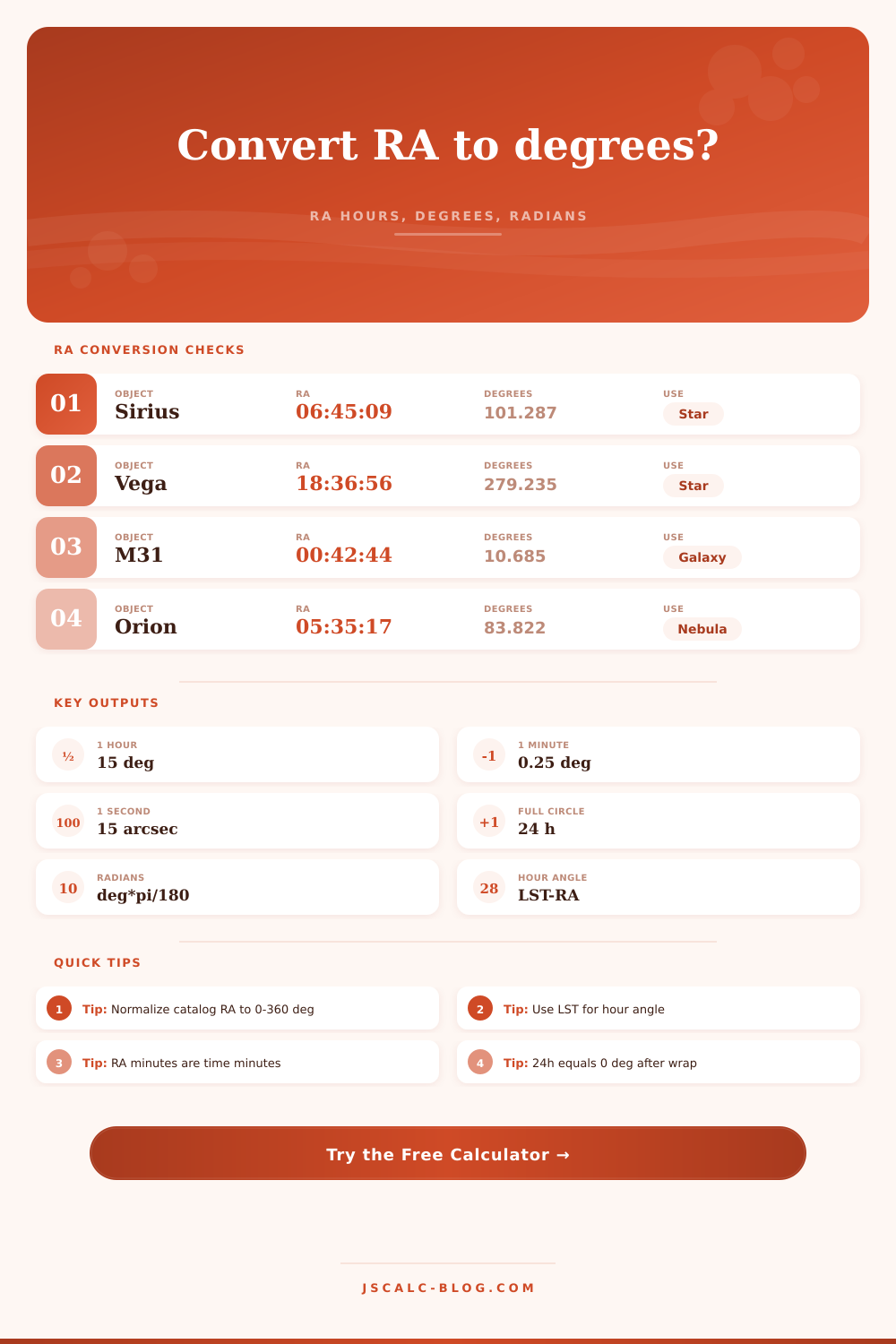
Right ascension is measured in time because Earth rotates 360° in 24 sidereal hours. That makes one RA hour equal to 15°, one RA minute equal to 0.25°, and one RA second equal to 15 arcseconds of angle.
The converter first builds decimal hours, then multiplies by 15. Radians use radians = degrees × π / 180. Normalization wraps any result into the standard 0–360° circle.
The hour angle helper uses HA = LST - RA. Positive hour angle means the object is west of the local meridian; negative hour angle means it has not crossed the meridian yet.
| Object | Catalog RA | Decimal hours | Degrees | Object type |
|---|---|---|---|---|
| Sirius A | 06h 45m 08.917s | 6.752477 h | 101.2872° | bright star |
| Vega | 18h 36m 56.336s | 18.615649 h | 279.2347° | bright star |
| Polaris | 02h 31m 49.094s | 2.530304 h | 37.9546° | north star |
| Betelgeuse | 05h 55m 10.305s | 5.919529 h | 88.7929° | red supergiant |
| Rigel | 05h 14m 32.272s | 5.242298 h | 78.6345° | blue supergiant |
| Antares | 16h 29m 24.460s | 16.490128 h | 247.3519° | red supergiant |
| Andromeda Galaxy | 00h 42m 44.330s | 0.712314 h | 10.6847° | galaxy |
| Orion Nebula | 05h 35m 17.300s | 5.588139 h | 83.8221° | nebula |
| Pleiades | 03h 47m 24.000s | 3.790000 h | 56.8500° | open cluster |
| Galactic Center | 17h 45m 40.040s | 17.761122 h | 266.4168° | sky reference |
| RA amount | Decimal hours | Degrees | Radians |
|---|---|---|---|
| 1 second | 0.0002778 h | 0.0041667° | 0.00007272 rad |
| 10 seconds | 0.0027778 h | 0.0416667° | 0.00072722 rad |
| 1 minute | 0.0166667 h | 0.25° | 0.00436332 rad |
| 15 minutes | 0.25 h | 3.75° | 0.06544985 rad |
| 1 hour | 1 h | 15° | 0.26179939 rad |
| 6 hours | 6 h | 90° | 1.57079633 rad |
| 12 hours | 12 h | 180° | 3.14159265 rad |
| 24 hours | 24 h | 360° | 6.28318531 rad |
| Local sidereal time | Object RA | Hour angle | Meridian meaning |
|---|---|---|---|
| 06h 00m | 06h 00m | 0h | on local meridian |
| 08h 00m | 06h 00m | +2h | west of meridian |
| 04h 00m | 06h 00m | -2h | east of meridian |
| 23h 30m | 00h 30m | -1h | east, crosses soon |
| 00h 30m | 23h 30m | +1h | west, already crossed |
| 12h 00m | 18h 00m | -6h | six hours before transit |
| Input value | Raw degrees | Normalized degrees | Normalized RA |
|---|---|---|---|
| 24h 00m 00s | 360° | 0° | 00h 00m 00s |
| 25h 00m 00s | 375° | 15° | 01h 00m 00s |
| -1h 00m 00s | -15° | 345° | 23h 00m 00s |
| 48h 30m 00s | 727.5° | 7.5° | 00h 30m 00s |
| 360.5° | 360.5° | 0.5° | 00h 02m 00s |
| -0.25° | -0.25° | 359.75° | 23h 59m 00s |
Unless you forget that the sky spins, right ascension feels backwards. Latitude and longitude are our measurements on the planet; up there, they use its own clockwork. Astronomers mark out the celestial sphere not by degrees, but by hours, minutes, and seconds.
That’s because the Earth turns sixty- or even three-sixtieths of it’s circumference once per day. It’s a handy short cut, a way of matching an object’s location with a specific time. Every hour of right ascension equal fifteen degrees. Every minute represents one-quarter of a degree. Every second equals fifteen arcseconds. It all works out neatly enough, but the intuition require some re-training. You’ll need to let go the globe’s shape and fall into the rotation’s rhythm.
How the Star Coordinate Converter Works
No more doing math; just plug it in And this is where the converter come in. It’s there to do the arithmetic for you while you pay attention to what’s going on up in sky. You can start with a time (hours, minutes and seconds) or decimal degrees. The converter will take your input and spit out those values in whatever format you need. It provides the hour angle for observing planning, degree values, normalized coordinates for plotting, and even the radian equivalent for coding.
Remove the human errors that sneak in when you’ve been staring at a computer screen doing calculations too long at end of a night at telescope. People’s biggest error: treating time minutes like angular minutes. Those aren’t the same thing. Time minutes are one-sixtieth of an hour, which equals fifteen minutes of arc or a quarter of a degree. Angular minutes is one-sixtieth of a degree. So if you substitute the wrong kind, you’re aiming at something that’s thirty times farther from what you think!
That’s where the calculator comes in: it handles the units behind the scenes. Simply enter the numbers the way they’re listed on star catalog page. The hard work of converting to and from the necessary units… A factor of fifteen degrees per hour, gets done for you. It is a small detail, but it is important when you’re attempting to place a tiny speck of light into the center of your eyepiece.
This adds another level of complication: the wrap-around point. Because right ascension begins from the vernal equinox and proceeds east, then twenty-four hours (hours) is the same as zero (hours). But that create problems for computers and plotting software, where anything greater than three-sixty, or less than zero, can cause confusion. That’s where normalization comes in. It normalizes a raw result, forcing it into the zero to three-sixty range. So if you compute a position that turns out to be negative fifteen degrees, normalization returns three hundred forty-five degrees as its answer. That keeps your data plotted properly on circular chart.
Look through the reference table on the page to see how this applies with real objects such as Vega and Sirius. Their catalog coordinates translate directly into what we call standard angular positions.
Hour angle brings some practicality to user. Unlike right ascension (a fixed coordinate like a street address), hour angle is a relative measure (like how many hours ago you passed that address). Subtracting the current local sidereal time from the right ascension yields the hour angle. Positive values represent objects west of the meridian, so they have already crossed it, and they’re on their way down in the west. Negative values mean the object hasn’t yet reached the meridian, so it’s still coming up out of the east.
That’s important information for scheduling observing runs! Do I want something setting? Transiting? Rising? The helper function provide that contextual clue immediately. It transforms what was a static number into a dynamic position.
Radians sound like a nerdy concept few people would care about, except if you write software (or use astronomy libraries) then you know: most mathematical functions take input arguments as radians rather than degrees. Converting from degrees to radians multiplies the number by pi and divides by one hundred eighty. If you do it yourself it’s annoying. You round off numbers. It becomes error-prone. This output lets you cut-and-paste the result right into whatever code you’re working on. That connects the visible sky with calculations we run inside computers.
This shifts your perception of the celestial sphere. It’s no longer a map that stays still; it’s a machine that spins. The position of Polaris relates directly to the clock on your wrist. Those numbers in the catalog aren’t merely labels, they’re directions: go here, now.
When you’ve internalized this rhythm of a fifteen-degree-per-hour cycle, then you have a predictable sky. Objects move in expectation, rather than needing a lookup every five minutes in the almanac. The conversion opens that intuition. It translates the abstract coordinates into something tangable. When the numbers match, everything in the universe makes sense.