Hectares to Acres Converter
Convert hectares, acres, square meters, square feet and square yards with parcel counts, usable land percentage, rounding mode, comparison unit and map scale checks.
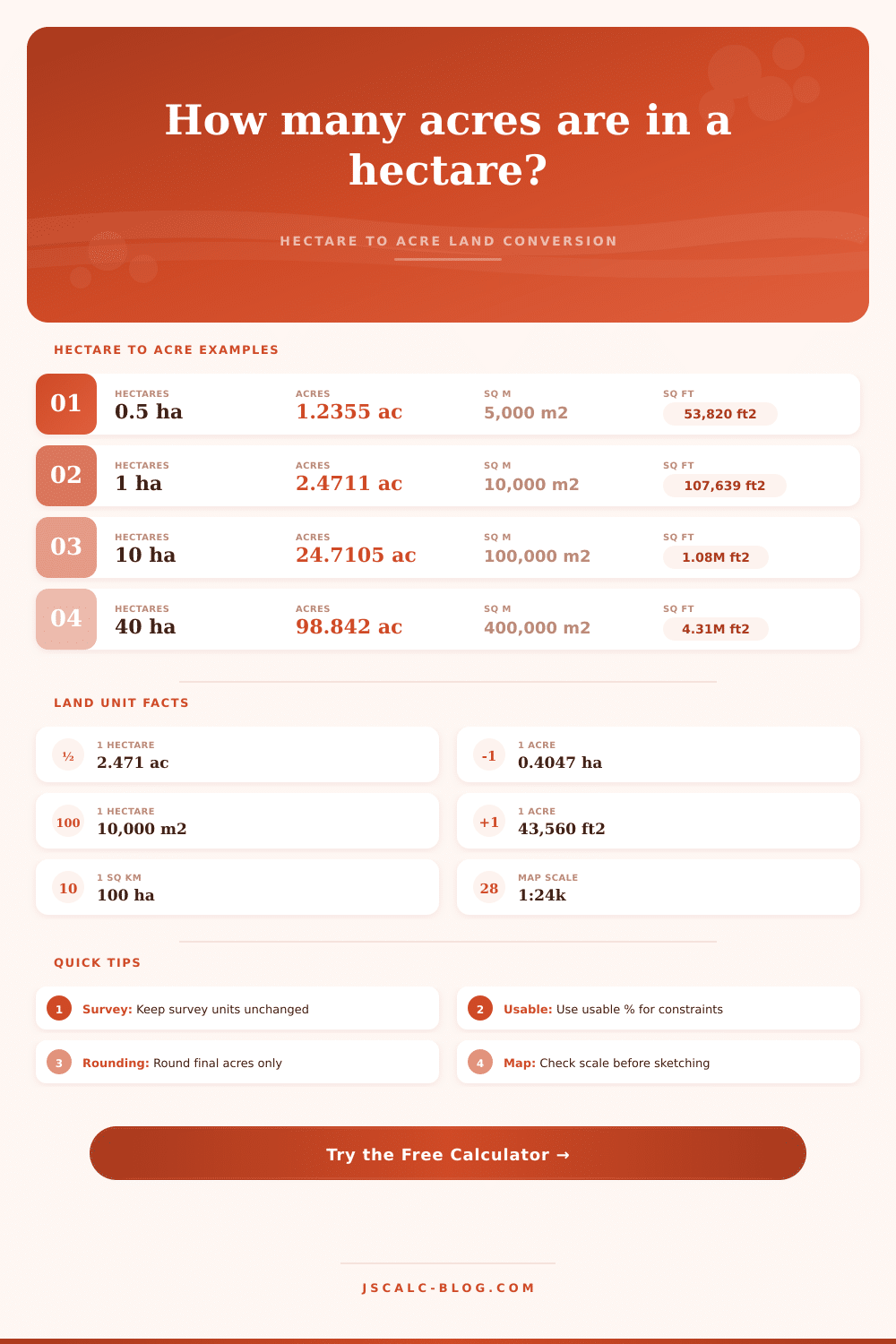
| Hectares | Acres | Square Meters | Square Feet | Typical Parcel Use |
|---|---|---|---|---|
| 0.1 ha | 0.247105 ac | 1,000 m² | 10,764 ft² | Large house lot or garden site |
| 0.5 ha | 1.235527 ac | 5,000 m² | 53,820 ft² | Small rural lot |
| 1 ha | 2.471054 ac | 10,000 m² | 107,639 ft² | Field, paddock, or development site |
| 2 ha | 4.942108 ac | 20,000 m² | 215,278 ft² | Homestead or small farm block |
| 5 ha | 12.355269 ac | 50,000 m² | 538,196 ft² | Farmlet or conservation buffer |
| 10 ha | 24.710538 ac | 100,000 m² | 1,076,391 ft² | Working farm field |
| 40 ha | 98.842153 ac | 400,000 m² | 4,305,564 ft² | Large tract or section comparison |
| Acres | Hectares | Square Feet | Square Meters | Typical Parcel Use |
|---|---|---|---|---|
| 0.25 ac | 0.101171 ha | 10,890 ft² | 1,012 m² | Quarter-acre residential lot |
| 0.5 ac | 0.202343 ha | 21,780 ft² | 2,023 m² | Half-acre lot |
| 1 ac | 0.404686 ha | 43,560 ft² | 4,047 m² | Small parcel benchmark |
| 5 ac | 2.023428 ha | 217,800 ft² | 20,234 m² | Homestead or acreage lot |
| 10 ac | 4.046856 ha | 435,600 ft² | 40,469 m² | Rural tract |
| 40 ac | 16.187426 ha | 1,742,400 ft² | 161,874 m² | Quarter-quarter section |
| 100 ac | 40.468564 ha | 4,356,000 ft² | 404,686 m² | Estate, ranch, or reserve parcel |
| Scenario | Input Area | Converted Area | Usable % | Usable Acres |
|---|---|---|---|---|
| 1 ha field | 1 ha | 2.4711 acres | 100% | 2.4711 ac |
| 10 ha farm | 10 ha | 24.7105 acres | 90% | 22.2395 ac |
| 40 ha tract | 40 ha | 98.8422 acres | 75% | 74.1316 ac |
| 0.5 ha lot | 0.5 ha | 1.2355 acres | 92% | 1.1367 ac |
| Conservation parcel | 125 ha | 308.8817 acres | 62% | 191.5067 ac |
| 5 acre homestead | 5 acres | 2.0234 hectares | 85% | 4.2500 ac |
| Sports complex | 7.14 ha | 17.6433 acres | 88% | 15.5261 ac |
| Scale | 1 cm On Map | 1 cm² On Map | 1 Hectare Draws As | Best Use |
|---|---|---|---|---|
| 1:1,000 | 10 m | 100 m² | 100.00 cm² | Site plan |
| 1:2,500 | 25 m | 625 m² | 16.00 cm² | Parcel map |
| 1:5,000 | 50 m | 2,500 m² | 4.00 cm² | Farm field map |
| 1:10,000 | 100 m | 10,000 m² | 1.00 cm² | Local land planning |
| 1:24,000 | 240 m | 57,600 m² | 0.17 cm² | Topographic map |
| 1:50,000 | 500 m | 250,000 m² | 0.04 cm² | Regional tract overview |
The deal’s in your hands. You’re standing on top of a ridge looking at a piece of ground that appears identical in size to one across the street. One deed say ten hectares, and the other says forty acres. The two systems don’t compute in your head; your mind stumbles over itself trying to make sense of them. Most land transactions gets complicated here: they fail because imperial and metric units lives in different parts of our brains.
Before you set foot on the land, the conversion tool on this page eliminates that distance, translating numbers into something tangible. By the time you get to the ground, it has done all the multiplying for you so that you can concentrate on the ground itself. Once you’ve seen it a couple of times you can just remember: one hectare is about 2.47 acres. That’s the main relationship, all other relationships comes from that number.
Make Sense of Your Land Numbers
You’ll probably encounter hectares if you’re working with government forestry records, or if you’re ordering something from Europe. You’ll hear people talk about acres if you’re chatting with your neighbor about pasture land, or talking with your local county assessor back in the U.S. Plug those numbers into our acres to hectares calculator and let it crunch the numbers for you, but knowing how that 2.47 ratio works help you catch mistakes in crappy data. That’s why it’s called a “coefficient.” It multiplies very quickly as your parcels increases in size.
The simple conversion gets most folks this far. They put their hectares into the calculator and see how many acres they have. Fine if you’re casually curious, not so fine if you want to do something with the land. Land is rarely flat, open expanses suitable for anything. Trees, steep slopes, wetland areas, easements, all gobble up useful square feet.
This tool show that fact by allowing you to enter the percentage that is usable. Enter the total amount of land available, then adjust the slider to show how much of that area suits your purpose. Adjusting that slider provides a better idea of land value when 20% of property is too steep to be built on or is a swampy mess unsuitable for building a foundation. It keeps you from making one of the errors common to amateur planners: assuming any given square meter can hold a foundation.
When dealing with fractional shares, the number of parcels matter. Suppose that instead of owning a single hectare-wide riverbank strip, you have three such strips scattered about. Instead of converting each parcel separately and summing up, you can simply enter three into the parcel count box, and let the tool add it up for you. This saves time. It also eliminates risk of math mistakes.
Besides precision, you also has to consider rounding. Two decimals work well enough for garden plants, but you may need four or even six decimals if you are creating legal documents or overlaying your map onto GIS maps. (Who cares? Answer: Until someone disputes a three-foot line, that’s how much precision can matter.)
The other thing people tend to neglect is scale. On a topo map, it’s possible for a field to appear smaller than your hand. One hectare will take up less than a square centimeter at a scale of 1:24,000. There is a breakdown of this as well on the tool, which shows you how much physical space on the map your land takes up. And that’s what it helps you visualize. It reminds you that all those little dots on a piece of paper mean a LOT of dirt. And that keeps you from underestimating how far away things are and how many materials you need simply because it appears to be a small dot on the page.
Below the calculator, there’s also a set of reference tables that allow you to get a feel for what various units mean with zero typing required. The square footage and square meter comparison on each side provides yet another way to understand it; seeing a hectare equal to 10,000 square meters can help if you’re more used to working with metric grids. It helps turn a unit that is hard to pictur into something you can see in a real space.
At its heart, it’s all just translation. It’s converting words in a legal description into what exists on the ground. If you want to subdivide your farm or ensure that your new backyard is large enough, you’re taking these numbers and making sure they match up to the reality. Adjustments and conversions are done by the tool. You take the information that results from it and put it on the ground below you. That’s how it makes sense out of the seemingly nonsensical numbers on deeds so you can walk around them and make plans.
You should of checked those measurements first.